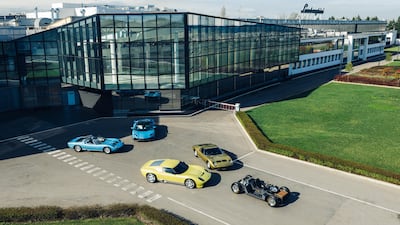


Sant’Agata Bolognese is a relatively small town between Bologna and Modena in Italy’s “Motor Valley”. Yet it is responsible for some of the world’s most ostentatious and recognisable cars ever made. This, after all, is where Ferruccio Lamborghini established his car company in 1963 and where, more than six decades later, Lamborghini continues to build its vehicles.
There is something slightly incongruous about the setting. Sant’Agata still feels modest and agricultural, surrounded by the flat landscape of Emilia-Romagna. And then, amid it all, you encounter the unmistakable Lamborghini shield and a factory producing cars destined for Dubai, Miami or Tokyo.
I am touring both the Museo Automobili Lamborghini and the neighbouring factory. The museum is not particularly large, something that works in its favour. Rather than trying to display everything, it tells the company’s story through a carefully curated collection before allowing visitors to see where its latest chapter is being built.
From tractors to Grand Tourers

The story begins, somewhat improbably, with tractors. By the 1950s, Ferruccio Lamborghini had found success manufacturing agricultural machinery, notably affordable tractors using material salvaged from the Second World War, before deciding to build grand touring cars.
The 350 GTV concept appeared in 1963, followed by the production 350 GT the next year and the Jarama in 1970. Viewed today, the 350 GT seems almost conservative. Its long bonnet and curved body resemble many Italian grand tourers of the era, with little of the visual aggression that would become a Lamborghini trademark. But it marks the beginning of an ambition to challenge Italy’s established sports car manufacturers.
A few steps away is the car that changed everything. I still don’t think Lamborghini has built anything more beautiful than the Miura. Sixty years after its debut, its proportions remain almost perfect. It sits incredibly low, with distinctive eyelashes surrounding the headlights and a shape that feels elegant rather than aggressive.

The museum is marking the Miura’s 60th anniversary, and one highlight is the Miura Roadster, a one-off created by the automotive company Bertone in 1968. Knowing there is no copy makes standing beside it feel particularly special. Nearby is a Miura P400 S. It is less extraordinary, but perhaps better at demonstrating why the car brand has endured. You are left simply appreciating how well the aircraft-wing-inspired shape has aged.
At the other extreme is the LM002. The enormous off-roader looks almost comically out of place among Lamborghini’s sleek supercars. Developed from earlier attempts at creating a military-style vehicle, the production LM002 arrived in 1986 using the 5.2-litre V12 from the Countach Quattrovalvole. Only about 300 were built.
It is not the Lamborghini most people picture when they hear the name, which makes it one of the museum’s most interesting cars. Decades before the Urus, Lamborghini was already willing to put its badge on something completely unexpected.
Watching a Lamborghini come together

The museum tells you what Lamborghini has built. The factory tour shows you how it happens. As I walk on to the production floor, one of the things I notice first is how human hands still play a prominent role.
Partially assembled cars move between stations where small teams add components – wiring, piping and interior pieces. Timers count down roughly 24 minutes, the time each station has before the car is meant to move forward. Despite deadlines, nothing feels rushed. The operation is methodical and surprisingly calm. Watching a collection of components gradually become something recognisable is strangely satisfying.
The most memorable moment comes when the powertrain and chassis finally meet, a process described during the tour as “a marriage”. It sounds overly romantic until you see it. Before that point, you have an engine and a chassis. Afterwards, you begin to have a car.

There is also a special connection between the factory floor and the museum next door. Lamborghini still produces its V12 flagship in the area where the Countach assembly line was established in the 1970s. Today, that car is the Revuelto.
What also becomes apparent is how much freedom customers have. Paint colours are only the beginning. Buyers can choose different leathers, stitching, trims and colour combinations. Lamborghini merges physical material selection with cutting-edge digital visualisation tools through its 'phygital' Ad Personam personalisation programme, extending those choices even further.
It is one reason why seeing two Lamborghinis that have been configured exactly alike will still feel distinct. After walking through the factory, I also find that it becomes harder to view the finished cars simply as collections of performance figures.
Someone fitted the pipes. Someone installed the trim. Someone checked the electronics. For all the technology involved, these still feel like machines constructed by people rather than cookie-cutter builds.
The Lamborghinis we grew up with

Back in the museum, the upper floor feels much more familiar. This is where the Countach, Murcielago, Gallardo, Aventador and Huracan sit alongside some of Lamborghini’s rarer creations.
These are the cars that appeared on bedroom walls and in video games, and were cherished as scale models. Seeing them together – all low, wide and rarely subtle – demonstrates how consistently Lamborghini has stuck to its philosophy. The design language changes from generation to generation, but the intention remains remarkably similar: a Lamborghini should elicit excitement even before anyone turns the engine on.
The special-edition cars take that idea further. In 2016, the Centenario marked 100 years since Ferruccio Lamborghini’s birth, with only 20 coupes and 20 roadsters made. The Sian combined a naturally aspirated V12 with Lamborghini’s first electrified production powertrain, with 63 coupes produced in reference to the company’s founding year.
These are cars most people will only ever see in photographs, in video games or in miniatures. Finding several of them metres apart is one of the pleasures of the museum. But after moving between the historic models, the production line and the modern supercars, it is not the sense of rarity that stays with me. It is the consistency.
Lamborghini has changed considerably since 1963. Ferruccio is long gone; the company passed through several owners, while Audi’s acquisition in 1998 brought greater stability, technology and production capacity. Yet the instinct behind the cars remains recognisable.
The Miura was radical. The Countach looked like nothing else on the road. The LM002 was an absurd idea that somehow made it into production. Today’s cars continue to chase that sense of theatre.
For all the international attention surrounding Lamborghini, it is still fascinating that these machines, some of the loudest and proudest on the road, emerge from one factory in a quiet community in northern Italy.


FOLLOW TN MAGAZINE