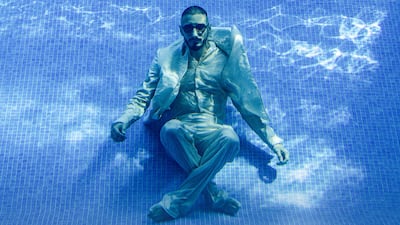


On the set of Dune: Part Three, Mohamed Faisal Mostafa watched closely as Timothee Chalamet, Zendaya and Jason Momoa prepared for their scenes. Each day, he saw how they learnt their lines, how they worked, how they treated the people around them. The Emirati actor wanted to reach that level himself, and here he could see what it took.
“I sat back and I saw it all and I said to myself: ‘This is not unattainable.’ I can be there and, inshallah, I will be there so long as I keep consistent,” he says. Mostafa joined the production as a stunt performer. Director Denis Villeneuve knew he also acted and began finding opportunities for him to do more on camera.
As the shoot was coming to an end, Mostafa went up to thank him for his support. “He said: ‘Mohamed, there’s no need to thank me. You’re a natural. You’re a very talented actor.’”

Even recounting it now gives Mostafa goosebumps. He holds out his arm to show them. It was a moment he’d been ready for nearly his whole life. Long before he worked with Villeneuve, a young Mostafa was jumping off a moving bicycle for his brother, director Ali Mostafa.
Ali was making home movies, and Mostafa was already fearless, at the age of six or seven, in front of his brother’s camera. As Ali kept making films, Mostafa kept helping. That bond is still strong decades later – every year on Ali’s birthday, he calls him “my brother, my teacher and my friend”.
But for years, film was one of several possible futures. Mostafa played professional football, worked in finance, ran a digital transformation agency and was involved in his family’s business.
Acting fitted around those pursuits, even as the parts grew bigger and took him further from home. He could keep building a career in business, with success nearly certain. But something in him knew he had to choose the harder path.

“I think you need to find an area of focus if you want to succeed,” he says. Dedicating himself to film full time makes the auditions his UK agent sends him feel more consequential.
A major production could give him the credit that leads to another job, then another. Yet a few lines are sometimes enough for him to turn one down. Even now, terrorists and other stereotypical Arab characters keep coming his way from major studios and streaming platforms, offering a route into the industry he has chosen to depend on.
“Trust me, it is not easy to say no to these because some of them are massive, life-changing projects,” he says. “I love acting, and it’s the only thing I do right now. It’s also what’s going to generate me income, put food on my table and support my future.”
But he has to consider what accepting a part would mean beyond his own career. He is willing to play a villain; the concern is a story that leaves an audience with another reason to distrust Arabs. He wants the roles he earns to expand what people understand about Emiratis and Muslim Arabs. He carries the responsibility for his country’s reputation as personally as he does for his own family’s.

“It’s part of who I am,” he says. “It’s every action I do in the morning, when I wake up. I want to prove something to my family, my country, our leaders, myself.”
There is a chance to take that work further at home, too. Dune: Part Three reaches cinemas this December and Dubai International Film Festival will return on December 8 after a decade-long hiatus.
Mostafa has established MFM Media in Abu Dhabi, working on production services, product placement and Emirati talent management. He wants to help to get films made and give other performers the connections he struggled to find.
DIFF’s return gives that ambition a place to develop, bringing filmmakers, actors and investors together in Dubai. Mostafa wants the next Emirati actor pursuing an international career to have more help and more work available here before setting off.
His own route into film took years to become clear. As a goalkeeper for Al Ain and Al Wasl, Mostafa turned his childhood love of football into a career before serious injuries ended it.
His work with Ali continued as his brother moved into feature films, casting Mostafa in City of Life (2009) and From A to B (2014), then giving him a larger role in the post-apocalyptic thriller The Worthy (2016). Mostafa also appeared in the Emirati military action film Al Kameen (2021), one of the biggest box-office hits the country has produced.

An open audition in London for Disney’s live-action Aladdin (2019), which eventually starred Mena Massoud and Will Smith, gave Mostafa a glimpse of how far acting might take him. He did not get the role. At the time, he carried on with other pursuits, but the possibility stayed with him: he had put himself forward for a production watched around the world, in which he could have represented the UAE.
“I realised that this can actually happen, and that I love acting and I’m not bad at it. So I had to keep going,” he says.
Finding an agent in Britain involved repeated approaches and rejections. When Hijack – the Apple TV thriller also starring Idris Elba – came, Mostafa finally had an international role to prepare for. He would play Abdullah, a Dubai air-traffic controller investigating suspicious events around a flight to London.
A driver collected him from a friend’s house on his first day of filming. During the journey, Mostafa questioned whether he was good enough to be there. Once he arrived, the more experienced actors treated him as an equal, and director Jim Field Smith welcomed his contributions. Mostafa helped with details of Emirati behaviour, including the way people hold their hands when greeting one another.
He realised the pressure was helping him perform – a feeling he recognised from his years on the football field.
“There’s nerves, but they’re nice nerves – the nerves that lock you in,” he said when Hijack was released in 2023.

The 2024 television drama Khattaf asked more of him. Ali gave him a lead role to carry through a whole series, playing an Emirati fighter making his way through Asia’s underground combat scene. The boy who had done stunts for his brother now had years of sport and Muay Thai training behind him when stunt co-ordinator Najmeddin Scorpion began teaching him fight choreography.
One move, known as the Black Widow, required Mostafa to hook a leg around another performer’s neck, swing around him and land on his own feet as the other man flipped away. He learnt quickly. An injury left his elbow so swollen it had to be bandaged, but his character was supposed to be injured in the next fight scene. The bandage stayed on for the camera – the injury served the scene, and that’s all that mattered to him.
Away from the fight choreography, Mostafa was working out the character’s childhood and family relationships, comparing them with his own. He wanted to understand the parents, how they had become the people they were, and how their behaviour had shaped their son. Early in the shoot, he drew on painful memories from his own life when a scene required him to cry. By the time he filmed a sequence in prison, he had spent enough time with the character to find the emotion in his story.
“I wasn’t thinking for a second about Mohamed. I was thinking about Khattaf, and I had tears rolling down my face, and I felt and I became,” he says. “That’s what acting is. Acting is becoming.”

Talking about that scene brings out the goosebumps again. Mostafa wants another role he can spend that kind of time on, and another production willing to put him at the centre of its story. The ambition to join the main cast of a Hollywood film now comes with a clearer understanding of what he would want to do once he got there.
Between Hijack, Khattaf and Dune, he has accumulated experience that has prepared him for the next step. He is grateful for each opportunity, although he has started to question how often he describes himself as lucky. It can leave out the work that earned him a place on those sets. “At some point, you have to realise you’re there for a reason. You were chosen,” Mostafa says.
Alongside that confidence, his faith shapes what he wants to do with the opportunities he earns. Mostafa has grown up seeing words he uses in his religious life associated with violence in western news and films. They belong to his everyday experience of gratitude and service, and he wants audiences to understand what they mean to him.
“Allahu akbar is the most beautiful term,” he says. “The direct definition of it is God is the greatest. No matter what happens in our life, we constantly remind ourselves that this is God’s plan, and He is greatest.”

Holding a door open for someone is among the examples Mostafa gives when explaining his understanding of jihad. “Any act of service, any sacrifice, whether it’s small or big, is jihad.”
Those words are part of the steadfast identity he carries into each audition. A role that reinforces their association with violence has consequences for him beyond the time he would spend playing it. He has to trust that there will be another opportunity after the one he declines. “When you walk with your value system intact, you might be saying no to those things. But I have this faith in God that other things will come that are much bigger.”
Waiting for the right part leaves much of that future in other people’s hands. With support from Abu Dhabi’s Creative Media Authority, Mostafa established MFM at Yas Creative Hub, putting his business experience to work in film.
“I can’t just be an actor with an agent in London waiting for auditions,” he says. “I have to create my movies. I need to collaborate.”
The work he had been dividing his time between could now support his ambitions in film. Mostafa had arranged sponsorships for fighters and concerts; he could bring brands into productions and draw on his finance background in discussions with investors. The difficulties he had faced in finding representation gave him a reason to help other Emirati performers approach the industry.
Mostafa takes a sip of coffee, holds it up, and suggests it might be one of the best he has had. “Just a little product placement,” he jokes. Behind the brand partnerships, however, is a struggle familiar to the filmmakers who approach MFM.
“The biggest problem I’m seeing is funding,” Mostafa says. He is working to explain the film business to investors who are more familiar with property and technology, taking them through production costs, distribution and incentives. He expects it to take years.
When City of Life had its premiere at DIFF in 2009, Mostafa watched the industry gather around his brother’s debut feature. When the festival returns, he will have a company to bring into those conversations, as well as his own ambitions as an actor. Finding the money for a film could give several performers their next job, and the time on set they need to improve.
He saw how quickly that possibility could take hold on Dune. Fellow Emirati Rashed Dawood, a mixed martial arts fighter, was working on his first film as a stunt performer. Dawood discovered how much he enjoyed being on set and wanted to do it again. For him to develop that interest into a career, there would have to be another production, and another after that.
“We’re not going to have a Dune come every year. We need to work on and scale up independent filmmaking,” Mostafa says.
Mostafa needs the next production, too. He wants another chance to get as deeply into a character as he did in Khattaf. He is working to help get those films made, while pursuing the roles he believes he can carry.
“I’m confident enough to know I can be in a blockbuster film as one of the main cast,” he says. “I just need to keep pushing, but I know I can do it.”
The fearlessness that put him in front of Ali’s camera has stayed with him. Now Mostafa wants to take it into a role where audiences around the world will see an Emirati actor leading the story. He is ready for the scrutiny that will come with it, and for the work it will demand of him.
“I would never be given that opportunity and not know the responsibility I’ll carry being there,” he says. “And also the responsibility I’d need to have to make sure I perform at the highest level because of what I represent.”

Fashion Director: Sarah Maisey
Photographer: Chris Whiteoak
Shot on location at Jumeirah Beach Hotel and Mohamed's family home in Dubai


FOLLOW TN MAGAZINE