

For a certain generation growing up in Britain in the 1990s, Lotus occupied a strange place in the automotive imagination. Ferrari and Lamborghini were distant fantasies – all Italian excess, aspirational bedroom posters and impossible price tags. Lotus felt different. It was exotic, certainly, but somehow more eccentric and attainable.
These were cars that seemed to have been built in a shed in North London by people who cared more about steering feel than whether the radio or door handles worked.
There was something distinctly British about that approach, shared with the likes of TVR and Caterham: the idea that engineering ingenuity, stubbornness and a willingness to sacrifice comfort could compensate for considerably smaller budgets.
Yet Lotus could do glamour, too. In 1977, Roger Moore drove a white Lotus Esprit off a pier in The Spy Who Loved Me, at which point it transformed into a submarine. Few cars have enjoyed a more spectacular introduction to popular culture.

The Esprit returned with Bond in For Your Eyes Only and, by the 1990s, had become something of a cinematic staple. Richard Gere drove one in Pretty Woman; Sharon Stone drove one in Basic Instinct. The car became shorthand for a particular kind of discerning cool. A Ferrari said you had money. A Lotus suggested you knew something about cars.
Behind the cinematic appearances was some serious pedigree. Team Lotus won 13 Formula One drivers and constructors world titles, while founder Colin Chapman’s pursuit of lightness and willingness to rethink how racing cars worked helped transform the sport.
Few cars embodied this pursuit better than the Elise. Launched in 1996, it was essentially a road-legal go-kart: tiny, impractical, difficult to get into and utterly brilliant once you were there. You didn’t need enormous power because there wasn’t much car to move. For decades, that was Lotus. Then everything changed.

Chinese automotive group Geely took control in 2017 and embarked on an ambitious attempt to turn this slightly eccentric British sports car maker into a global luxury brand. The transformation has produced cars that would once have seemed unimaginable wearing a Lotus badge.
The Eletre is a large electric hyper-SUV. The Emeya is a four-door electric grand tourer. The Evija is an electric hypercar producing about 2,000hp.
And then there is the Emira. When it was unveiled in 2021, the Emira was supposed to represent the end of an era. Lotus declared it would be its final petrol-powered production car, one last combustion-engine go-around the track before the company embraced an all-electric future.

Five years later, that future looks considerably more complicated. Which makes getting behind the wheel of an Emira in 2026 feel even more fun.
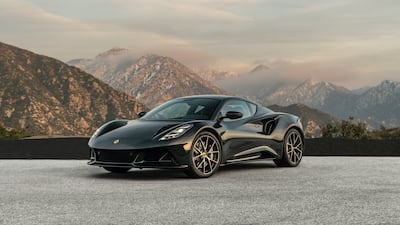
Visually, it is difficult to fault. There is something almost mischievous about how expensive the Emira looks compared to its actual price tag – just over $100,000. With its low, mid-engined proportions, sculpted sides and enormous air intakes, there are traces of the multimillion-dollar Evija in its bodywork. Parked at the kerb, it looks like a supercar.
I drove the entry-level Emira Turbo, powered by a 2.0-litre turbocharged four-cylinder engine derived from Mercedes-AMG and paired with an eight-speed dual-clutch gearbox. Here it produces 360hp, deliberately dialled down from some of its more manic AMG applications.
It is still plenty fast enough. More importantly, it drives beautifully. The hydraulic steering is alive in your hands, the chassis feels wonderfully balanced and the entire car communicates what is happening beneath you in a way that feels increasingly unusual.

As modern performance cars become heavier, more powerful and more electronically sophisticated, many also seem determined to remove their drivers from the process of driving. The Emira does the opposite. You feel involved.
After spending time with it, I did, however, find myself wanting it to misbehave a bit more. Perhaps this is unfair. Perhaps it is nostalgia speaking. But the Lotus that exists in my imagination has always been slightly precarious. It should reward you for getting things right while suggesting that getting them wrong might be death-defying.
The Emira feels remarkably composed. I wanted a little more snarl from it. Occasionally, I wanted the sense that the car was trying to get away from me, just a little, as if some of the old, made-in-a-shed madness was still trapped underneath all that beautifully finished bodywork.

Some of that is undoubtedly down to the version I drove. The V6 SE retains a supercharged 3.5-litre V6 and can still be ordered with a six-speed manual gearbox. Meanwhile, the new Emira 420 Sport takes the four-cylinder car to 420hp, with revised aerodynamics and a more aggressive chassis set-up.
That sounds much closer to the Lotus I was looking for. More interestingly, however, Lotus itself appears to have reached a similar conclusion about what its customers want. The company’s original plan to become an all-electric marque has softened considerably. Under the company’s new Focus 2030 strategy, electric cars remain central to Lotus’s future, but they will increasingly sit alongside hybrids – and the Emira is staying in production.
The last petrol Lotus, in other words, isn’t going anywhere just yet. There is a branding logic to this as much as an engineering one. Moving Lotus entirely to electric power was always going to require an enormous leap from its historic identity. You only have to look at the difficulties other famous British marques – such as Jaguar – have faced while attempting radical reinvention to understand the risk. Modernising a heritage brand is one thing. Removing too many of the things that made people care about it in the first place is another. Lotus appears to understand this.

Perhaps the clearest indication comes from the car currently known as Type 135, expected in 2028. Originally conceived as an electric successor to the Emira, it has evolved into something far more intriguing: a V8 hybrid supercar producing more than 1,000hp.
It is also widely tipped to revive the Esprit name. If it does, the symbolism will be significant. The Esprit helped turn Lotus from a quirky British sports-car company into something glamorous enough for James Bond. The Elise subsequently stripped the idea of a Lotus back to its essentials. The Emira was supposed to draw a line beneath all of that and carry the company towards an electric future.
Instead, it may have done something more important. It reminded Lotus what people loved about Lotus in the first place.
The Emira was designed as a farewell. Five years later, it increasingly feels like an intervention. Lotus went looking for its electric future and discovered that the lightweight, noisy and slightly irrational sports cars of its past still mattered.


FOLLOW TN MAGAZINE