



Infiniti has revealed an upgraded version of its heftiest offering — the QX80 — for 2023.
The new car has not undergone a ground-up refurbishment, but the manufacturer has added a series of enhancements to freshen up the package.
A major change for UAE customers is the introduction of the MyINFINITI app, which is now standard across all of this year's QX80 models. The manufacturer is offering this as a complimentary service for three years from the date of purchase.
The app gives users access to and an analysis of the vehicle's driving history, as well as a car finder function.
There are an array of remote options that come with this new tech as well, including horn and lights activation, engine starting and door release.
A vehicle health report will also send users alerts about possible malfunctions, maintenance requirements and speed traps. They will also be notified should the car be stolen.
The centre console has been redesigned to allow the fitting of an updated touchscreen with controls that Infiniti says are more user-friendly than before.
Much of the established QX80 package is still in place though.
Power as before comes in the shape of a 5.6-litre V8 engine, capable of producing 400 horsepower and 560Nm of torque.

Active safety technologies include a variety of emergency braking options, pedestrian detection, as well as blind spot and lane departure warnings.
These alerts now come through the steering wheel in what is known as a haptic fashion, which means, essentially, vibrations are felt through your fingertips.
It's still lavish inside, with stitched Nappa leather across seating and parts of the trim, and the 13-speaker Bose audio system fills the cabin with whatever sounds float your boat.
The 2023 QX80 is available in the UAE now, with prices starting at Dh325,000.
Infiniti's QX60 arrives in the Middle East — in pictures
-

The 2022 Infiniti QX60 has arrived in the Middle East. All photos: Infiniti -
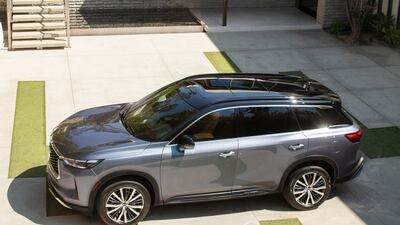
The next-generation model has been completely redesigned, the carmaker says. -
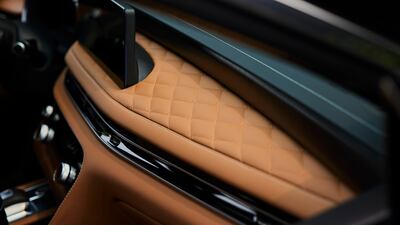
The Japanese-influenced interior includes plush leather details. -

Massage seats are controlled by the central screen. -
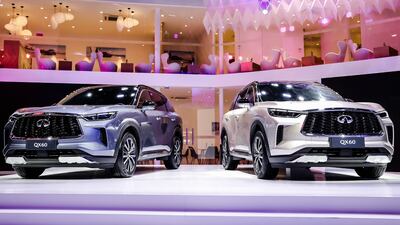
A pair of QX60s on display at the Guangzhou International Automobile Exhibition 2021. -

Designers take inspiration from “ripples on a pond" for the leather seats and interior. -

Doors may be required before setting off. -
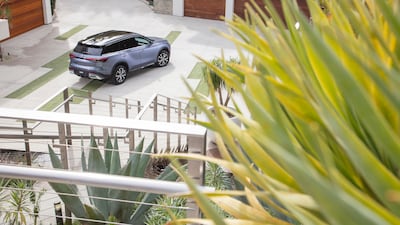
The QX60 demonstrates its kerb appeal. -

An early design sketch. -
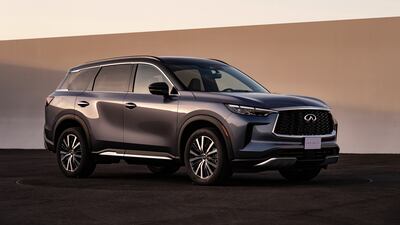
The colour 'Moonbow Blue' shimmers elegantly. -

That'll be the digital piano key tail light.



