



On June 2, 2022, Queen Elizabeth II will celebrate seven decades on the throne, making her Britain’s longest-reigning monarch.
The platinum jubilee celebrations begin on the hybrid date of her coronation day, June 2, and the year she ascended the throne, 1952.
Back then, no one could have guessed that the 25-year-old Queen Elizabeth would rule for so long, nor that the gown she wore for the occasion would gain a new audience 70 years later.

To mark the jubilee, celebrations are scheduled to take place all over the UK, one of which is Superbloom at the Tower of London, essentially a garden of wild flowers filling the ancient moat. Part of it, called The Queen's Garden, was created by British artist Max Jacquard, who has crafted a series of glass "flowers" on stands to rise above the flower beds.
In gently pastel colours, the glass flowers are flat, as if pressed in a book, yet are intricately patterned, because each one was inspired by the hand-embroidered flowers on Queen Elizabeth's coronation gown of 1953.
The story behind Queen Elizabeth II's coronation gown
The original coronation gown that inspired Jacquard was created by Norman Hartnell, and although it marks such an important moment in British history, ironically, it was not the design Hartnell wanted.
Known for his use of embroidery, Hartnell was already something of a star in Britain for the lavish gowns he created during the interwar years. With an exacting eye, and a skilled atelier that created all the handwork, Hartnell's flair for tasteful opulence made him famous, and soon he was drawn into the royal circle.
In 1940 he was awarded a Royal Warrant as dressmaker to Queen Elizabeth the Queen Mother, and a 1947 photograph of a then Princess Elizabeth by Cecile Beaton has her in an embroidered, puff-sleeved Hartnell gown.
Such was his relationship with the royal family that when the queen married Prince Philip in 1947, she asked Hartnell to design her dress.

For her coronation, naturally, she turned to her trusted designer to create what is arguably the most significant gown of her reign.
In his 1955 autobiography, Silver and Gold, Hartnell wrote of being overwhelmed by the enormity of the invitation. “I can scarcely remember what I murmured in reply," he would later write, but did note Elizabeth's request that the gown be similar to her wedding dress, and that she wanted it to be made in white satin.
At the first televised coronation of a British royal — 27 million people in the UK, out of a population of 36 million, watched it — the queen's gown was more than just a dress. It had to set the tone of a new monarchy. As only the eighth queen since medieval times, the dress had to convey the weight, history and solemnity of the occasion, while emphasising Queen Elizabeth's youth and, crucially, her connection to the modern world.
The making of the gown
Clearly, Hartnell was under pressure to create something that could live up to moment. "I settled down to study exactly what history and tradition meant by a 'Coronation dress'," he wrote. "I visited the London Museum and the London Library and leafed through authoritative tomes. I then retired to the seclusion of Windsor Forest and there spent many days making trial sketches.”
Working around ideas of heraldic motifs and flowers, including "lilies, roses, marguerites and golden corn", Hartnell came up with nine different designs for the dress that ran from “severe simplicity" to the richly elaborate.
Queen Elizabeth chose the eighth design, covered in the emblems of Great Britain; the rose, thistle and shamrock, and even a daffodil Hartnell mistakenly thought represented Wales. Of the different designs he later admitted he "liked the last one best", but had prudently kept his preference to himself.
To ensure the dress was different from her wedding gown, Queen Elizabeth requested the embroidery should be in colour rather than silver, and she asked that the design reflect all of the domains she would soon be ruler over.
With a dress of this magnitude, every element had to be perfected in advance, and Hartnell presented samples of what the embroidery of each motif would look like. England, for example, would be represented by a Tudor rose, stitched in "palest pink silk, pearls, gold and silver bullion and rose diamonds", while the Scottish thistle would be worked in "pale mauve silk and amethysts". The stem would be in green silk and diamond dewdrops.

Ireland's shamrock emblem was captured in green silk, silver thread bullion and diamonds, while Wales' now-correct leek would be in "white silk and diamonds with the leaves in palest green silk".
Canada's maple leaf was to be embroidered in green silk and bordered with gold bullion thread and veined in crystal, while the wattle flower of Australia would be rendered as mimosa yellow blossom with the foliage in green and gold thread.
India, meanwhile, would be represented by the lotus flower, captured in mother-of-pearl embroidered petals, seed pearls and diamonds.
For the body of the gown, the silk came from Britain's first silk farm in Lullingstone Castle, established by Lady Hart Dyke, and was woven in cloth by Warner & Sons in Essex, the silk specialist that had woven the coronation robes for King Edward VII. The company would also make the Queensway Coronation Silk that would hang in Westminster Abbey during the queen's crowning.

The cut of Hartnell's dress is relatively simple: floor length, with full skirts, short sleeves and a sweetheart neckline. What makes it spectacular, however, is the painstaking embroidery that covers it from neck to hem.
In what must have taken thousands of hours to create, three tiers of scalloped shapes — in pearls, diamante and gold bugle beads — frame bunches of flowers that also spill around the hem. The rest of the gown, meanwhile, is covered in an intricate lattice of seed pearls, sequins and crystals, so every part of the dress was decorated.
For the actual ceremony, the queen wore the Robe of the Estate on her shoulders, with its 6.5-metre-long, ermine-trimmed cape covering most of Hartnell's work.
The robe, made by Ede and Ravenscroft in English silk, was itself decorated with 18 different types of gold thread and embroidered with wheat ears and olive branches, to symbolise prosperity and peace for Queen Elizabeth's reign.
A legacy that lives on
Now, Hartnell's gown is on display at Windsor Castle, renunited with the Robe for the first public display since 2013.
Thousands of people are expected to view the historical garment, to marvel at its place in history, and to enjoy the astonishing handwork that is it covered in.
In contrast, millions are expected to see the floral tribute at the Tower of London, and the fragile glass flower garden created by Jacquard.
While many will have little idea of the inspiration behind it, Hartnell, who died in 1979, would have been delighted that work that was often hidden in the ceremony, is finally having its moment in the sun.
Royal tiaras on display to mark Queen Elizabeth's platinum jubilee — in pictures
-

The Spencer Tiara worn by Diana, Princess of Wales on her wedding day, is on display at Sotheby's, London, as part of the UK's largest exhibition of tiaras in 20 years. PA -
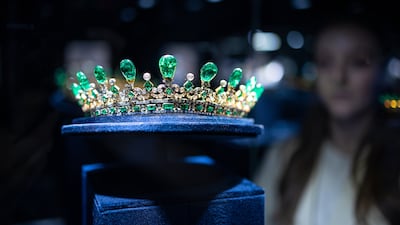
This emerald and diamond tiara, designed by Prince Albert and created by Joseph Kitching in 1845, was reportedly Queen Victoria's favourite and is also part of the exhibition. EPA -
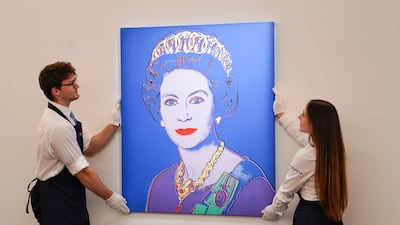
Andy Warhol's pop art screen print of the queen, painted in 1985, is among the highlights. AP -

'The Armada Portrait' painted in 1588 depicting Britain's Queen Elizabeth I. AP -
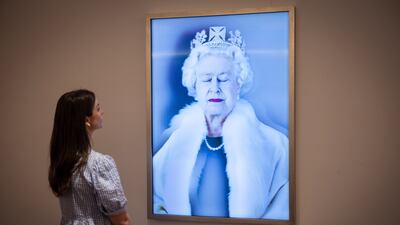
The 'Lightness of Being', a new work donated by Chris Levine. EPA -
A turquoise cabochon and diamond tiara by Van Cleef and Arpels, crafted in the 1960s at the peak of the West's fascination for Indian culture and jewellery design. PA -
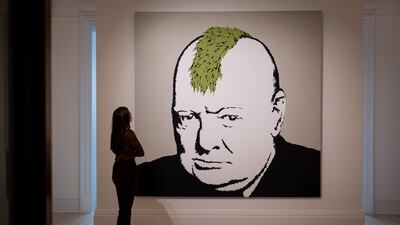
The 2003 artwork titled 'Turf War' by British artist Banksy is also on display at Sotheby's. EPA



