



The Al Saud are today one of the richest and most powerful families in the world. They rule the Kingdom of Saudi Arabia, home to Islam’s two holiest cities and the world’s second largest oil reserves.
But 120 years ago, they found themselves in less fortunate circumstances.
For decades, the Al Saud had been competing with the rival Al Rashid family for supremacy over the Najd region in central Arabia. Disaster struck in 1891, when the Rashidis and their tribal allies captured the desert oasis town of Riyadh, ousting them from their ancestral capital.
Without a home, the Saudi leader Imam Abdul Rahman bin Faisal Al Saud was forced to take his family into exile. With him came his 15-year-old son, Abdulaziz bin Abdul Rahman Al Saud – later known as Ibn Saud in the West – who would go on to become Saudi Arabia’s first king.
In exile, the Saudis first took refuge with the nomadic Al Murrah tribe, where Abdulaziz learned the skills of desert life and the customs of the Bedouin.
After two years in the desert, they were welcomed as guests by Kuwait’s ruler Sheikh Mubarak, who gave the Al Saud access to his court and allowed them to use Kuwait as a base for raids against the Rashidis.
Yet the Saudis remained exiles, without any territory to call their own and reliant on Sheikh Mubarak’s patronage.
Abdulaziz was determined to change their fortune.
During his time in Kuwait, the son of the Al Saud’s leader had grown from a teenager into a man. He had learned the ways of the desert, experienced international politics at an Arabian ruler’s court and honed his martial skills through raiding, the most common form of tribal combat. He was ready.
Ten years after his family went into exile, Abdulaziz decided to put these skills to the test and set out on a mission. His aim was to recapture Riyadh and restore his family’s home.

The road to Riyadh
In autumn 1901, Abdulaziz rode out from Kuwait with a band of 40 to 60 men on camels.
He began by raiding the Al Hasa region in eastern Arabia, continuing the pattern of raid and counter-raid between the Saudis and Rashidis. Things went well at first. The promise of raiding bounty attracted sympathetic tribes including the Al Murrah in eastern Arabia, and Abdulaziz’s force grew to more than 200 men.
But the promising start soon faded away. As the loot from raids began to diminish and with the Islamic holy month of Ramadan approaching, many of the tribesmen melted away, returning to their families to rest.
By the time Abdulaziz reached Haradh to the south, on the edge of the harsh desert known as the Empty Quarter, his party was pared down to its original size.
Rejecting a retreat to Kuwait, Abdulaziz took his men deep into the desert somewhere near Yabreen in December 1901. Here they spent the Islamic holy month fasting, sleeping by day and foraging by night.
For almost 50 days they hid in the desert. Then in early January 1902, with Abdulaziz’s enemies no longer on high alert, he marched north, travelling by darkness.
By January 15, they arrived at the small oasis town of Riyadh.
The battle for Riyadh
The battle for Riyadh in the early hours of January 16, 1902, has since entered the realm of legend.
Abdulaziz himself enjoyed retelling the story in different forms and with varied emphasis throughout his life, leading to some variations in the exact details among the many Arab and European chroniclers who later recounted the tale.
But there is a consensus on the details, even if the story has since taken on mythical status, explains Robert Lacey, historian and author of two books on Saudi Arabia, The Kingdom and Inside the Kingdom.
“The story has a strong element of oral folk myth as told round the campfire but it was told by those present and confirmed by European, largely British, reports at the time. I think we can be sure that it happened and one can feel pretty confident of the details since they were recorded contemporaneously,” he told The National.
On January 15, Abdulaziz and a small group of armed scouts infiltrated Riyadh by stealth.
Riyadh was then a small oasis town with a low wall demarcating the central town from the surrounding date palm groves. At the centre of the town was the Masmak Fort, where the Rashidi governor, Ajlan, and his garrison were stationed.
-
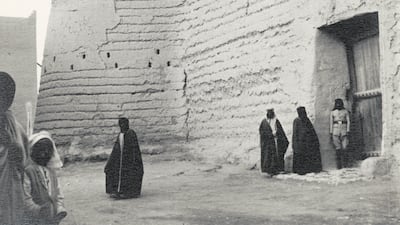
The Masmak Fort in Riyadh, Saudi Arabia, in a photo taken in 1934 by the British diplomat, explorer and historian, Gerald de Gaury. Photo: Gerald de Gaury / Royal Geographical Society via Getty Images -
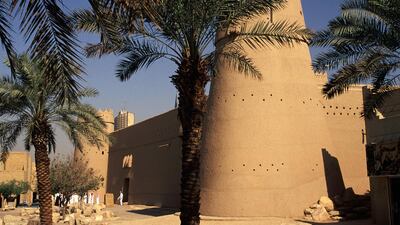
The fort was built between 1865 and 1895 and completed by the Al Rashid family, who fought against the Al Saud for supremacy in central Arabia. Amar Grover / The National -
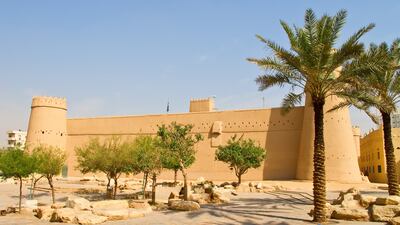
The fort was at the centre of historic Riyadh in 1902, when Abdulaziz bin Abdul Rahman Al Saud retook the town from the Al Rashid governor. Getty Images -
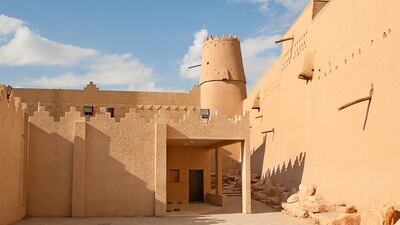
A close-up shows the fort's clay and mudbrick walls. Getty Images -
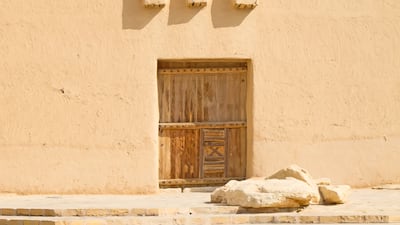
The main entrance to the Al Masmak fort was a large gate, within which was a smaller postern gate almost a metre off the ground known as the Al Khokha. This small entrance was easily defensible as it required the person entering to hop over the waist-high ledge. Getty Images -

Another angle shows the entrance to the fort. It was here that the decisive moment of the battle for Riyadh took place in the early hours of January 16, 1902, when the Rashidi governor Ajlan was killed by either the future Saudi king Abdulaziz or his cousin, Abdullah Ibn Jaluwi. Alamy -
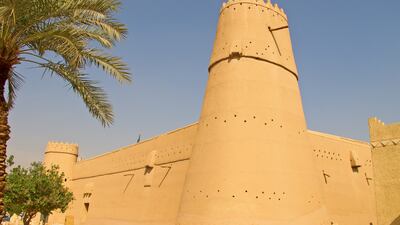
The fort still stands today and is one of the few buildings in Riyadh from the pre-oil era. In 1995 it was converted into the Al Masmak Museum. Getty Images -
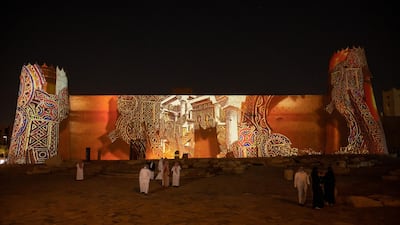
During the Noor Riyadh festival, a logo designed by Saudi artist Ali Al Ruzaiza to commemorate the 100th anniversary of the founding of Saudi Arabia was projected on to the Masmak Fort. Photo: Noor Riyadh -

The fort featured on the official logo to mark the 100th anniversary of the 1902 battle of Riyadh, which was circulated across the kingdom. Photo: Eiman Elgibreen -
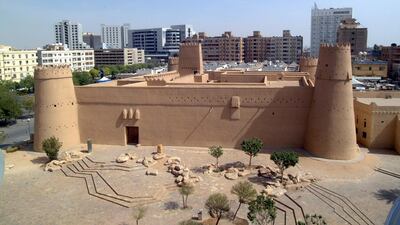
The Al Masmak Museum today, with Riyadh seen in the background. Photo: Al Masmak Museum


That evening, Abdulaziz and his scouts snuck through the palm groves and scaled the wall. From a local farmer loyal to the Al Saud, they had learnt that Ajlan had a house close to the Masmak Fort.
The band infiltrated the house and discovered that Ajlan spent his nights in the fort for safety. They also learnt that the stronghold was usually entered by a small postern gate almost a metre off the ground known as the Al Khokha, which was easily defensible as it required the person to hop over the waist-high ledge.
However, the postern entrance was part of a larger main gate, which was opened at dawn each morning, when Ajlan left the fort with a garrison.
They now had a plan. Abdulaziz’s forward party quietly let the rest of his men into the house close to the fort, where they waited until dawn.
After several hours, the gate was opened and Ajlan appeared. Abdulaziz and his men charged forward. They took the governor and the few guards with him completely by surprise. But as they charged across the square, the sentries inside the fort closed the main gate, leaving only the small postern entrance open.

Abdulaziz seized Ajlan but was thrown off by one of the guards. Another grabbed him but was killed by Abdulaziz’s cousin Abdullah Ibn Jaluwi.
Amid the chaotic skirmish, Ajlan and his men dived back towards the postern, trying to escape within the fort.
Ibn Jaluwi tried to stop them and threw a spear at Ajlan. It missed but the strength of the throw left it stuck in the gate.
The defining moment of the battle came as Ajlan tried to scramble through the gate to safety.
Sources disagree on what happened next but it seems Ibn Jaluwi threw himself forward through the opening and grabbed Ajlan before he could escape and close the door on the Saudi advance. Either he or Abdulaziz himself then killed Ajlan and the remaining guards were either overwhelmed or they surrendered.
The battle was over and Riyadh was back in Saudi hands.
From capital to kingdom
The capture of Riyadh led to the gradual expansion of Saudi rule across Arabia that eventually resulted in the formation of the Kingdom of Saudi Arabia in 1932.
“This was a crucial step to reunite the vast lands that had fallen to sociopolitical erosion after the collapse of the Second Al Saud monarchy [1824-1891],” said Joseph A. Kéchichian, a Senior Fellow at the King Faisal Centre in Riyadh.
“Abdulaziz's bravura was exceptional and his conquest – for it was one in every sense of the word – set the stage for the eventual re-establishment of the monarchy.”
After conquering Riyadh, Abdulaziz consolidated Saudi rule over central Arabia, expanding to Al Hasa, in today’s Eastern Province, in 1913. He then expanded west to the Hejaz, home to the Islamic holy cities of Makkah and Madinah, defeating the rival Hashemite family in a short war of 1924-1926.
Alongside conquest, Abdulaziz also consolidated his power through marriage, forging marital alliances with tribes and families across Arabia and producing about 100 children.
His sons, including the current King Salman, have ruled the kingdom since Abdulaziz's death in 1953.

Lasting legacy
The capture of Riyadh not only enabled the creation of the kingdom but also became one of Saudi Arabia’s foundational myths and contributed to Abdulaziz’s heroic status as the kingdom’s founding father.
“The story has got all these wonderful connotations and resonances of the founding myths of so many countries: it’s got the brandishing of swords, personal bravery, religious conviction and a young dynamic hero in the form of Abdulaziz,” Mr Lacey said.
The kingdom in 1999 commemorated the 100th anniversary of the capture, marking the milestone as per the Islamic Hijri calendar. It has since moved to the Gregorian calendar, meaning the 120th anniversary is this year.
Abdulaziz also features in annual Saudi National Day celebrations that mark 1932's creation of the kingdom, with his image often shown alongside his son, the current King Salman, and grandson, Crown Prince Mohammed bin Salman.
The Masmak Fort is now a museum in Riyadh, one of the few buildings left from the era before oil revenue fuelled rapid urban growth in the second half of the 20th century.
Visitors to the fort can reportedly still see a small piece of metal in the outside gate, apparently the remains of the spear thrown by Abdulaziz’s cousin that day, a brief window back in time to a small skirmish that shaped the map of Arabia today.

Saudi National Day - in pictures
-
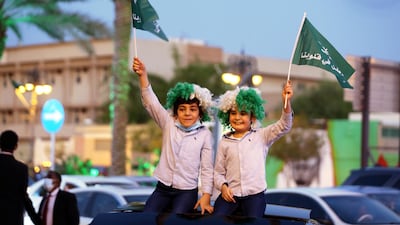
Children wave flags as people celebrate Saudi Arabia's 90th annual National Day in the capital Riyadh in 2020. Reuters -
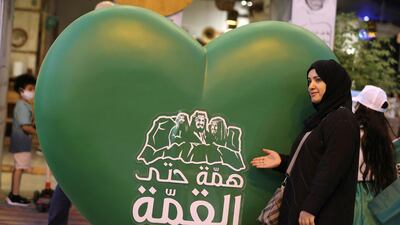
The 90th annual National Day in Riyadh. Reuters -
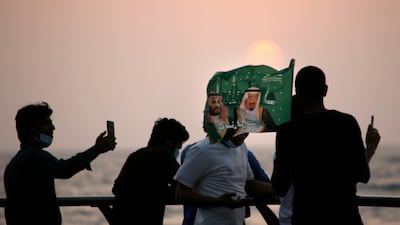
Saudis watch the sunset as they wave a flag with pictures of Saudi King Salman and Crown Prince Mohammed bin Salman, marking National Day to commemorate the unification of the country as the Kingdom of Saudi Arabia, in Jeddah. AP Photo -

Saudi Hawks air force aerobatic team Al-Suqoor flies over Riyadh during celebrations marking Saudi Arabia's 90th National Day in 2020. AFP -

Boys wave national flags. AFP -

Posters mark National Day. Reuters -

A woman waves a flag as people celebrate National Day, despite the spread of Covid-19, in 2020. Reuters -
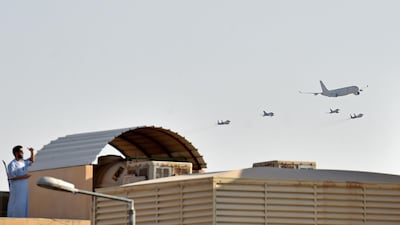
Civil and military aircraft fly over Riyadh marking Saudi Arabia's 90th National Day. AFP -
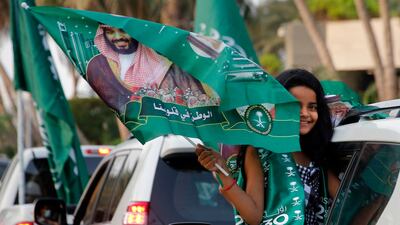
A Saudi girl waves a national flag emblazoned with an image of Saudi Crown Prince Mohammed bin Salman in Jeddah. AP Photo



