

Saudi Arabia has stressed its commitment to nuclear non-proliferation at a meeting of the UN nuclear watchdog, the International Atomic Energy Agency (IAEA), on Monday.
Energy Minister Prince Abdulaziz bin Salman said the kingdom shared the concerns of the international community that Iran’s nuclear research activities lacked transparency.
He said Saudi Arabia was concerned by the potential for nuclear weapons to be developed within the region and would continue to support the peaceful application of nuclear research and technology.
Saudi Arabia remained committed to the Treaty on the Non-Proliferation of Nuclear Weapons, a 1968 international agreement designed to limit the spread of nuclear weapons of mass destruction, he said.
Since its inception, the treaty has been the bedrock of a global effort to slow the nuclear arms race and prioritise civilian nuclear research.
Last year, former Iranian Foreign Minister Javad Zarif threatened that Iran could withdraw from the treaty, which it signed prior to the 1979 revolution which overthrew the Shah of Iran.
"If the Europeans continue their improper behaviour or send Iran's file to the Security Council, we will withdraw from the NPT," Mr Zarif warned.
-
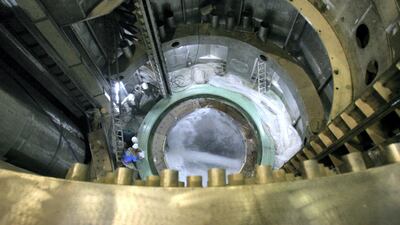
Russian contractors work at the Bushehr nuclear reactor site in 2007. The plant opened four years later. Bloomberg -
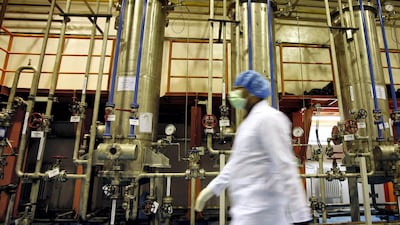
An Iranian technician at the International Atomic Energy Agency inspects the country's Isfahan plant in 2007. Tehran is no longer co-operating with the agency at nuclear sites across the country. EPA -

Workers wait to begin constructing a second reactor at the Bushehr nuclear power plant in 2019. AFP -
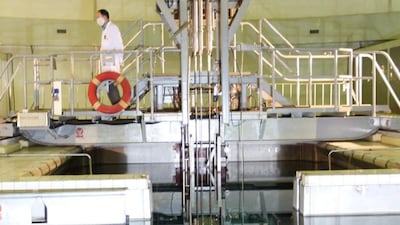
A metal-encased rod with 20 per cent enriched nuclear fuel is inserted into a reactor in Tehran in 2012. AFP -
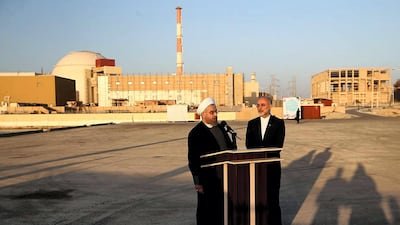
Fomer Iranian President Hassan Rouhani and the country's Atomic Energy Organisation chief Ali Akbar Salehi speak at the Bushehr nuclear site in 2015. AFP -
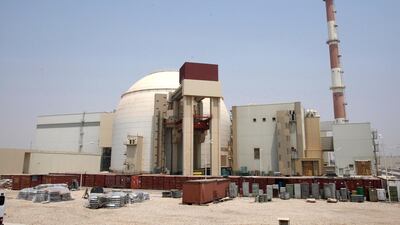
Iran's Bushehr nuclear plant has been restarted. EPA -
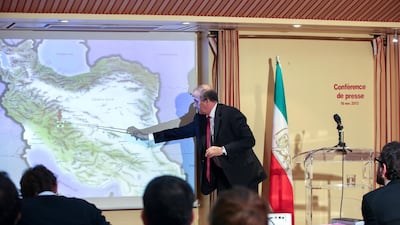
Mehdi Abrichamtchi, chairman of the Peace and Security Committee at the National Council of Resistance of Iran, shows journalists the location of a secret nuclear site in Iran in 2013. AFP -
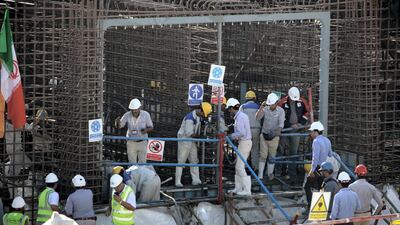
Workers prepare to begin the construction of a second reactor at the Bushehr site. AFP


On Sunday, Prince Abdulaziz also met with Raphael Grossi, director general of the IAEA, where Mr Grossi said they discussed the kingdom’s “nuclear power program and the role of legal and regulatory frameworks to support it”.
Saudi Arabia and the IAEA have increased co-operation in recent years, although the kingdom has had a civilian nuclear research programme since the 1970s.
In March, Minister of Foreign Affairs Prince Faisal bin Farhan Al Saud discussed non-proliferation with Mr Grossi, a conversation Mr Grossi said was positive.
The discussions followed a meeting in September where Mr Grossi praised the contribution of the kingdom to the IAEA, noting the organisation is working with the kingdom on a number of nuclear-related activities.
Mr Grossi said the kingdom is “interested in developing nuclear energy, for peaceful purposes of course”.
“We are working on providing (Saudi Arabia) with the necessary support,” he said.

