

Related: Captagon crisis and the Middle East's war on drugs
Saudi Arabia's security forces in Jeddah seized about 1.4 million Captagon pills, authorities announced on Monday.
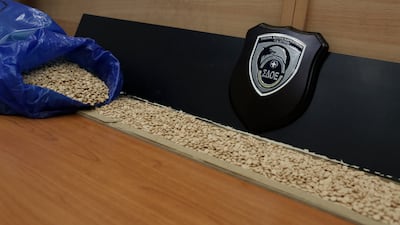
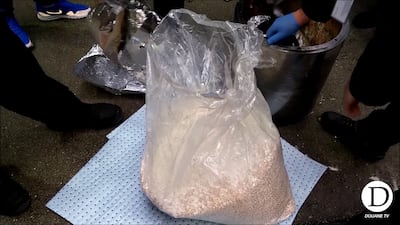
A stash of 1,395,930 Captagon pills was found hidden in a shipment of wooden panels.
Saudi authorities made the discovery as the drugs were travelling through Jeddah Islamic Port.
Customs officers have arrested one man suspected of involvement with the shipment.
Saudi Arabia's Zakat, Tax and Customs Authority released a video on social media showing officers extracting the drugs from wooden panels stored in a lorry.
The agency said it was working with the General Directorate of Drug Control to tighten procedures around the kingdom's imports and exports as well as security.
Customs officers encouraged the public to share any evidence of drug use or supply within the kingdom, promising whistleblowers anonymity and rewards.
Officials did not disclose the value of the drugs, but in line with global estimates the haul would be expected to be worth millions of dollars.
Captagon is the most in-demand narcotic in the Middle East.
In March, almost five million Captagon pills were seized by Saudi security forces in Riyadh after they were discovered in a shipment of electrical cables.
A Syrian citizen was arrested and referred to prosecutors.
The war on Captagon
-
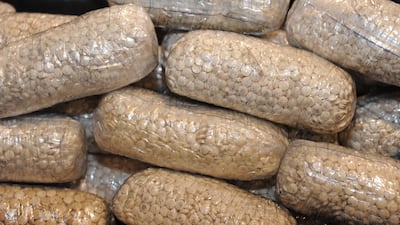
According to the United Nations Office on Drugs and Crime, trafficking in amphetamines has increased in the Middle East in recent years. Photo: Dubai Customs -
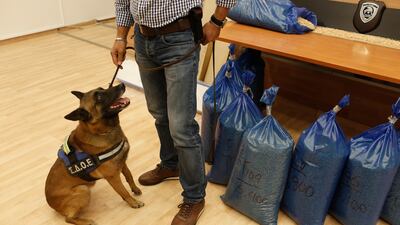
Specially trained K-9 units are often used by border forces to intercept shipments. EPA -
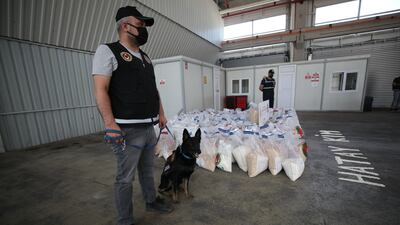
Experts believe the amount intercepted accounts for only around a tenth of the total quantity of pills being smuggled out of places like Syria and Jordan. EPA -
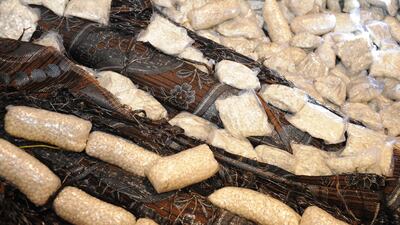
Dubai Customs thwarted 398 attempts to smuggle drugs into the city in the first three months of this year. Photo: Dubai Customs -
Captagon pills on display after being seized in Greece in 2019. EPA -
Captagon became synonymous with the Syrian Civil War. AFP -
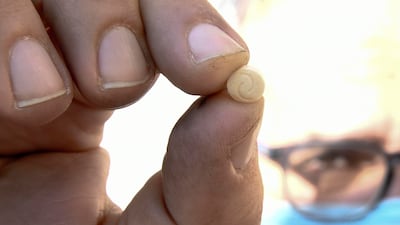
The small, off-white pills have quickly become one of the most widely consumed drugs in the Middle East. EPA -

Millions of Captagon pills are seized around the world each year. EPA -
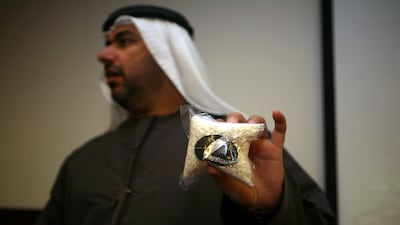
Captagon pills on display after a major interception of a shipment in 2009. Nicole Hill / The National -
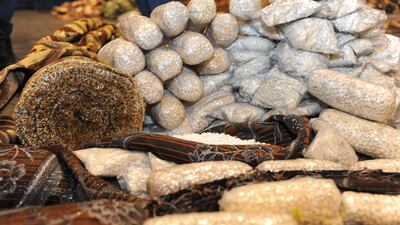
Customs officers say Captagon smugglers prefer to use sea ports rather than airports because of the size of shipping containers, enabling them to conceal larger quantities of drugs. Photo: Dubai Customs


Captagon was created in 1961 as an alternative to amphetamine and methamphetamine.
It was used to treat attention deficit hyperactivity disorder, and less commonly, depression.
However, it never received regulatory approval from the US Food and Drug Administration.
In 1981, the drug was declared a controlled substance after doctors determined that the drug's addictive properties outweighed its clinical benefits.
By 1986, its manufacture had been outlawed in almost every country, although illegal production continued.
The small, off-white pills have become the Middle East's most popular drug.
Trade in Captagon in the region grew exponentially in 2021 to exceed $5 billion, posing an increasing health and security risk to the Middle East, a 2022 report said.
Most of the global Captagon production originates in Syria, where it has become a $10 billion industry, according to AFP estimates drawn from official data, making the drug the country's biggest export so far.
The synthetic amphetamine has long been associated with the Syrian civil war. Many fighters on all sides are believed to use the drug.
It has now become one of the most widely used drugs among young substance abusers in Saudi Arabia and the UAE.

