



As violence continues to engulf Yemen, millions of people are suffering from food and medicine shortages, with more than 130,000 killed in the civil war.
But it is not just people who are suffering through what has been called the world’s worst man-made humanitarian crisis – the country’s animals are facing their own form of brutality, too.
In March 2020, as another wave of rockets struck Yemen’s capital Sanaa, more than 70 purebred Arabian horses were left for dead in the raided stables of the military college, the Ataa Initiative for Environment and Animal Welfare said.
Around 30 of the graceful creatures were wounded in the attack. Members of Ataa, a group founded just two months before, rushed to the horses’ rescue.
The group of animal lovers and a veterinarian have since tended to Sanaa’s animals, whether harmed by the ongoing civil war or abused.
“The initiative was created by ten animal-loving people in response to the increased violence against animals which are helpless and can’t defend themselves against abuse,” Zahra Haid, 29, founder of Ataa, told The National.
The group relies on its 3,500 followers on Facebook for reports of animals in distress.
“Once we get notifications of a suffering animal, we immediately visit it and provide treatment and care, under the guidance of our volunteering vet,” Zahra said.

Magdy Al Ameri, the initiative’s volunteering vet, said he has rescued around 90 animals from various injuries, not including those which did not make it.
“Traffic accidents and run over cats and dogs are the most common cases I deal with, almost daily, as well as cases of fractures and bleeding as a result of the animal being beaten with stones or a sharp tool,” said Dr Al Ameri. “This is in addition to performing some surgeries such as complex births and cases of animals which were directly shot.”
Zaher said the initiative raises awareness of the need for compassion towards animals, which she said is an “integral part of the Islamic faith”.
Negligence towards animals is a common practice in many countries in the Arab world as a result of lack of awareness.
Group member Arwa Gamal, 27, said the Facebook page is also used to look for homes to adopt stray puppies and kittens.
“Lately, we have been receiving increasing interest from our followers to take in kittens and puppies which we post about on our page,” she said. The group follows up on adopted animals to ensure they are taken care of.
Groups forced to close
A key challenge the group faces is security threats from the war. Zahra said the group once received a tip-off that a dog was bleeding heavily from a firearm wound.
She said the animal was left to suffer for hours as the region it was in came under heavy aerial raid, preventing members of the group from reaching it. When they finally did, they hurriedly offered first aid and rushed back in fear the raids would resume, she said.
A scarcity of vets and the lack of an integrated and qualified veterinary clinic with the latest technical capabilities, plus high prices of medicines, are other challenges facing the group, Zahra said.
Limited financing is also a problem.
“In a country facing grave economic and financial hardships, and with salaries being cut off Yemeni employees for years, resources are very tight,” said Zahra. She said humble contributions by the initiative’s members is what keeps it afloat.
“At first, we were met with a disapproving view from some people who argue that humans should be prioritised for any help or support, rather than animals. Now, thank God, awareness has increased,” she said.
She said some who cannot afford providing direct financial support are taking in helpless animals off the street. Some families regularly offer food leftovers to stray animals in their streets.
Shortages in financing have led to the closure of similar groups in other parts of Yemen.
“Financial funding is the most prominent obstacle facing any initiative. The country, being exhausted by a fierce war, led many emerging organisations and initiatives to stop their activities,” said Soha Hassan, 28, founder of Al Salam Initiative for Animal Welfare in the southern city of Lahg.
Her initiative, which operated between 2019 and 2020, tended to animals and carried out awareness campaigns in schools and public spaces.
Galal Al Amrawi, who was the general secretary of a registered society that operated in Aden for two years, agrees. Mr Al Amrawi’s group closed because of a lack of funding, but he still offers care to stray animals as part of the academy he founded to train dogs on detecting explosives and drugs.
“It is essential to have continuous funding for any initiative so that it does not stop at some point,” he said.
This article was written in collaboration with Egab.
Fighting in Marib – in pictures
-
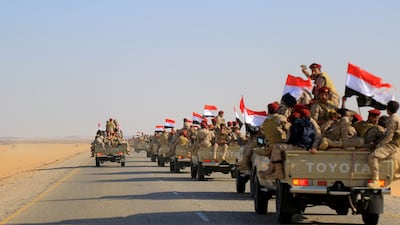
Yemeni army reinforcements arrive to join fighters loyal to Yemen's Saudi Arabia-backed government, on the southern front of Marib. AFP -
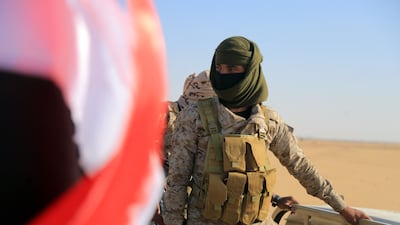
Outside Marib, a government stronghold in northern Yemen, joint forces have made advances in the provinces of Taez. AFP -
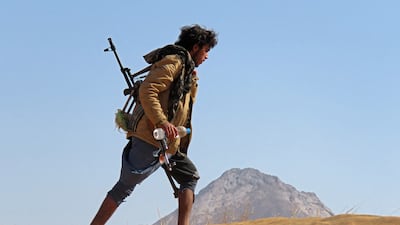
A Yemeni pro-government fighter is pictured during fighting with Houthi rebels. AFP -
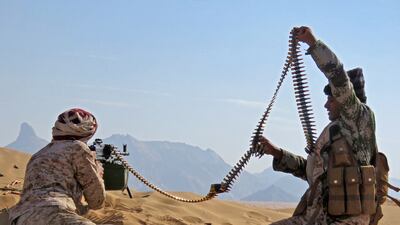
Yemeni pro-government forces. AFP -
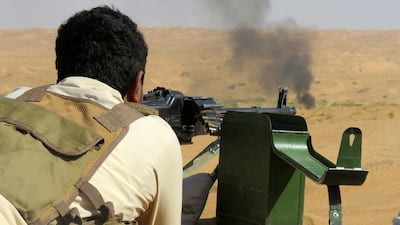
Hundreds of Houthi fighters have been killed as fierce fighting continues for a second week near Yemen's west coast. AFP -

Coalition forces continued the progress and took control of areas in the provinces of Ibb and Taez. AFP -
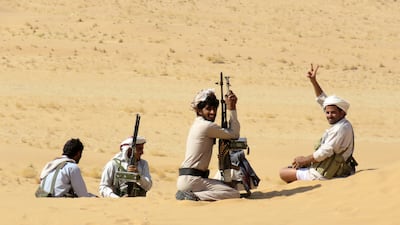
Marib, a region that hosts more than two million internally displaced people, was until recently the main focal point of the war. But focus has now moved to the west, where about 200 Houthi fighters were killed in a second week of confrontations in Hays, Al Jarahi, Maqbanah and Jabal Ras. AFP -
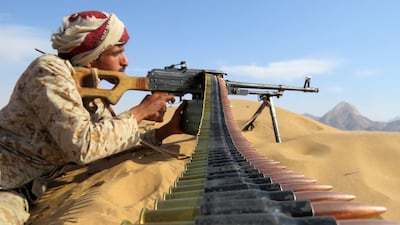
Saudi Arabia is backing the pro-government fighters. AFP -

A Houthi fighter fires a weapon at a front line in the Al Jubah district of Yemen's Marib province. Reuters -

A Houthi fighter with an amputated right arm takes position, in a frame grab from video handed out by the Houthi media centre. Reuters -

Houthi fighters in the Al Jubah district of Yemen's Marib province, in another frame grab from video handed out by the Houthi media centre. Reuters



