A man takes a photograph of Athens from Tourkovounia hill, as southerly winds carry waves of Saharan dust to the city in 2024. AFP

Saharan storms ‘threaten Europe’s solar power future’


Paul Carey
  • English
  • Arabic

A growing atmospheric phenomenon is complicating Europe’s path towards climate and energy security targets, scientists have warned.

Mineral dust carried on the wind from the Sahara could hamper Europe’s reliance on solar energy, the European Geosciences Union General Assembly (EGU25) heard.

In their presentation at EGU25, Dr Gyorgy Varga and collaborators from Hungarian and European institutions said dust-laden skies disrupt photovoltaic (PV) performance and challenge existing forecasting models.

Their work, using field data from more than 46 Saharan dust events between 2019 and 2023, spans both Central Europe (Hungary) and Southern Europe (Portugal, Spain, France, Italy, and Greece).

The Sahara releases billions of tonnes of fine dust into the atmosphere every year, and tens of millions of tonnes reach European skies.

These particles scatter and absorb sunlight, reduce irradiance at the surface, and can even promote cloud formation – all of which degrade PV output.

  • Skiers wearing protective face mask ski as Sahara sand colours the snow and the sky in a yellow cast and creates a special light atmosphere, in the Alpine resort of Anzere, Switzerland. EPA
    Skiers wearing protective face mask ski as Sahara sand colours the snow and the sky in a yellow cast and creates a special light atmosphere, in the Alpine resort of Anzere, Switzerland. EPA
  • Snowkiters sliding on snow covered with sand at Col du Lautaret mountain pass in Serre Chevalier, a major ski resort in Southeastern France. Reuters
    Snowkiters sliding on snow covered with sand at Col du Lautaret mountain pass in Serre Chevalier, a major ski resort in Southeastern France. Reuters
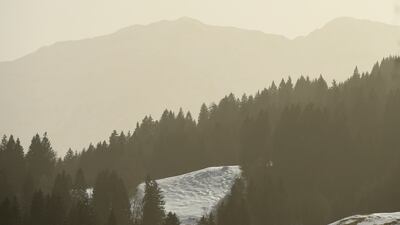
  • Bavaria, Garmisch-Partenkirchen: The sky above the mountains in the Wetterstein range is clouded by the Sahara sand in the air. Getty Images
    Bavaria, Garmisch-Partenkirchen: The sky above the mountains in the Wetterstein range is clouded by the Sahara sand in the air. Getty Images
  • Ski slopes are covered with Sahara sand in the tiny Andorra principality in the Pyrenees mountains. Reuters
    Ski slopes are covered with Sahara sand in the tiny Andorra principality in the Pyrenees mountains. Reuters
  • Skiers wearing protective face masks sit on a chairlift as Sahara sand colours the snow and the sky in a yellow cast and creates a special light atmosphere, in the Alpine resort of Anzere, Switzerland. EPA
    Skiers wearing protective face masks sit on a chairlift as Sahara sand colours the snow and the sky in a yellow cast and creates a special light atmosphere, in the Alpine resort of Anzere, Switzerland. EPA
  • Sahara dust makes the sky misty as skiers rest on the terrace of a restaurant beside a piste at the Corviglia ski area in the Alpine resort of St. Moritz, Switzerland. Reuters
    Sahara dust makes the sky misty as skiers rest on the terrace of a restaurant beside a piste at the Corviglia ski area in the Alpine resort of St. Moritz, Switzerland. Reuters
  • Tourists ride an ATV along the sand dunes at just before sunset in Erg Chebbi desert near the small Moroccan village of Merzouga in the Sahara Desert. Reuters
    Tourists ride an ATV along the sand dunes at just before sunset in Erg Chebbi desert near the small Moroccan village of Merzouga in the Sahara Desert. Reuters
  • Dr Diana Francis said snow melt can be expected to occur more frequently under global warming.
    Dr Diana Francis said snow melt can be expected to occur more frequently under global warming.

Previous research has shown dust storms have a significant effect on climate change. Fine desert dust blown across the ocean can also make the rain heavier by changing the size of cloud droplets.

UAE researchers also found dust travelling from the Sahara to the Alps causes snowy pistes and glaciers to turn a dramatic red, pink or orange.

Huge plumes of dust also get transported from North Africa to the Arctic, which could have stark consequences for climate change, research from New York University Abu Dhabi (NYUAD) has found.

A study of a 2011 cyclone over Morocco found it carried 38 million tonnes of dust, depositing 1.3 million tonnes of it in the Arctic.

Prof Benjamin Murray, an atmospheric scientist at Leeds, told The National: "Dust from places like the Sahara has long been known to be important for the planet’s climate. It reflects sunlight back into space so affects climate directly."

The researchers found that conventional forecasting tools which study average particle levels in the atmosphere miss the mark during these events.

Instead, the team recommends integrating near-real-time data on dust levels with cloud particles into forecasting models. This would allow for more reliable scheduling of solar energy and better preparedness for the variability introduced by atmospheric dust.

“There’s a growing need for dynamic forecasting methods that account for both meteorological and mineralogical factors,” said Mr Varga.

“Without them, the risk of underperformance and grid instability will only grow as solar becomes a larger part of our energy mix.”

Beyond atmospheric effects, the team also pointed to the long-term impacts of dust on the physical infrastructure of solar panels, including contamination and erosion – factors that can further reduce efficiency and increase maintenance costs.

This research was supported by the National Research, Development and Innovation Office the Hungarian Academy of Sciences, and the EU-funded National Multidisciplinary Laboratory for Climate Change.


THE BIO

Age: 33

Favourite quote: “If you’re going through hell, keep going” Winston Churchill

Favourite breed of dog: All of them. I can’t possibly pick a favourite.

Favourite place in the UAE: The Stray Dogs Centre in Umm Al Quwain. It sounds predictable, but it honestly is my favourite place to spend time. Surrounded by hundreds of dogs that love you - what could possibly be better than that?

Favourite colour: All the colours that dogs come in

Attacks on Egypt’s long rooted Copts

Egypt’s Copts belong to one of the world’s oldest Christian communities, with Mark the Evangelist credited with founding their church around 300 AD. Orthodox Christians account for the overwhelming majority of Christians in Egypt, with the rest mainly made up of Greek Orthodox, Catholics and Anglicans.

The community accounts for some 10 per cent of Egypt’s 100 million people, with the largest concentrations of Christians found in Cairo, Alexandria and the provinces of Minya and Assiut south of Cairo.

Egypt’s Christians have had a somewhat turbulent history in the Muslim majority Arab nation, with the community occasionally suffering outright persecution but generally living in peace with their Muslim compatriots. But radical Muslims who have first emerged in the 1970s have whipped up anti-Christian sentiments, something that has, in turn, led to an upsurge in attacks against their places of worship, church-linked facilities as well as their businesses and homes.

More recently, ISIS has vowed to go after the Christians, claiming responsibility for a series of attacks against churches packed with worshippers starting December 2016.

The discrimination many Christians complain about and the shift towards religious conservatism by many Egyptian Muslims over the last 50 years have forced hundreds of thousands of Christians to migrate, starting new lives in growing communities in places as far afield as Australia, Canada and the United States.

Here is a look at major attacks against Egypt's Coptic Christians in recent years:

November 2: Masked gunmen riding pickup trucks opened fire on three buses carrying pilgrims to the remote desert monastery of St. Samuel the Confessor south of Cairo, killing 7 and wounding about 20. IS claimed responsibility for the attack.

May 26, 2017: Masked militants riding in three all-terrain cars open fire on a bus carrying pilgrims on their way to the Monastery of St. Samuel the Confessor, killing 29 and wounding 22. ISIS claimed responsibility for the attack.

April 2017Twin attacks by suicide bombers hit churches in the coastal city of Alexandria and the Nile Delta city of Tanta. At least 43 people are killed and scores of worshippers injured in the Palm Sunday attack, which narrowly missed a ceremony presided over by Pope Tawadros II, spiritual leader of Egypt Orthodox Copts, in Alexandria's St. Mark's Cathedral. ISIS claimed responsibility for the attacks.

February 2017: Hundreds of Egyptian Christians flee their homes in the northern part of the Sinai Peninsula, fearing attacks by ISIS. The group's North Sinai affiliate had killed at least seven Coptic Christians in the restive peninsula in less than a month.

December 2016A bombing at a chapel adjacent to Egypt's main Coptic Christian cathedral in Cairo kills 30 people and wounds dozens during Sunday Mass in one of the deadliest attacks carried out against the religious minority in recent memory. ISIS claimed responsibility.

July 2016Pope Tawadros II says that since 2013 there were 37 sectarian attacks on Christians in Egypt, nearly one incident a month. A Muslim mob stabs to death a 27-year-old Coptic Christian man, Fam Khalaf, in the central city of Minya over a personal feud.

May 2016: A Muslim mob ransacks and torches seven Christian homes in Minya after rumours spread that a Christian man had an affair with a Muslim woman. The elderly mother of the Christian man was stripped naked and dragged through a street by the mob.

New Year's Eve 2011A bomb explodes in a Coptic Christian church in Alexandria as worshippers leave after a midnight mass, killing more than 20 people.

Skoda Superb Specs

Engine: 2-litre TSI petrol

Power: 190hp

Torque: 320Nm

Price: From Dh147,000

Available: Now

The President's Cake

Director: Hasan Hadi

Starring: Baneen Ahmad Nayyef, Waheed Thabet Khreibat, Sajad Mohamad Qasem 

Rating: 4/5

Lexus LX700h specs

Engine: 3.4-litre twin-turbo V6 plus supplementary electric motor

Power: 464hp at 5,200rpm

Torque: 790Nm from 2,000-3,600rpm

Transmission: 10-speed auto

Fuel consumption: 11.7L/100km

On sale: Now

Price: From Dh590,000

From Europe to the Middle East, economic success brings wealth - and lifestyle diseases

A rise in obesity figures and the need for more public spending is a familiar trend in the developing world as western lifestyles are adopted.

One in five deaths around the world is now caused by bad diet, with obesity the fastest growing global risk. A high body mass index is also the top cause of metabolic diseases relating to death and disability in Kuwait,  Qatar and Oman – and second on the list in Bahrain.

In Britain, heart disease, lung cancer and Alzheimer’s remain among the leading causes of death, and people there are spending more time suffering from health problems.

The UK is expected to spend $421.4 billion on healthcare by 2040, up from $239.3 billion in 2014.

And development assistance for health is talking about the financial aid given to governments to support social, environmental development of developing countries.


Living in...

This article is part of a guide on where to live in the UAE. Our reporters will profile some of the country’s most desirable districts, provide an estimate of rental prices and introduce you to some of the residents who call each area home.

Five famous companies founded by teens

There are numerous success stories of teen businesses that were created in college dorm rooms and other modest circumstances. Below are some of the most recognisable names in the industry:

  1. Facebook: Mark Zuckerberg and his friends started Facebook when he was a 19-year-old Harvard undergraduate. 
  2. Dell: When Michael Dell was an undergraduate student at Texas University in 1984, he started upgrading computers for profit. He starting working full-time on his business when he was 19. Eventually, his company became the Dell Computer Corporation and then Dell Inc. 
  3. Subway: Fred DeLuca opened the first Subway restaurant when he was 17. In 1965, Mr DeLuca needed extra money for college, so he decided to open his own business. Peter Buck, a family friend, lent him $1,000 and together, they opened Pete’s Super Submarines. A few years later, the company was rebranded and called Subway. 
  4. Mashable: In 2005, Pete Cashmore created Mashable in Scotland when he was a teenager. The site was then a technology blog. Over the next few decades, Mr Cashmore has turned Mashable into a global media company.
  5. Oculus VR: Palmer Luckey founded Oculus VR in June 2012, when he was 19. In August that year, Oculus launched its Kickstarter campaign and raised more than $1 million in three days. Facebook bought Oculus for $2 billion two years later.
RACE CARD

4.30pm: Maiden Dh80,000 1,400m
5pm: Conditions Dh80,000 1,400m
5.30pm: Liwa Oasis Group 3 Dh300,000 1,400m
6pm: The President’s Cup Listed Dh380,000 1,400m
6.30pm: Arabian Triple Crown Group 2 Dh300,000 2,200m
7pm: Wathba Stallions Cup Handicap (30-60) Dh80,000 1,600m
7.30pm: Handicap (40-70) Dh80,000 1,600m.

The biog

Born November 11, 1948
Education: BA, English Language and Literature, Cairo University
Family: Four brothers, seven sisters, two daughters, 42 and 39, two sons, 43 and 35, and 15 grandchildren
Hobbies: Reading and traveling

Mercer, the investment consulting arm of US services company Marsh & McLennan, expects its wealth division to at least double its assets under management (AUM) in the Middle East as wealth in the region continues to grow despite economic headwinds, a company official said.

Mercer Wealth, which globally has $160 billion in AUM, plans to boost its AUM in the region to $2-$3bn in the next 2-3 years from the present $1bn, said Yasir AbuShaban, a Dubai-based principal with Mercer Wealth.

Within the next two to three years, we are looking at reaching $2 to $3 billion as a conservative estimate and we do see an opportunity to do so,” said Mr AbuShaban.

Mercer does not directly make investments, but allocates clients’ money they have discretion to, to professional asset managers. They also provide advice to clients.

“We have buying power. We can negotiate on their (client’s) behalf with asset managers to provide them lower fees than they otherwise would have to get on their own,” he added.

Mercer Wealth’s clients include sovereign wealth funds, family offices, and insurance companies among others.

From its office in Dubai, Mercer also looks after Africa, India and Turkey, where they also see opportunity for growth.

Wealth creation in Middle East and Africa (MEA) grew 8.5 per cent to $8.1 trillion last year from $7.5tn in 2015, higher than last year’s global average of 6 per cent and the second-highest growth in a region after Asia-Pacific which grew 9.9 per cent, according to consultancy Boston Consulting Group (BCG). In the region, where wealth grew just 1.9 per cent in 2015 compared with 2014, a pickup in oil prices has helped in wealth generation.

BCG is forecasting MEA wealth will rise to $12tn by 2021, growing at an annual average of 8 per cent.

Drivers of wealth generation in the region will be split evenly between new wealth creation and growth of performance of existing assets, according to BCG.

Another general trend in the region is clients’ looking for a comprehensive approach to investing, according to Mr AbuShaban.

“Institutional investors or some of the families are seeing a slowdown in the available capital they have to invest and in that sense they are looking at optimizing the way they manage their portfolios and making sure they are not investing haphazardly and different parts of their investment are working together,” said Mr AbuShaban.

Some clients also have a higher appetite for risk, given the low interest-rate environment that does not provide enough yield for some institutional investors. These clients are keen to invest in illiquid assets, such as private equity and infrastructure.

“What we have seen is a desire for higher returns in what has been a low-return environment specifically in various fixed income or bonds,” he said.

“In this environment, we have seen a de facto increase in the risk that clients are taking in things like illiquid investments, private equity investments, infrastructure and private debt, those kind of investments were higher illiquidity results in incrementally higher returns.”

The Abu Dhabi Investment Authority, one of the largest sovereign wealth funds, said in its 2016 report that has gradually increased its exposure in direct private equity and private credit transactions, mainly in Asian markets and especially in China and India. The authority’s private equity department focused on structured equities owing to “their defensive characteristics.”

Updated: May 02, 2025, 3:00 PM