


The UAE and the UN on Tuesday said they were committed to ensuring Cop28 would be an “inclusive and safe space for all participants”.
A joint statement underlined the importance of staging “an inclusive, transparent and respectful setting”, as well as stressing that voices from all backgrounds must be heard and acknowledged.
It said that space would be available for “climate activists to assemble peacefully and make their voices heard”.
Dr Sultan Al Jaber, Cop28 President-designate, and UN Climate Change executive secretary Simon Stiell made the statement after what is known as the “host country agreement” for the crucial talks was signed in Abu Dhabi.
Cop28 will take place at Expo City Dubai from November 30 to December 12 and the host country agreement typically puts in place the legal infrastructure to organise the event.
“As the work to prepare for a successful Cop28 gathers momentum, we want to express our commitment to making Cop28 an inclusive and safe space for all participants,” the statement said.
“Recognising the global nature of the climate emergency and its varying impacts across communities and societies, we want to emphasise the crucial importance of an inclusive, transparent and respectful setting for all participants to engage in the Cop process.
“In line with UN Framework Convention on Climate Change guidelines and adherence to international human rights norms and principles, there will be space available for climate activists to assemble peacefully and make their voices heard.
“We are committed to upholding the rights of all participants and to ensuring that everyone’s perspectives are heard and their contributions to the climate challenge are recognised.”
-
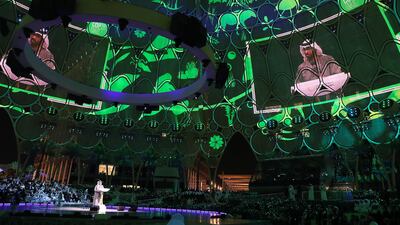
Dr Sultan Al Jaber, Minister of Industry and Advanced Technology and Cop28 President-designate, speaking at the Road to Cop28 launch event at Al Wasl Plaza, Expo City Dubai. All photos: Pawan Singh / The National -
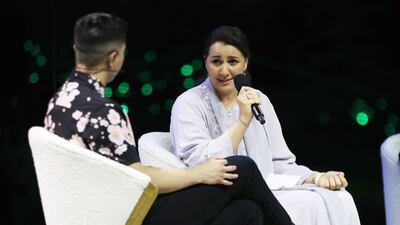
Minister of Climate Change and Environment Mariam Al Mheiri in conversation on stage at the event -

Ms Al Mheiri with Minister of Community Development and and Cop28 Youth Climate Champion Shamma Al Mazrui, Youngo spokeswoman and lead on nationally determined contributions working group Shreya KC and UN climate change high-level champion Razan Al Mubarak, in discussion on stage -
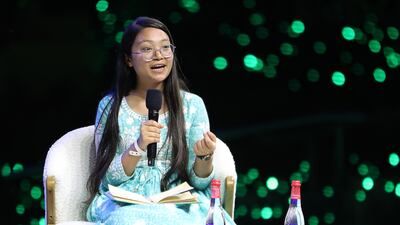
Shreya KC, a Nepali climate justice activist, addresses the event at Al Wasl Plaza -
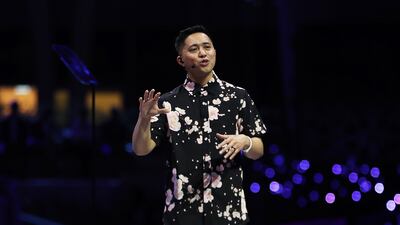
Filipino award-winning poet, rapper and climate artist Meta Sarmiento on stage at the event -
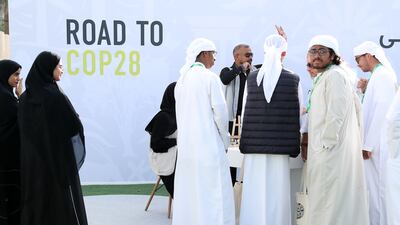
Visitors at the Road to Cop28 launch event -
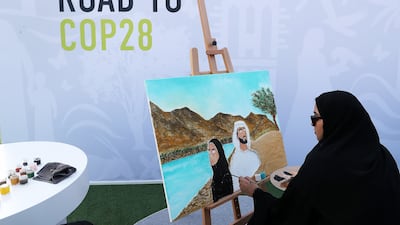
An artist at work on an Emirati scene at the Road to Cop28 launch -
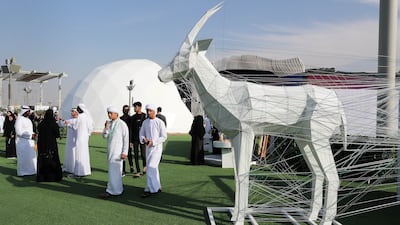
A model of an onyx – a UAE conservation success story – at the launch event -
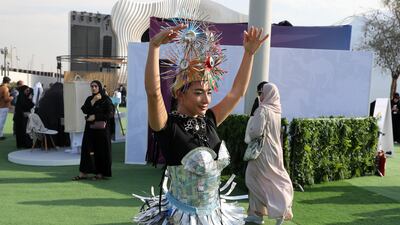
A performer wearing a dress made from recycled material at the Road to Cop28 launch event at Al Wasl Plaza, Expo City Dubai


Both sides said they were working to ensure Cop28 was the most inclusive conference to date and all parties had been contacted to encourage “increased participation and meaningful engagement of youth, women, local communities and indigenous peoples as members of party and observer delegations to Cop and in climate decision-making, policy and action”.
Crucial global gathering
Organisers expect up to 70,000, from heads of states to youth advocates, to converge on the venue for the talks to tackle the escalating climate emergency. Cops also typically see vibrant calls to action from groups and organisations from across the climate landscape.
“The Cop28 plan of action is centred around fast-tracking a just, equitable and orderly energy transition; fixing climate finance; focusing on people, lives and livelihoods; and underpinning everything with full inclusivity,” said Dr Al Jaber.
“The Cop28 presidency believes inclusivity is a critical enabler to achieving transformative progress across the climate agenda.
“Only by rising above our differences and working together can we raise our shared ambition and deliver progress to keep 1.5°C within reach.”
Mr Stiell said he was firmly committed to ensuring UN values are upheld at Cops.
“We are also making every effort on our part to ensure that this will be a Cop process where the voices of youth, women, local communities, indigenous peoples and those most impacted by climate change will be heard and reflected within the process,” he said.
Dr Al Jaber, who is also Minister of Industry and Advanced Technology and managing director and group chief executive of Adnoc, said in July that Cop28 will be based around four pillars – fast-tracking the energy transition, fixing climate finance, focusing on people and making inclusivity a hallmark of the summit.
He said the “north star” of his plan would be keeping the Paris Agreement target of limiting global warming to 1.5°C on pre-industrial levels within reach.
Other major issues at the crunch talks are expected to be mitigation (UN parlance for cutting warming emissions), scaling up climate funding and how to bring into operation the loss and damage fund agreed at Cop27 in Egypt last year.
Cop28 will also see the first ever “global stocktake” of progress in limiting climate change.

