


The tropics lost an area of primary forest almost the size of Switzerland last year, according to recent figures from the World Resources Institute.
Despite decades-long campaigns against deforestation and in the face of temperature increases in part driven by the felling of forests, 3.7 million hectares were cleared.
CEO of the Rainforest Trust
The WRI said there were increases in deforestation in Bolivia, Laos and Nicaragua in 2023, but Brazil and Colombia both significantly reduced the amount of logging.
According to the environmental organisation WWF, forest destruction accounts for about 10 per cent of the temperature increases the world is experiencing, because it causes the release of vast amounts of carbon that had been stored by the trees.
Estimates suggest 137 animal and plant species are driven to extinction each day as a result of deforestation, with creatures that see their habitat destroyed having nowhere else to go.
Why it's happening
Much of the destruction is blamed on clearances for agriculture and the growing of crops, including soya, which is often to feed animals, and palm oil.
A key issue is what Georg Winkel, professor of forest and nature conservation policy at Wageningen University and Research in the Netherlands, describes as “imported and exported” deforestation.
Countries may deforest their own territory to produce goods or commodities that are exported to other nations.
Linked to this is the forest transition theory, which suggests that forest cover falls most rapidly when a developing country is experiencing its fastest economic and demographic (or population) growth.
Later, once a country is richer and its population has stabilised, forest cover may rebound slightly, with the country importing goods that have been produced through deforestation in other nations.

Prof Winkel described international trade patterns as “important drivers” of logging and said tackling them was central to efforts to reduce deforestation.
“We have global production of agricultural commodities, where land seems to be available, forests are not protected and land seems fertile,” Prof Winkel said.
“From an environmental perspective we want to make sure these large-scale old forests remain for the future because of the biodiversity and carbon storage, but populations are growing and there’s an interest in the population in becoming wealthy.”
Hope remains
Brazil, home to the Amazon basin, one of the most prized and threatened areas of primary rainforest in the world, has seen its deforestation rates fall thanks to a clampdown on illegal logging by the country’s president, Luiz Inacio Lula da Silva, who returned to power at the beginning of 2023. In Gustavo Petro, Colombia too has a president keen to reduce deforestation.
In response to the WRI report, Dr James Deutsch, chief executive of the Rainforest Trust, said the statistics showed that deforestation could be slowed or stopped “given high-level political leadership, good governance and direct action”.
“Community support is key, and conservation areas, including indigenous territories and titled land, remain our best tool for halting deforestation,” he added.
Meanwhile, the EU is aiming to reduce its contribution to deforestation by introducing the EU Deforestation Regulation (EUDR), which the European Commission, has called “an important turning point in the global fight against deforestation”.
Due by the end of 2024, it would bar key commodities, including palm oil, rubber and coffee, from being imported into the EU if their production has contributed to deforestation.
The UK has also announced regulations aimed at stopping imports of essential commodities linked to illegal deforestation.
Challenges to come
The EU’s rules have faced pushback from countries that export to the bloc as well as from trade associations. As a result, implementation is likely to be gradual.
One potential consequence of the rules could be that suppliers develop separate supply chains, said Dr Kristjan Jespersen, an associate professor at the Copenhagen Business School in Denmark and the chief Engagement officer at Loh-Grønager Partners, a London-based hedge fund.
“[There could be] clean products going to Europe and deforestation products being sent to other parts of the world that are not as demanding. That’s the tension happening right now,” he said.
“If you have people willing to pay the same price but with less regulatory requirements, you will see products [going] to China or India, where the [consumers] are more price sensitive … The producers are very rational and will distribute their products globally.”
Organisations including the Rainforest Alliance and the Fair Trade Advocacy Office, while welcoming the EU’s rules, have said that smallholders – who produce a third of the world’s food – must not “bear a disproportionate burden for compliance” or risk being pushed out of the market.
Brazil in transition
Prof Winkel suggested that Brazil may be moving towards the later stages of the development process, evidenced by a slowing of its population growth.
In the early 1960s, the country’s population was increasing by about three per cent a year, but the rate now is about 0.5 per cent.
“Brazil and other forest-rich emerging economies have become more wealthy and population growth slowed down,” Prof Winkel said.

“There’s lots of inequality, but I’m carefully optimistic there will be a forest transition and large parts of the Amazon will remain forested, but part will be secondary forest, managed forest.
“Policies tackling harmful investments and trade, and consumers that are sensitive to environmental issues, will play a key role there as well.”
An African future
Prof Winkel said there may be even greater pressure in future on forested areas of Africa, such as the Congo Basin, which is the continent's largest forested area and stores more carbon than even the Amazon.
The UN Environment Programme states that the basin’s peat swamps alone contain about 29 billion tonnes of carbon – equivalent of three years’ worth of global greenhouse emissions.
Each year the whole basin absorbs about 1.5 billion tonnes of carbon, which is well over twice the annual emissions of Saudi Arabia.
Africa is experiencing some of the fastest population growth in the world; jumping from about 818 million in 2000 to 1.39 billion in 2020, and the UN forecasts that, by the middle of the century, it will have reached 2.5 billion.
This, Prof Winkel said, will inevitably lead to more challenges down the line.
“In the end, it’s more and more people plus our human desire to consume more and more, and capitalist logic of exploring and investing in land where it is still available, that drives deforestation,” he said.
“There is no easy solution to these challenges but we have to tackle them from different perspectives.”
Climate tipping points – in pictures
-

An aerial shot of the Great Barrier Reef in Australia, showing parts of the reef that has been subjected to coral bleaching. -

A house located on land that has been deformed by permafrost thaw at a former airfield in Churapcha, Russia. Reuters -

Native vegetation has been cut down to give space for eucalyptus plantations in the Setubinha region in Brazil. AFP -
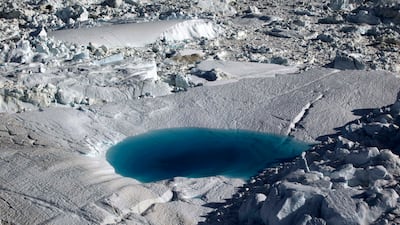
A large melt pool forms in the Ilulissat ice fjord below the Jakobshavn Glacier at the fringe of the Greenland ice sheet. AP -
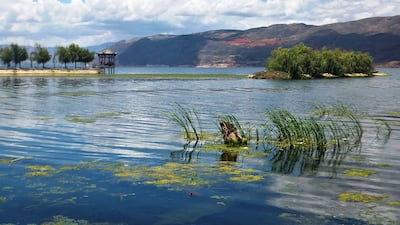
Lake Erhai in China has become eutrophic (where an entire body of water becomes enriched with nutrients and minerals) which caused algal growth that destroyed other life. Photo: Ronan O'Connell -
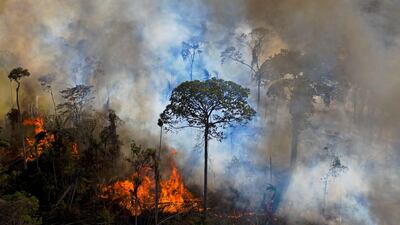
Deforestation in Para state, Brazil. AFP -
Moai statues in Easter Island, Chile, were damaged after a wildfire. Reuters



