

Live updates: Follow the latest news on Cop28
Hundreds of millions of dollars have been pledged towards eradicating neglected tropical diseases that blight lives in the developing world.
UAE President Sheikh Mohamed and billionaire philanthropist Bill Gates each donated $100 million, with hundreds of millions more from donor nations.
In an exclusive interview with The National, Bill Gates said “Climate change is a headwind against the incredible progress we've made in health.
“If money is scarce, we have to prioritise the [causes] that are highly impactful, including in the health area things like vaccines, or these donated drugs that we get for neglected diseases.
chief executive, World Mosquito Programme
"These are incredibly high-impact.”
In total, donors pledged more than $777 million to defeat NTDs and improve the lives of 1.6 billion people.
Reaching the Last Mile, the philanthropic foundation launched by Sheikh Mohamed, joined with the Bill and Melinda Gates Foundation to announce a milestone expansion of the Reaching the Last Mile Fund to $500 million to eliminate two NTDs from Africa.
The UAE committed a further $100 million to the fund created to fight the diseases of river blindness and lymphatic filariasis, commonly known as elephantiasis, that causes painful swelling of limbs. This was matched by the Gates Foundation.
'This agenda is often neglected'
"Having this moment during Cop, really elevated tropical diseases on the global agenda, and is vital to achieving our goals," said Tala AlRamahi, chief strategy officer of Reaching the Last Mile.
"This agenda is often neglected. It's not just neglected diseases but people. We cannot afford to neglect, so everyone can live a dignified life."
The Reaching the Last Mile Fund was launched in 2017 to eliminate the two specific NTDs from seven countries, six in Africa, as well as Yemen.
Since its launch, more than 100 million treatments have been delivered to people in need, with the initiative now expanding to accelerate progress to 39 African countries.
“The UAE is proud to host this pivotal conference and expresses gratitude to all those who have seized the opportunity to renew their commitment to end neglected tropical diseases,” said Sheikh Abdullah bin Zayed, Minister of Foreign Affairs.
-
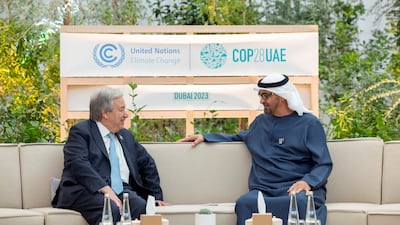
President Sheikh Mohamed and UN Secretary General Antonio Guterres hold a meeting at the Cop28 summit in Dubai. Photo: UAE Presidential Court -
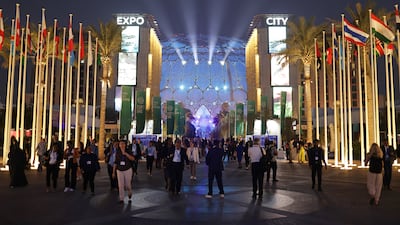
Participants walk among flagpoles on day four of the Cop28 summit in Dubai. Getty Images -
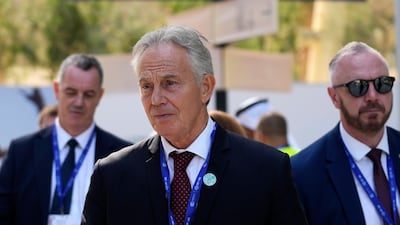
Britain's former prime minister Tony Blair at the summit. AP -
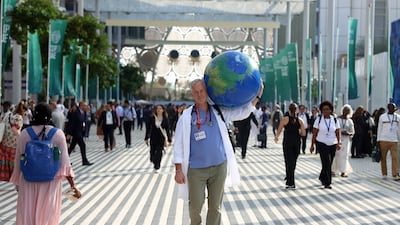
Joseph Vipond from the Canadian Association of Physicians for the Environment crosses the Blue Zone. Getty Images -
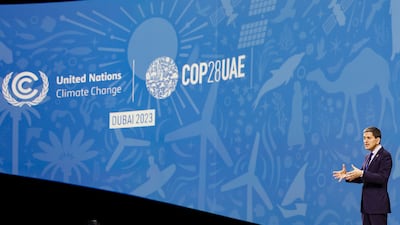
David Miliband, president and chief executive of the International Rescue Committee, addresses a session at Cop28. Getty Images -
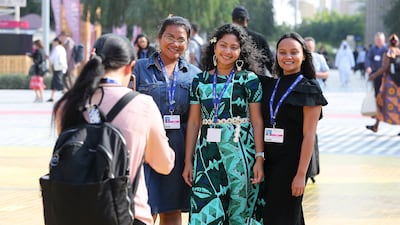
Delegates are photographed in the Blue Zone on the fourth day of Cop28. Pawan Singh / The National -
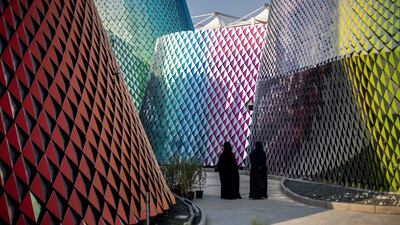
Participants walk at Expo City Dubai. EPA -

Sheikh Abdullah bin Zayed, Minister of Foreign Affairs, Microsoft co-founder Bill Gates, Tanzanian President Samia Hassan and Reem Al Hashimy, Minister of State for International Co-operation, attend the Reaching the Last Mile Forum held alongside Cop28. Reuters -
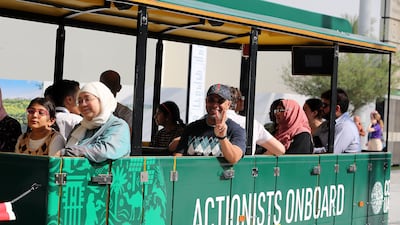
Cop28 visitors ride a train in the Green Zone at Expo City Dubai. Pawan Singh / The National -

Visitors in the Green Zone at Expo City Dubai. Pawan Singh / The National -

Visitors ride an electric cart in the Green Zone. Pawan Singh / The National -
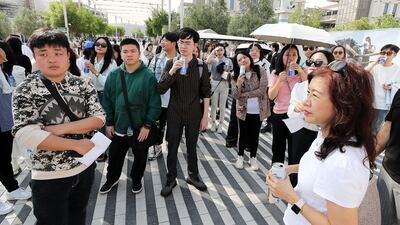
Located in the Sustainability District, the Green Zone will host a wide variety of events and workshops until the final day of Cop28 on December 12. Pawan Singh / The National -
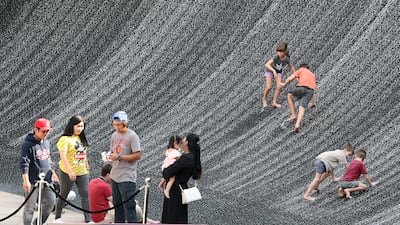
Visitors at the water feature in the Green Zone. Pawan Singh / The National -
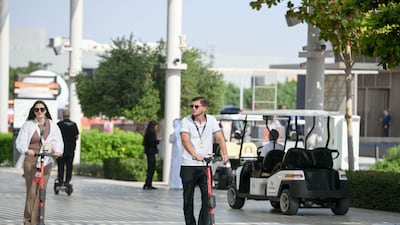
Members of the public ride electric scooters in the Green Zone. Khushnum Bhandari / The National -
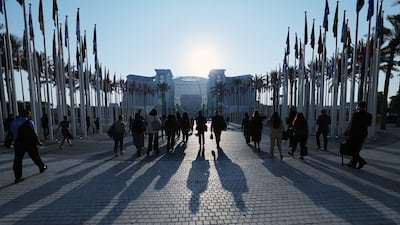
People arrive for the fourth day of the Cop28 summit at Expo City Dubai. EPA -

A welcome sign at the Cop28 venue. AP -
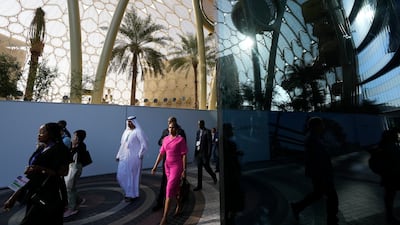
People walk through the site near Al Wasl Dome. AP -
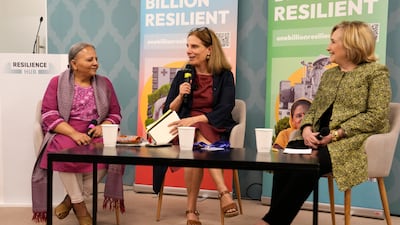
Eleni Myrivili, global chief heat officer at UN Habitat, with former US secretary of state Hillary Clinton and Indian social worker Reema Nanavaty at the Resilience Hub. AP -
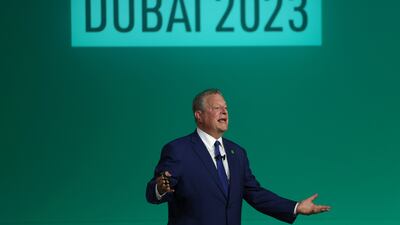
Al Gore, environmentalist and former US vice president, presents the Climate Trace global greenhouse gases emissions database on day four of Cop28. Getty Images -
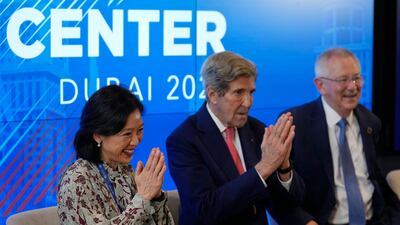
Elizabeth Yee and John Kerry, US Special Presidential Envoy for Climate, at a session at the US Centre. AP -
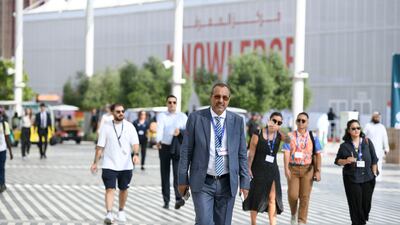
About 200 countries are taking part in the Cop28 talks. Khushnum Bhandari / The National -
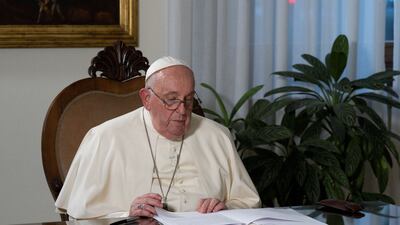
Pope Francis records a video message to be broadcast during the inauguration of the Faith Pavilion, at Casa Santa Marta, in the Vatican. Reuters -

Dr Tedros Ghebreyesus, Director General of the World Health Organisation, speaks at the Health Day opening session. Getty Images -
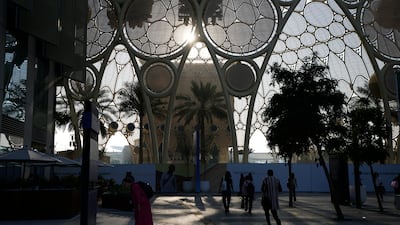
Attendees arrive at the Cop28 summit. AP -
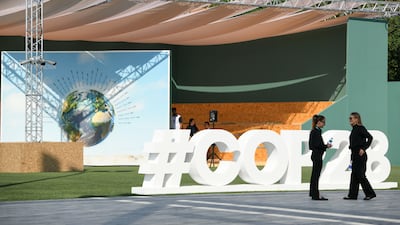
The Voice Action hub for peaceful protesters at Cop28, Expo City, Dubai. Khushnum Bhandari / The National -
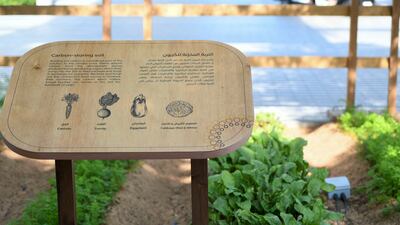
The Expo City farm, which will remain in operation after Cop28 ends. Khushnum Bhandari / The National


“Today’s demonstration of global solidarity reflects a shared determination to deliver a better and more dignified future for all. Incredible progress over the last two decades has proved that a world free of NTDs is an achievable goal."
The fund has also facilitated the training of 1.3 million health workers who have played a critical role in the elimination of transmission of river blindness.
“Despite this set of diseases being largely preventable and treatable, NTDs continue to pose a really significant challenge to human health and global development,” said Katey Owen, director of NTD and of vaccine development at the Bill and Melinda Gates Foundation.
“They cause painful disabilities and disfigurement and keep children from school. They keep adults from going to work and from participating in the social fabric of life.
“In the case of NTDs, we actually have the tools, the key is just deploying them.
“That takes scientific help and some policy work with the WHO but for the most part, it takes resources.”
Like dengue fever and malaria, elephantiasis is transmitted by mosquitoes that are being increasingly found in dense populations around the world.
Eradication milestones
River blindness, which is spread by black flies close to fast-flowing water, has been eradicated in Niger, an achievement once thought to be scientifically impossible in Africa. Senegal is also edging closer to reaching the same milestone.
Despite the progress, global shocks such as humanitarian crises driven by conflict, pandemics and climate change threaten to upend recent successes.
In Pakistan, since the devastating floods of 2022 that claimed the lives of 1739 people, viruses spread by mosquitoes have soared.
“It was truly heart-wrenching to see the devastation caused at a societal level and at an economic level,” said Pakistan Senator Dr Sania Nishtar, a former special adviser on poverty alleviation, who was speaking at the Last Mile Forum at Cop28.
“Health was a part of that. Since the floods, we have seen a 278 per cent increase in malaria cases and a 900 per cent increase in dengue.”
Once restricted to rural sub-Saharan Africa, mosquito-born viruses have exploded around the world.
Urbanisation fuelling the fire
A tourism boom this century that has seen international trips in Africa increase from around 800 million to 1.4 billion a year, are proliferating the spread of disease.
Rapid urbanisation is also threatening to put the world at risk, as the Aedes aegypti mosquito that carries tropical diseases thrives in densely populated areas.
“When we talk about NTDs, we are talking about a group of diseases predominantly in the tropical regions,” said Dr Ibrahima Sove Fall, director of the WHO Global Neglected Tropical Disease Programme.
“Entities like dengue and leprosy are not just diseases, but indicators of the perpetrator of poverty and social inequity.
“They are diseases of neglect and affect communities too often under the global health radar.
“We are witnessing how shifts in our climate are impacting the spread of these entities.
“This is real and I see that in dengue, with 100 countries worldwide now reporting transmissions.”
By 2050, three out of four people are expected to live in cities, with more than 50 megacities with a population of more than 10 million expected to be in topical environments.
In the last 80 years, the number of countries reporting dengue fever have increased from three to 129, and a 3000 per cent increase in cases since 1970, up from about 100,000 to more than 4.2 million in 2019.
“Mosquitoes are whipping up into an enormous storm globally,” said Scott O’Neill, chief executive of the World Mosquito Programme.
“Billions of people are travelling by aeroplane every year and they're not travelling alone.
“There's problems with waste management, there's problems with water delivery and what we see is increasing local storage of water and with that, mosquito populations are booming."
Scientific solution
A solution to the storm aims to prevent it continuing to ravage, while limiting its velocity and intensity.
By introducing a bacteria called Wolbachia into mosquito populations, a naturally occurring insect bacteria, mosquitoes are prevented from transmitting RNA viruses.
Since mosquitoes containing Wolbachia were released in northern Australia 13 years ago, dengue transmission has stopped altogether.
“By introducing Wolbachia, a mosquito bites a person that doesn't have dengue and there's no transmission,” said Mr O’Neill.
“We get a complete block of the virus within the body of the mosquito.
“And not only that, the Wolbachia gets passed from generation to generation in the mosquitoes.
“With this, we can prevent this storm that is brewing.
“Dengue is about to hit the shores of Europe, North America and Japan as it's been ravaging the tropics of the world for the last 30 or 40 years.”

