

At a cremation ground on the banks of the Ganges in Ballia, a district in India's northern state of Uttar Pradesh, head priest Pappu Pandey counts the cost of extreme weather in the area.
As a vicious combination of extreme heat and punishing humidity blanketed the region before the arrival of the seasonal monsoon, the area filled with funeral pyres.
One of Mr Pandey's jobs is to keep a count of the bodies. Deaths doubled to about 50 a day at the peak of the heatwave in mid-June – numbers he has not seen in 20 years, other than during the pandemic, he said.
“It was like a divine curse,” Mr Pandey said.
-

People suffering from heat-related ailments in the district hospital in Ballia, Uttar Pradesh state, India. All photos: AP -

Victims of the heat in Ballia, Uttar Pradesh state -

A woman wipes the head of her ailing husband at the hospital in Ballia -

A nomadic family rests in shade outside their tent in Lalitpur district in the northern state of Uttar Pradesh, India -
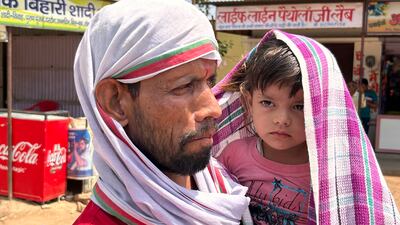
A man and a child covered with scarves to shield themselves from the blazing sunshine in Lalitpur, Uttar Pradesh state -

People crowd round a hospital desk in Ballia district -

A villager in Ballia district sprays water on his livestock to cool them down -

People queue to register outside the district hospital in Ballia -

A father tries to pacify his heat-affected daughter at the government district hospital in Ballia -
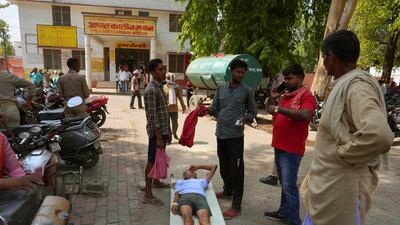
An elderly patient waiting to be admitted to hospital in Ballia -

A ward at the district hospital in Ballia -

A milkman with containers covered with wet jute sacks to protect the milk from the severe heat in Lalitpur, Uttar Pradesh state


The sweltering June weather, when the mercury soars as high as 46ºC, is forecast to worsen.
Scientists estimate climate change has made periods of extreme heat 30 times more likely in India and the World Bank said the country could be one of the first places where heatwaves breach the human survivability threshold.
Reports of a sharp increase in deaths among the most vulnerable in society have raised concerns about how the authorities can prepare for such extreme conditions.
As well as the human cost, failure to tackle the challenge could pose a risk to India’s economy.
McKinsey Global Institute estimates that the labour lost due to extreme heat in sectors such as construction and agriculture could put up to 4.5 per cent of India’s gross domestic product at risk by 2030.
“I have never seen such heat in my entire lifetime,” said C P Thakur, 91, a physician and former Indian health minister.
“It is worrying that so many people have died.”
Disputed death tolls
The exact death toll from the heatwave is not known, but some have suggested it is in the hundreds. Government representatives say the figure is lower.
Medical authorities have resisted directly connecting the weather with deaths, referring instead to people’s ages and health concerns.
One practical problem is that there may be several reasons behind the deaths, said Ronita Bardhan, associate professor of sustainable built environment at the University of Cambridge.
If somebody with an underlying health condition such as diabetes, which makes them more prone to dehydration, dies on a day of 45ºC temperatures, was it diabetes or the heat that killed them?
associate professor of sustainable built environment, University of Cambridge
“It is very challenging to establish a direct correlation between deaths and extreme heat as there is no diagnostic test for heat stroke,” Ms Bardhan said.
A further complication is that less than a fifth of deaths in India are certified by a medical professional.
In north-eastern Bihar state, where the recent heatwave has also been felt, authorities estimate that 52 per cent of all deaths were officially recorded in 2019.
More than 11,000 people died from heat stroke between 2012 and 2021, data from the National Crime Records Bureau has shown.
Heatwaves also hit the poor hardest, a group that is least likely to be recorded in the statistics.
Many poor people work outside, do not have access to well-ventilated housing or air conditioning and tend to avoid going to hospital.
Sree Ram, 55, a mason in Bharauli village, about 35km from Ballia, became ill in early June after working in the heat. He makes 500 rupees ($6) a day.
When the heat became unbearable, he took a few days off – a heavy financial burden for his family.
Many others decided they could not, and they were the most common victims of the sweltering summer, health officials said.
Coping with heat
There is no agreement on whether such deaths are a consequence of inadequate preparation, general underinvestment in health care or simply the daunting challenges of the situation.
It has been an extremely hot year across Asia, with record temperatures in places such as Singapore and Vietnam.
India reported its hottest February since 1901 and forecasters issued warnings about the high heat and humidity in advance.
In March, Prime Minister Narendra Modi led a high-level meeting to review preparations for hot weather and ordered officials to produce information for the public.
Many states and districts have heat action plans in place.
Standard operating procedures in Uttar Pradesh include instructions to provide shade for stray animals.
But local media has reported that medical centres have been overwhelmed by a surge in patients suffering from high fever and diarrhoea – common symptoms of heat stroke.
There has also been inconsistent power supplies as the grid struggled to cope with the surge in demand.
In Bihar, people said heat alerts by the government were erratic. While some said they received an occasional text message in April or May, most said the alerts became more frequent only after the heat peaked and the death toll in hospitals rose.
State officials have rejected the suggestion they were caught out.
Ravindra Kumar, district magistrate in Ballia, said authorities had a tried-and-tested warning system that is followed every year for all natural calamities.
Ranjeet Kumar, chief health surveillance officer for Bihar, said officials began to inform people about heat protection in March and made ample preparations in hospitals.
“People are well aware of these do's and don'ts,” Mr Kumar said. “But they have to step out for work.”
One of the few places in India where there is any mechanism for day labourers to recoup earnings if they heed advice to stay inside is in the western city of Ahmedabad.
A pilot project there has experimented with an insurance scheme in which women can receive payouts whenever heat makes it impossible to work outdoors.
It is funded by the Adrienne Arsht-Rockefeller Foundation Resilience Centre.

A key question is whether the heat plans go far enough. When researchers at the Centre for Policy Research in New Delhi reviewed 37 plans in a report, they found significant gaps.
About a third discussed funding sources and few identified vulnerable populations and how to distribute resources. Most were not statutory documents and lacked clear legal authority.
“Heatwaves have historically received less attention compared to other disasters,” said Aditi Madan, associate fellow at the Institute for Human Development.
While the plans demonstrate progress, the recent deaths should “serve as a stark reminder of the necessity for proactive measures by the government”, she said.
The risks of not allocating more resources may change as extreme heat becomes more common and more cities start to experience dangerous summer highs.
The planet has been scorched by eight of the warmest years on record. Last year, temperatures in the country hit a record 49ºC.
In its report on heat action plans, the CPR think tank said that by 2050, 24 urban centres were projected to breach average summer highs of at least 35ºC.
“Many places that need to have local heat action plans do not have one,” said Aditya Pillai, lead author of the report.
He said that among the cities not to publish comprehensive plans are many of India’s biggest metropolitan areas – and drivers of its economy – including Chennai, Mumbai and New Delhi.

