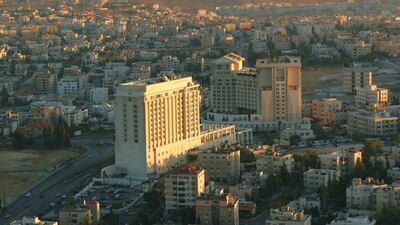
The Amman skyline. Venture capital firm Flat6Labs on Wednesday said it will support up to 90 startups over a period of five years in Jordan. Courtesy: Four Seasons Hotel Amman

Flat6Labs launches $20m fund to support early stage start-ups in Jordan


Fareed Rahman
  • English
  • Arabic

Cairo-based venture capital firm Flat6Labs is launching a new $20 million fund to support early stage start-ups in Jordan.

The Jordan Seed Fund (JSF) will support up to 90 start-ups over a period of five years, the venture capital firm said in a statement on Wednesday.

“Flat6Labs is well placed to support the aspirations of the kingdom’s talented entrepreneurs and help them take their businesses to the next level,” Ramez El Serafy, Flat6Labs chief executive, said. “We aim to support the growth and development of Jordan’s start-up ecosystem and thus contribute to a thriving national economy.”

The JSF has already attracted $7.4m worth of investment ahead of its first close from prominent backers such as the International Finance Corporation (IFC), the Innovative Startups and SMEs Fund (ISSF), Beyond Capital, Jordan’s Bank Al-Etihad, and GMS Ventures & Investments. A fund's final close typically takes place within a year of its first close.

Flat6Labs will also establish a seed programme to nurture the growth and development of promising start-ups in sectors such as information and communication technologies, software, healthcare, digital content and games, renewable energy, big data and FinTech, among others.

Each of the start-ups chosen for the programme will receive tailored support designed to help them scale and grow their businesses, with the long-term goal of creating regional and global champions, the statement said.

The companies chosen will have the opportunity to benefit from a cash seed investment of up to 50,000 Jordanian dinars ($70,521), with potential follow-on funding of up to 120,000 dinars.

“Jordan is an attractive market for entrepreneurship and early stage capital given its young and increasingly urban population, high rates of technology adoption and increasing government support,” Abdullah Jefri, IFC’s country manager for the Levant, said.

“Addressing the funding gaps will help build a robust start-up ecosystem to tap into this potential and spur innovation and economic growth in Jordan and the region.”

Venture capital companies have in recent months stepped up the funding of start-ups that intend to ease coronavirus-induced business challenges through the use of innovative technology.

Start-ups in the Mena region secured $1.03bn in funding last year, 13 per cent more than in 2019, according to data platform Magnitt.

“ISSF has been mandated to improve the Jordanian entrepreneurial ecosystem through acting as a fund of funds and through facilitating the creation of new funds to serve the investment needs of entrepreneurs and start-ups along their journey towards success,” Laith Al-Qassem, chief executive at ISSF, said.

“Flat6Labs fills an important gap and role by providing studied equity capital starting from seed stage accompanied by competent hands-on incubation and mentoring, which will facilitate speedier and more focused growth in the investments they make.”

Set up in 2011, Flat6Labs manages a number of seed funds with total assets under management of more than $85m.

Strait of Hormuz

Fujairah is a crucial hub for fuel storage and is just outside the Strait of Hormuz, a vital shipping route linking Middle East oil producers to markets in Asia, Europe, North America and beyond.

The strait is 33 km wide at its narrowest point, but the shipping lane is just three km wide in either direction. Almost a fifth of oil consumed across the world passes through the strait.

Iran has repeatedly threatened to close the strait, a move that would risk inviting geopolitical and economic turmoil.

Last month, Iran issued a new warning that it would block the strait, if it was prevented from using the waterway following a US decision to end exemptions from sanctions for major Iranian oil importers.

Brief scores:

Kashima Antlers 0

River Plate 4

Zuculini 24', Martinez 73', 90 2', Borre 89' (pen)

The Dark Blue Winter Overcoat & Other Stories From the North
Edited and Introduced by Sjón and Ted Hodgkinson
Pushkin Press 

%20Ramez%20Gab%20Min%20El%20Akher
%3Cp%3E%3Cstrong%3ECreator%3A%3C%2Fstrong%3E%20Ramez%20Galal%3C%2Fp%3E%0A%3Cp%3E%3Cstrong%3EStarring%3A%3C%2Fstrong%3E%20Ramez%20Galal%3C%2Fp%3E%0A%3Cp%3E%3Cstrong%3EStreaming%20on%3A%20%3C%2Fstrong%3EMBC%20Shahid%3C%2Fp%3E%0A%3Cp%3E%3Cstrong%3ERating%3A%20%3C%2Fstrong%3E2.5%2F5%3C%2Fp%3E%0A
What can victims do?

Always use only regulated platforms

Stop all transactions and communication on suspicion

Save all evidence (screenshots, chat logs, transaction IDs)

Report to local authorities

Warn others to prevent further harm

Courtesy: Crystal Intelligence

Dengue%20fever%20symptoms
%3Cul%3E%0A%3Cli%3EHigh%20fever%3C%2Fli%3E%0A%3Cli%3EIntense%20pain%20behind%20your%20eyes%3C%2Fli%3E%0A%3Cli%3ESevere%20headache%3C%2Fli%3E%0A%3Cli%3EMuscle%20and%20joint%20pains%3C%2Fli%3E%0A%3Cli%3ENausea%3C%2Fli%3E%0A%3Cli%3EVomiting%3C%2Fli%3E%0A%3Cli%3ESwollen%20glands%3C%2Fli%3E%0A%3Cli%3ERash%3C%2Fli%3E%0A%3C%2Ful%3E%0A%3Cp%3EIf%20symptoms%20occur%2C%20they%20usually%20last%20for%20two-seven%20days%3C%2Fp%3E%0A
The burning issue

The internal combustion engine is facing a watershed moment – major manufacturer Volvo is to stop producing petroleum-powered vehicles by 2021 and countries in Europe, including the UK, have vowed to ban their sale before 2040. The National takes a look at the story of one of the most successful technologies of the last 100 years and how it has impacted life in the UAE.

Part three: an affection for classic cars lives on

Read part two: how climate change drove the race for an alternative 

Read part one: how cars came to the UAE

Farage on Muslim Brotherhood

Nigel Farage told Reform's annual conference that the party will proscribe the Muslim Brotherhood if he becomes Prime Minister.
"We will stop dangerous organisations with links to terrorism operating in our country," he said. "Quite why we've been so gutless about this – both Labour and Conservative – I don't know.
“All across the Middle East, countries have banned and proscribed the Muslim Brotherhood as a dangerous organisation. We will do the very same.”
It is 10 years since a ground-breaking report into the Muslim Brotherhood by Sir John Jenkins.
Among the former diplomat's findings was an assessment that “the use of extreme violence in the pursuit of the perfect Islamic society” has “never been institutionally disowned” by the movement.
The prime minister at the time, David Cameron, who commissioned the report, said membership or association with the Muslim Brotherhood was a "possible indicator of extremism" but it would not be banned.

What%20is%20Dungeons%20%26%20Dragons%3F%20
%3Cp%3EDungeons%20%26amp%3B%20Dragons%20began%20as%20an%20interactive%20game%20which%20would%20be%20set%20up%20on%20a%20table%20in%201974.%20One%20player%20takes%20on%20the%20role%20of%20dungeon%20master%2C%20who%20directs%20the%20game%2C%20while%20the%20other%20players%20each%20portray%20a%20character%2C%20determining%20its%20species%2C%20occupation%20and%20moral%20and%20ethical%20outlook.%20They%20can%20choose%20the%20character%E2%80%99s%20abilities%2C%20such%20as%20strength%2C%20constitution%2C%20dexterity%2C%20intelligence%2C%20wisdom%20and%20charisma.%20In%20layman%E2%80%99s%20terms%2C%20the%20winner%20is%20the%20one%20who%20amasses%20the%20highest%20score.%3C%2Fp%3E%0A
Ms Yang's top tips for parents new to the UAE
  1. Join parent networks
  2. Look beyond school fees
  3. Keep an open mind
Who has lived at The Bishops Avenue?
  • George Sainsbury of the supermarket dynasty, sugar magnate William Park Lyle and actress Dame Gracie Fields were residents in the 1930s when the street was only known as ‘Millionaires’ Row’.
  • Then came the international super rich, including the last king of Greece, Constantine II, the Sultan of Brunei and Indian steel magnate Lakshmi Mittal who was at one point ranked the third richest person in the world.
  • Turkish tycoon Halis Torprak sold his mansion for £50m in 2008 after spending just two days there. The House of Saud sold 10 properties on the road in 2013 for almost £80m.
  • Other residents have included Iraqi businessman Nemir Kirdar, singer Ariana Grande, holiday camp impresario Sir Billy Butlin, businessman Asil Nadir, Paul McCartney’s former wife Heather Mills. 
Hunting park to luxury living
  • Land was originally the Bishop of London's hunting park, hence the name
  • The road was laid out in the mid 19th Century, meandering through woodland and farmland
  • Its earliest houses at the turn of the 20th Century were substantial detached properties with extensive grounds


Ruwais timeline

1971 Abu Dhabi National Oil Company established

1980 Ruwais Housing Complex built, located 10 kilometres away from industrial plants

1982 120,000 bpd capacity Ruwais refinery complex officially inaugurated by the founder of the UAE Sheikh Zayed

1984 Second phase of Ruwais Housing Complex built. Today the 7,000-unit complex houses some 24,000 people.  

1985 The refinery is expanded with the commissioning of a 27,000 b/d hydro cracker complex

2009 Plans announced to build $1.2 billion fertilizer plant in Ruwais, producing urea

2010 Adnoc awards $10bn contracts for expansion of Ruwais refinery, to double capacity from 415,000 bpd

2014 Ruwais 261-outlet shopping mall opens

2014 Production starts at newly expanded Ruwais refinery, providing jet fuel and diesel and allowing the UAE to be self-sufficient for petrol supplies

2014 Etihad Rail begins transportation of sulphur from Shah and Habshan to Ruwais for export

2017 Aldar Academies to operate Adnoc’s schools including in Ruwais from September. Eight schools operate in total within the housing complex.

2018 Adnoc announces plans to invest $3.1 billion on upgrading its Ruwais refinery 

2018 NMC Healthcare selected to manage operations of Ruwais Hospital

2018 Adnoc announces new downstream strategy at event in Abu Dhabi on May 13

Source: The National

While you're here
Results:

CSIL 2-star 145cm One Round with Jump-Off

1.           Alice Debany Clero (USA) on Amareusa S 38.83 seconds

2.           Anikka Sande (NOR) For Cash 2 39.09

3.           Georgia Tame (GBR) Cash Up 39.42

4.           Nadia Taryam (UAE) Askaria 3 39.63

5.           Miriam Schneider (GER) Fidelius G 47.74

Mercer, the investment consulting arm of US services company Marsh & McLennan, expects its wealth division to at least double its assets under management (AUM) in the Middle East as wealth in the region continues to grow despite economic headwinds, a company official said.

Mercer Wealth, which globally has $160 billion in AUM, plans to boost its AUM in the region to $2-$3bn in the next 2-3 years from the present $1bn, said Yasir AbuShaban, a Dubai-based principal with Mercer Wealth.

Within the next two to three years, we are looking at reaching $2 to $3 billion as a conservative estimate and we do see an opportunity to do so,” said Mr AbuShaban.

Mercer does not directly make investments, but allocates clients’ money they have discretion to, to professional asset managers. They also provide advice to clients.

“We have buying power. We can negotiate on their (client’s) behalf with asset managers to provide them lower fees than they otherwise would have to get on their own,” he added.

Mercer Wealth’s clients include sovereign wealth funds, family offices, and insurance companies among others.

From its office in Dubai, Mercer also looks after Africa, India and Turkey, where they also see opportunity for growth.

Wealth creation in Middle East and Africa (MEA) grew 8.5 per cent to $8.1 trillion last year from $7.5tn in 2015, higher than last year’s global average of 6 per cent and the second-highest growth in a region after Asia-Pacific which grew 9.9 per cent, according to consultancy Boston Consulting Group (BCG). In the region, where wealth grew just 1.9 per cent in 2015 compared with 2014, a pickup in oil prices has helped in wealth generation.

BCG is forecasting MEA wealth will rise to $12tn by 2021, growing at an annual average of 8 per cent.

Drivers of wealth generation in the region will be split evenly between new wealth creation and growth of performance of existing assets, according to BCG.

Another general trend in the region is clients’ looking for a comprehensive approach to investing, according to Mr AbuShaban.

“Institutional investors or some of the families are seeing a slowdown in the available capital they have to invest and in that sense they are looking at optimizing the way they manage their portfolios and making sure they are not investing haphazardly and different parts of their investment are working together,” said Mr AbuShaban.

Some clients also have a higher appetite for risk, given the low interest-rate environment that does not provide enough yield for some institutional investors. These clients are keen to invest in illiquid assets, such as private equity and infrastructure.

“What we have seen is a desire for higher returns in what has been a low-return environment specifically in various fixed income or bonds,” he said.

“In this environment, we have seen a de facto increase in the risk that clients are taking in things like illiquid investments, private equity investments, infrastructure and private debt, those kind of investments were higher illiquidity results in incrementally higher returns.”

The Abu Dhabi Investment Authority, one of the largest sovereign wealth funds, said in its 2016 report that has gradually increased its exposure in direct private equity and private credit transactions, mainly in Asian markets and especially in China and India. The authority’s private equity department focused on structured equities owing to “their defensive characteristics.”
