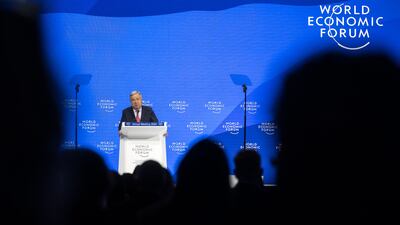
Microsoft CEO Satya Nadella spoke of his optimism for AI at the World Economic Forum in Davos. AFP

Davos: Microsoft boss backs AI for global good and highlights UAE classroom chatbot plans


Neil Murphy
  • English
  • Arabic

Microsoft chief executive Satya Nadella highlighted the UAE's plans to provide AI tutors in its classrooms as an example of how generative technology was "diffusing rapidly" and creating benefits for people around the world.

Speaking at the World Economic Forum in Davos, Mr Nadella said the proliferation of AI has been "fast and furious" but 2024 would be the year when the fledgling technology would eventually "scale".

Mr Nadella said machine-learning tools such as Open AI's ChatGPT and Microsoft's own CoPilot software should have a profound effect in the future, transforming industries such as health care, education and software.

He highlighted the UAE's plan to "roll out a personal tutor for every person in the country" as an example, adding that similar classroom initiatives might eventually be provided in other nations.

In March last year, the UAE's Ministry of Education said it was looking at plans to embrace AI and machine-learning technology by introducing AI-generated tutors.

Ahmad Al Falasi, Minister of Education, said the plans to use chatbot tutors, using tech similar to that offered by ChatGPT or Google Bard, was intended to assist teachers, not replace them.

Mr Nadella predicted the leap in AI would be most felt in scientific fields, helping cancer prevention and the creation of new high-tech materials.

"Science is where we will see real acceleration. If we can accelerate cures for diseases and other fundamental issues, all of these changes are going to be pretty profound," he said.

However, designers and engineers needed to be "mindful" about the risks of AI, and a "harmful divide" was not what the world needed.

He backed the creation of a global agency to oversee regulation of AI, saying these challenges required global norms and standards which would be otherwise hard to enforce.

Mr Nadella said the promise of generative AI could help people in all countries, particularly those in the Global South.

In the past 15 years the emergence of mobile and cloud-computing technology has taken place, radically changing people's lives for the better, he said.

However, he said the new generation of technology could have a similar effect in less than a decade.

"We've never had a broad general purpose technology that diffused around the world and created abundance equally," he said.

The 2024 World Economic Forum in Davos - in pictures

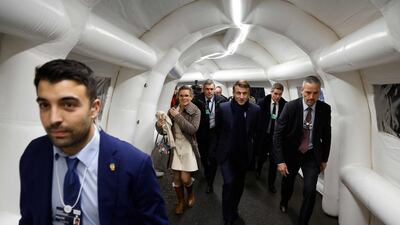
  • French President Emmanuel Macron (centre), flanked by delegation members, walks through an inflatable tunnel connecting venues at Davos. AFP
    French President Emmanuel Macron (centre), flanked by delegation members, walks through an inflatable tunnel connecting venues at Davos. AFP
  • Argentina's President Javier Milei. Reuters
    Argentina's President Javier Milei. Reuters
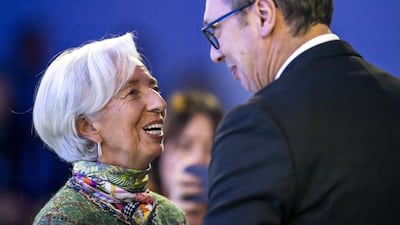
  • European Central Bank chief Christine Lagarde with Serbia's President Vucic. EPA
    European Central Bank chief Christine Lagarde with Serbia's President Vucic. EPA
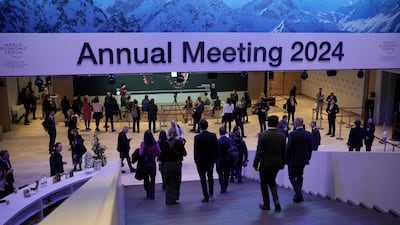
  • WEF participants gather at Davos Congress Centre. AP Photo
    WEF participants gather at Davos Congress Centre. AP Photo
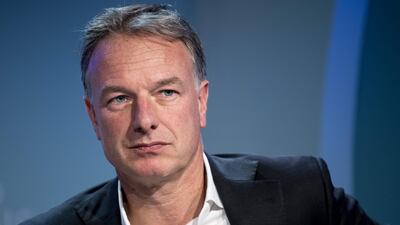
  • ING Group chief executive Steven van Rijswijk at the World Economic Forum gathering in Davos. AFP
    ING Group chief executive Steven van Rijswijk at the World Economic Forum gathering in Davos. AFP
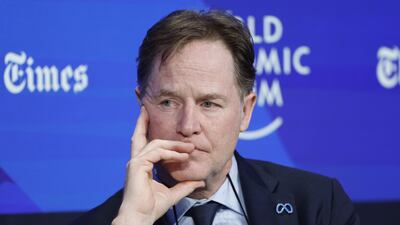
  • Nick Clegg, president of global affairs and communications with Meta at the WEF. Bloomberg
    Nick Clegg, president of global affairs and communications with Meta at the WEF. Bloomberg
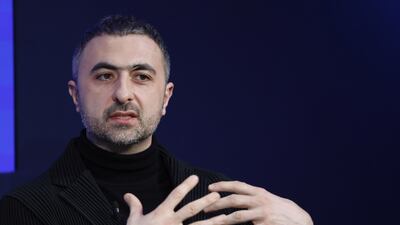
  • Mustafa Suleyman, co-founder and chief executive officer of Inflection AI, speaking at the event. Bloomberg
    Mustafa Suleyman, co-founder and chief executive officer of Inflection AI, speaking at the event. Bloomberg
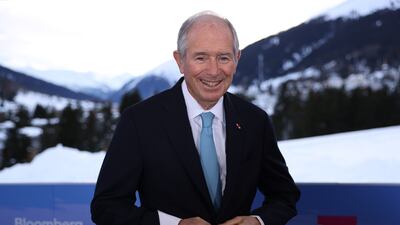
  • Steve Schwarzman, co-founder and chief executive officer of Blackstone Group, at the Swiss alpine resort. Bloomberg
    Steve Schwarzman, co-founder and chief executive officer of Blackstone Group, at the Swiss alpine resort. Bloomberg
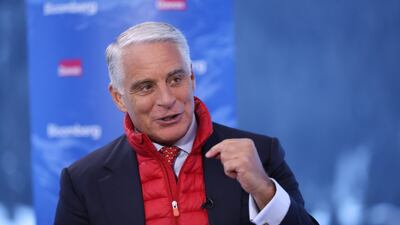
  • Andrea Orcel, group chief executive of Unicredit, speaking during an interview at the World Economic Forum in Davos, Switzerland. Bloomberg
    Andrea Orcel, group chief executive of Unicredit, speaking during an interview at the World Economic Forum in Davos, Switzerland. Bloomberg
  • Mike Brown, chief executive of Nedbank Group Ltd. Bloomberg
    Mike Brown, chief executive of Nedbank Group Ltd. Bloomberg
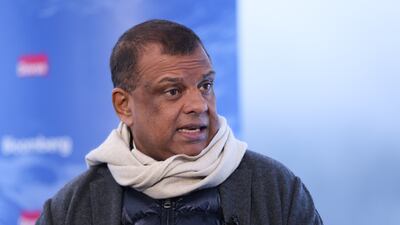
  • Tony Fernandes, chief executive Capital A Berhad. Bloomberg
    Tony Fernandes, chief executive Capital A Berhad. Bloomberg
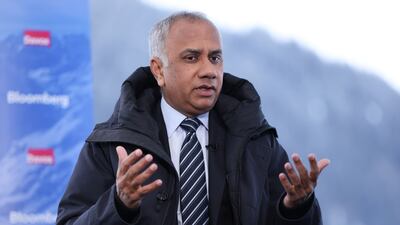
  • Salil Parekh, chief executive officer of Infosys. Bloomberg
    Salil Parekh, chief executive officer of Infosys. Bloomberg
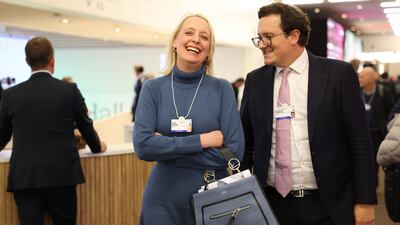
  • Julie Sweet, chief executive of Accenture, and Ludovic Subran, chief economist at Allianz SE. Bloomberg
    Julie Sweet, chief executive of Accenture, and Ludovic Subran, chief economist at Allianz SE. Bloomberg
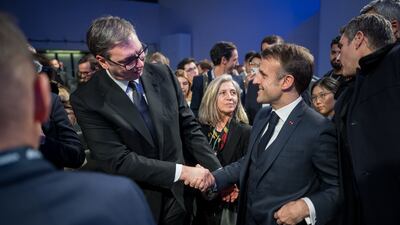
  • France's President Macron (right) shakes hand with Serbia's President Aleksandar Vucic after his speech. AFP
    France's President Macron (right) shakes hand with Serbia's President Aleksandar Vucic after his speech. AFP
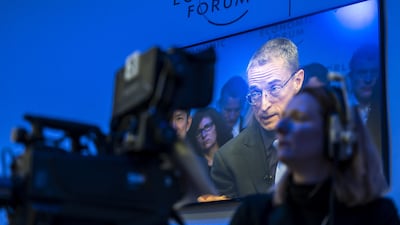
  • Pat Gelsinger, chief executive of Intel. EPA
    Pat Gelsinger, chief executive of Intel. EPA
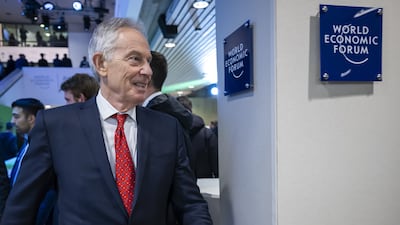
  • Former British prime minister Tony Blair. EPA
    Former British prime minister Tony Blair. EPA
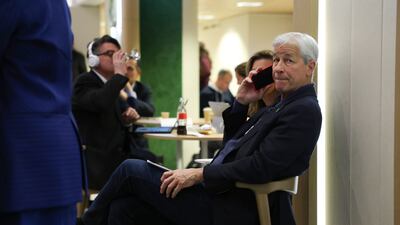
  • Jamie Dimon, chief executive of JP Morgan Chase. Bloomberg
    Jamie Dimon, chief executive of JP Morgan Chase. Bloomberg
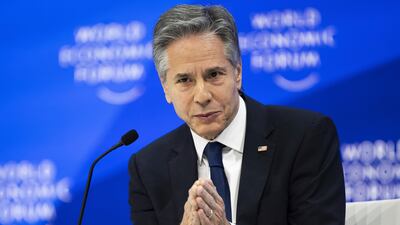
  • US Secretary of State Antony Blinken. AP
    US Secretary of State Antony Blinken. AP
  • Antonio Guterres, UN Secretary General, addresses the assembly. AFP
    Antonio Guterres, UN Secretary General, addresses the assembly. AFP
  • Former US vice president Al Gore speaks. Reuters
    Former US vice president Al Gore speaks. Reuters
CREW
%3Cp%3E%3Cstrong%3EDirector%3A%20%3C%2Fstrong%3ERajesh%20A%20Krishnan%3C%2Fp%3E%0A%3Cp%3E%3Cstrong%3EStarring%3A%20%3C%2Fstrong%3ETabu%2C%20Kareena%20Kapoor%20Khan%2C%20Kriti%20Sanon%26nbsp%3B%3C%2Fp%3E%0A%3Cp%3E%3Cstrong%3ERating%3A%3C%2Fstrong%3E%203.5%2F5%3C%2Fp%3E%0A
Iran's dirty tricks to dodge sanctions

There’s increased scrutiny on the tricks being used to keep commodities flowing to and from blacklisted countries. Here’s a description of how some work.

1 Going Dark

A common method to transport Iranian oil with stealth is to turn off the Automatic Identification System, an electronic device that pinpoints a ship’s location. Known as going dark, a vessel flicks the switch before berthing and typically reappears days later, masking the location of its load or discharge port.

2. Ship-to-Ship Transfers

A first vessel will take its clandestine cargo away from the country in question before transferring it to a waiting ship, all of this happening out of sight. The vessels will then sail in different directions. For about a third of Iranian exports, more than one tanker typically handles a load before it’s delivered to its final destination, analysts say.

3. Fake Destinations

Signaling the wrong destination to load or unload is another technique. Ships that intend to take cargo from Iran may indicate their loading ports in sanction-free places like Iraq. Ships can keep changing their destinations and end up not berthing at any of them.

4. Rebranded Barrels

Iranian barrels can also be rebranded as oil from a nation free from sanctions such as Iraq. The countries share fields along their border and the crude has similar characteristics. Oil from these deposits can be trucked out to another port and documents forged to hide Iran as the origin.

* Bloomberg

Our legal columnist

Name: Yousef Al Bahar

Advocate at Al Bahar & Associate Advocates and Legal Consultants, established in 1994

Education: Mr Al Bahar was born in 1979 and graduated in 2008 from the Judicial Institute. He took after his father, who was one of the first Emirati lawyers

The specs

Engine: 2.0-litre 4cyl turbo

Power: 261hp at 5,500rpm

Torque: 405Nm at 1,750-3,500rpm

Transmission: 9-speed auto

Fuel consumption: 6.9L/100km

On sale: Now

Price: From Dh117,059

GAC GS8 Specs

Engine: 2.0-litre 4cyl turbo

Power: 248hp at 5,200rpm

Torque: 400Nm at 1,750-4,000rpm

Transmission: 8-speed auto

Fuel consumption: 9.1L/100km

On sale: Now

Price: From Dh149,900

Specs

Engine: Dual-motor all-wheel-drive electric

Range: Up to 610km

Power: 905hp

Torque: 985Nm

Price: From Dh439,000

Available: Now

Trump v Khan

2016: Feud begins after Khan criticised Trump’s proposed Muslim travel ban to US

2017: Trump criticises Khan’s ‘no reason to be alarmed’ response to London Bridge terror attacks

2019: Trump calls Khan a “stone cold loser” before first state visit

2019: Trump tweets about “Khan’s Londonistan”, calling him “a national disgrace”

2022:  Khan’s office attributes rise in Islamophobic abuse against the major to hostility stoked during Trump’s presidency

July 2025 During a golfing trip to Scotland, Trump calls Khan “a nasty person”

Sept 2025 Trump blames Khan for London’s “stabbings and the dirt and the filth”.

Dec 2025 Trump suggests migrants got Khan elected, calls him a “horrible, vicious, disgusting mayor”

Traits of Chinese zodiac animals

Tiger:independent, successful, volatile
Rat:witty, creative, charming
Ox:diligent, perseverent, conservative
Rabbit:gracious, considerate, sensitive
Dragon:prosperous, brave, rash
Snake:calm, thoughtful, stubborn
Horse:faithful, energetic, carefree
Sheep:easy-going, peacemaker, curious
Monkey:family-orientated, clever, playful
Rooster:honest, confident, pompous
Dog:loyal, kind, perfectionist
Boar:loving, tolerant, indulgent   

Avatar: Fire and Ash

Director: James Cameron

Starring: Sam Worthington, Sigourney Weaver, Zoe Saldana

Rating: 4.5/5

Who is Tim-Berners Lee?

Sir Tim Berners-Lee was born in London in a household of mathematicians and computer scientists. Both his mother, Mary Lee, and father, Conway, were early computer scientists who worked on the Ferranti 1 - the world's first commercially-available, general purpose digital computer. Sir Tim studied Physics at the University of Oxford and held a series of roles developing code and building software before moving to Switzerland to work for Cern, the European Particle Physics laboratory. He developed the worldwide web code as a side project in 1989 as a global information-sharing system. After releasing the first web code in 1991, Cern made it open and free for all to use. Sir Tim now campaigns for initiatives to make sure the web remains open and accessible to all.

Updated: January 17, 2024, 4:53 AM