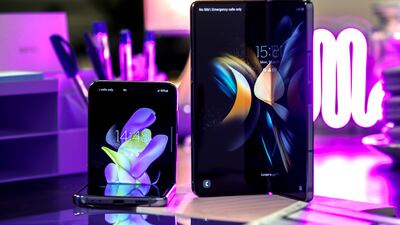
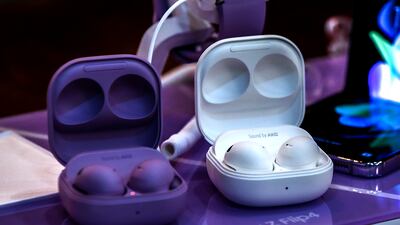
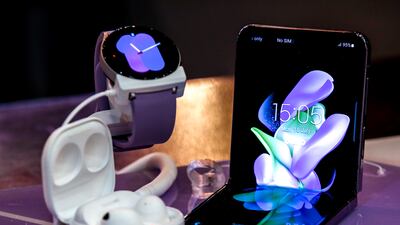
Global shipments of foldable smartphones are projected to surge by almost three quarters to around 16 million units this year.
The premium market shows resilience and steady demand, despite current economic headwinds, a new study from Counterpoint Research showed.
The 73 per cent annual growth from 2021's 9 million units would make this device category the fastest growing in the overall smartphone sector, and the momentum will continue with a further 44 per cent jump to 23 million units in 2023, the Hong Kong-based research company said.
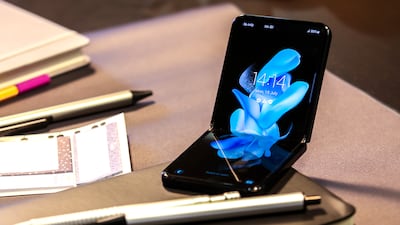
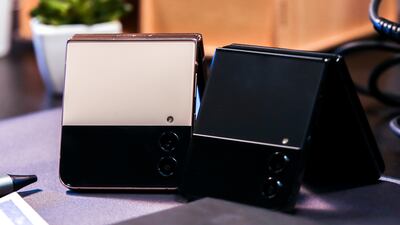
Samsung will continue to dominate the industry, and is expected to solidify its hold on top after it launched its new devices, the Galaxy Z Fold 4 and Flip 4, this week.
“Samsung has led the market since the beginning, and we think its dominance will continue for some time. Huawei, Oppo, Xiaomi and Vivo are all introducing new foldables but they are mostly limited to the Chinese market. Motorola may be the only contender in markets like the US for now,” Jene Park, a senior analyst at Counterpoint, wrote.
“We expect the new Galaxy Fold 4 and Flip 4 combo to continue Samsung’s momentum in the space and sell close to 9 million units this year, helping the company’s second-half foldables share to jump to 80 per cent.”
The growth in popularity of foldable smartphones has been largely attributed to Samsung, which pushed the category into the mainstream, starting with the original Fold in 2019.
While the category is growing, it still barely makes a dent in the overall smartphone sector. Foldables hold a 0.5 per cent market share in the industry, with traditional smartphones accounting for 99.5 per cent of the total with more than 1.34 billion shipments last year, according to the International Data Corporation.
Even with a projected 70 per cent compound annual growth rate through to 2025, foldables would eke out less than a 2 per cent market share by then with 27.6 million shipments, it said.
Counterpoint's study showed that Samsung held 62 of the foldable device market, with China's Huawei and Oppo coming in at a distant second and third with 16 per cent and 3 per cent, respectively.
Counterpoint's latest projections are lower than its previous forecast, which said that foldable shipments would leap 83 per cent to 16.6 million units this year. That would outperform the overall smartphone market, which is expected to decline by 2.5 per cent to about 1.36 billion, it added.
The research company sees the premium market showing strong growth despite macro headwinds, with ultra-premium devices leading the segment.
“Foldables not only bring fresh design to smartphones — traditionally ruled by bar-type form factors — but also more screen real estate. This is growing in importance with smartphone use cases expanding, especially across media, entertainment and work,” Mr Park said.

COMPANY PROFILE
Founders: Sebastian Stefan, Sebastian Morar and Claudia Pacurar
Based: Dubai, UAE
Founded: 2014
Number of employees: 36
Sector: Logistics
Raised: $2.5 million
Investors: DP World, Prime Venture Partners and family offices in Saudi Arabia and the UAE
Avatar: Fire and Ash
Director: James Cameron
Starring: Sam Worthington, Sigourney Weaver, Zoe Saldana
Rating: 4.5/5
Killing of Qassem Suleimani
Benefits of first-time home buyers' scheme
- Priority access to new homes from participating developers
- Discounts on sales price of off-plan units
- Flexible payment plans from developers
- Mortgages with better interest rates, faster approval times and reduced fees
- DLD registration fee can be paid through banks or credit cards at zero interest rates
Dr Afridi's warning signs of digital addiction
Spending an excessive amount of time on the phone.
Neglecting personal, social, or academic responsibilities.
Losing interest in other activities or hobbies that were once enjoyed.
Having withdrawal symptoms like feeling anxious, restless, or upset when the technology is not available.
Experiencing sleep disturbances or changes in sleep patterns.
What are the guidelines?
Under 18 months: Avoid screen time altogether, except for video chatting with family.
Aged 18-24 months: If screens are introduced, it should be high-quality content watched with a caregiver to help the child understand what they are seeing.
Aged 2-5 years: Limit to one-hour per day of high-quality programming, with co-viewing whenever possible.
Aged 6-12 years: Set consistent limits on screen time to ensure it does not interfere with sleep, physical activity, or social interactions.
Teenagers: Encourage a balanced approach – screens should not replace sleep, exercise, or face-to-face socialisation.
Source: American Paediatric Association
Why it pays to compare
A comparison of sending Dh20,000 from the UAE using two different routes at the same time - the first direct from a UAE bank to a bank in Germany, and the second from the same UAE bank via an online platform to Germany - found key differences in cost and speed. The transfers were both initiated on January 30.
Route 1: bank transfer
The UAE bank charged Dh152.25 for the Dh20,000 transfer. On top of that, their exchange rate margin added a difference of around Dh415, compared with the mid-market rate.
Total cost: Dh567.25 - around 2.9 per cent of the total amount
Total received: €4,670.30
Route 2: online platform
The UAE bank’s charge for sending Dh20,000 to a UK dirham-denominated account was Dh2.10. The exchange rate margin cost was Dh60, plus a Dh12 fee.
Total cost: Dh74.10, around 0.4 per cent of the transaction
Total received: €4,756
The UAE bank transfer was far quicker – around two to three working days, while the online platform took around four to five days, but was considerably cheaper. In the online platform transfer, the funds were also exposed to currency risk during the period it took for them to arrive.
Our legal advisor
Rasmi Ragy is a senior counsel at Charles Russell Speechlys, a law firm headquartered in London with offices in Europe, the Middle East and Hong Kong.
Experience: Prosecutor in Egypt with more than 40 years experience across the GCC.
Education: Ain Shams University, Egypt, in 1978.
Section 375
Cast: Akshaye Khanna, Richa Chadha, Meera Chopra & Rahul Bhat
Director: Ajay Bahl
Producers: Kumar Mangat Pathak, Abhishek Pathak & SCIPL
Rating: 3.5/5
KILLING OF QASSEM SULEIMANI
Our legal consultants
Name: Hassan Mohsen Elhais
Position: legal consultant with Al Rowaad Advocates and Legal Consultants.
Mercer, the investment consulting arm of US services company Marsh & McLennan, expects its wealth division to at least double its assets under management (AUM) in the Middle East as wealth in the region continues to grow despite economic headwinds, a company official said.
Mercer Wealth, which globally has $160 billion in AUM, plans to boost its AUM in the region to $2-$3bn in the next 2-3 years from the present $1bn, said Yasir AbuShaban, a Dubai-based principal with Mercer Wealth.
“Within the next two to three years, we are looking at reaching $2 to $3 billion as a conservative estimate and we do see an opportunity to do so,” said Mr AbuShaban.
Mercer does not directly make investments, but allocates clients’ money they have discretion to, to professional asset managers. They also provide advice to clients.
“We have buying power. We can negotiate on their (client’s) behalf with asset managers to provide them lower fees than they otherwise would have to get on their own,” he added.
Mercer Wealth’s clients include sovereign wealth funds, family offices, and insurance companies among others.
From its office in Dubai, Mercer also looks after Africa, India and Turkey, where they also see opportunity for growth.
Wealth creation in Middle East and Africa (MEA) grew 8.5 per cent to $8.1 trillion last year from $7.5tn in 2015, higher than last year’s global average of 6 per cent and the second-highest growth in a region after Asia-Pacific which grew 9.9 per cent, according to consultancy Boston Consulting Group (BCG). In the region, where wealth grew just 1.9 per cent in 2015 compared with 2014, a pickup in oil prices has helped in wealth generation.
BCG is forecasting MEA wealth will rise to $12tn by 2021, growing at an annual average of 8 per cent.
Drivers of wealth generation in the region will be split evenly between new wealth creation and growth of performance of existing assets, according to BCG.
Another general trend in the region is clients’ looking for a comprehensive approach to investing, according to Mr AbuShaban.
“Institutional investors or some of the families are seeing a slowdown in the available capital they have to invest and in that sense they are looking at optimizing the way they manage their portfolios and making sure they are not investing haphazardly and different parts of their investment are working together,” said Mr AbuShaban.
Some clients also have a higher appetite for risk, given the low interest-rate environment that does not provide enough yield for some institutional investors. These clients are keen to invest in illiquid assets, such as private equity and infrastructure.
“What we have seen is a desire for higher returns in what has been a low-return environment specifically in various fixed income or bonds,” he said.
“In this environment, we have seen a de facto increase in the risk that clients are taking in things like illiquid investments, private equity investments, infrastructure and private debt, those kind of investments were higher illiquidity results in incrementally higher returns.”
The Abu Dhabi Investment Authority, one of the largest sovereign wealth funds, said in its 2016 report that has gradually increased its exposure in direct private equity and private credit transactions, mainly in Asian markets and especially in China and India. The authority’s private equity department focused on structured equities owing to “their defensive characteristics.”
The Light of the Moon
Director: Jessica M Thompson
Starring: Stephanie Beatriz, Michael Stahl-David
Three stars
Six large-scale objects on show
- Concrete wall and windows from the now demolished Robin Hood Gardens housing estate in Poplar
- The 17th Century Agra Colonnade, from the bathhouse of the fort of Agra in India
- A stagecloth for The Ballet Russes that is 10m high – the largest Picasso in the world
- Frank Lloyd Wright’s 1930s Kaufmann Office
- A full-scale Frankfurt Kitchen designed by Margarete Schütte-Lihotzky, which transformed kitchen design in the 20th century
- Torrijos Palace dome
Tamkeen's offering
- Option 1: 70% in year 1, 50% in year 2, 30% in year 3
- Option 2: 50% across three years
- Option 3: 30% across five years
Trump v Khan
2016: Feud begins after Khan criticised Trump’s proposed Muslim travel ban to US
2017: Trump criticises Khan’s ‘no reason to be alarmed’ response to London Bridge terror attacks
2019: Trump calls Khan a “stone cold loser” before first state visit
2019: Trump tweets about “Khan’s Londonistan”, calling him “a national disgrace”
2022: Khan’s office attributes rise in Islamophobic abuse against the major to hostility stoked during Trump’s presidency
July 2025 During a golfing trip to Scotland, Trump calls Khan “a nasty person”
Sept 2025 Trump blames Khan for London’s “stabbings and the dirt and the filth”.
Dec 2025 Trump suggests migrants got Khan elected, calls him a “horrible, vicious, disgusting mayor”
COMPANY PROFILE
Name: Cofe
Year started: 2018
Based: UAE
Employees: 80-100
Amount raised: $13m
Investors: KISP ventures, Cedar Mundi, Towell Holding International, Takamul Capital, Dividend Gate Capital, Nizar AlNusif Sons Holding, Arab Investment Company and Al Imtiaz Investment Group
The years Ramadan fell in May