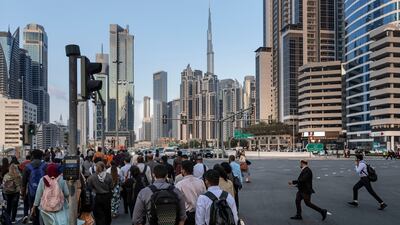

Hiring in the UAE rebounded in the third quarter of the year to 4 per cent, the highest across the Gulf, as business demand recovers, a report has found.
After hiring in the country dropped by 4 per cent in the second quarter, demand recovered from the mid-year slowdown and by September new export business was growing at its fastest pace in almost two years, Cooper Fitch said its third quarter employment index.
Companies remain cautious about the year ahead, the report added.

Across the Gulf, hiring returned to growth in the third quarter, rising 2 per cent following a 3 per cent decline in the previous quarter. In Saudi Arabia, recruitment rose 1.5 per cent, while Oman recorded 0.5 per cent growth. Hiring, however, fell by 1 per cent in Qatar, 2 per cent in Kuwait and 2 per cent in Bahrain.
The Iran war, which began on February 28, has had a significant impact on regional economies, with the effective closure of the Strait of Hormuz affecting oil-exporting countries.
The International Monetary Fund, in a report this month, projected the UAE's economy to contract by 3.9 per cent this year before rebounding at a 7.7 per cent growth rate in 2027, as long as shipping routes normalise and the strait reopens.
The fund also expects Saudi Arabia's economy to contract 3.3 per cent this year, while Bahrain, Kuwait and Qatar are forecast to see double-digit contractions of 11.3 per cent, 16.7 per cent and 15.6 per cent, respectively, in 2026. Oman is the only Gulf member to see positive economic growth in 2026 at 4.1 per cent.
However, all the six states are anticipated to post growth in 2027, the IMF said.
The contraction in Gulf hiring "lasted a single quarter and the market is now back within the modest growth range seen through 2025", Cooper Fitch said. "Growth extended across a wider range of functions than in the previous quarter, with paused mandates resuming in sectors such as energy."
Sectors hiring
Hiring in energy recorded the sharpest increase at 7 per cent across the Gulf in the July-September period. Mandates stalled during the regional tensions returned steadily as conditions eased, the report said.
"Clients resumed searches where they left off. In the UAE, growth came from across the energy market, including nuclear and renewables," it added.
The delivery of Saudi Arabia’s Vision 2030 pipeline also supported the sector's growth. "Project directors, commissioning specialists and contracts leaders remained difficult to secure. Candidates with scarce technical skills continued to receive multiple offers, keeping the market firmly in their favour," the report added.
Hiring in finance grew 5 per cent, strategy rose 6 per cent – its first increase of 2026, while real estate and software employment was up 4 per cent.
Recruitment in sales and marketing rose 3 per cent in the third quarter, "reflecting cautious confidence rather than a broad hiring rebound", while human resources grew 2 per cent, the report said.
However, hiring in banking declined 4 per cent, while investment management fell by 5 per cent "after a strong run of hiring earlier in the year, driven by regional platform expansion and fund activity".
While hiring picked up in the third quarter, it remained selective, Cooper Fitch said. "Clients focused on advancing active searches and securing specialist capability rather than broad expansion, and several markets and parts of financial services saw lower activity," it said.
Looking ahead to the fourth quarter, it remains to be seen whether the improvement can be sustained.
"Business demand has provided a firmer base, but costs remain elevated and visibility on trade and shipping is still limited," the report said. "Competition for scarce specialist talent has also intensified, adding pressure on employers seeking to secure critical capability."