



The jobs market in the UAE is continuing to recover in 2022 as business confidence and hiring activity return to pre-coronavirus levels, according to recruitment experts as we hit the mid-year mark.
At the beginning of the year, salaries were also expected to rise by an average of 3 per cent to 5 per cent depending on the sector (see slide show above), while bonuses have been predicted to make a comeback this year.
“Salaries certainly have increased year on year and are set to continue on this trajectory for 2022, with a proportionally higher number of salary rises likely to take place this year than in the past three years,” Sarah Dixon, managing director of Hays Middle East told The National in January.
“The most common increase is likely to be an uplift of up to 5 per cent.”
Since the Covid-19 pandemic began in March 2020, the UAE has spent billions of dirhams in economic stimulus measures to support businesses.
Business activity in the UAE’s non-oil private sector improved to its strongest level in about two and a half years in November 2021, activity which was boosted by Expo 2020 Dubai, a rise in tourism and increased spending amid the post-pandemic economic recovery.
The UAE's IHS Markit Purchasing Managers’ Index climbed to 55.9 in November, from 55.7 in October, the highest reading since June 2019. A reading above 50 indicates economic expansion while anything below points to a contraction.
Employment levels also remained steady during the survey period and “further rises in demand and backlogs could support an increase in employment sooner rather than later”, IHS Markit economist David Owen said at the time.
With hiring on the increase, what is the salary and employment outlook for jobseekers this year? Read on to find out.
How much can Emiratis earn in Dubai and Abu Dhabi?
-
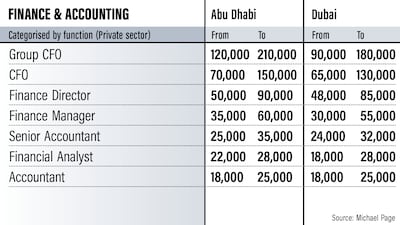
Emiratisation salary guide 2022 -
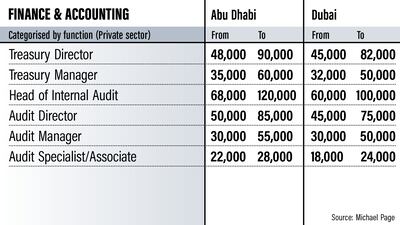
Emiratisation salary guide 2022 -
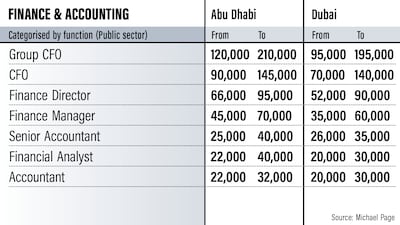
Emiratisation salary guide 2022 -
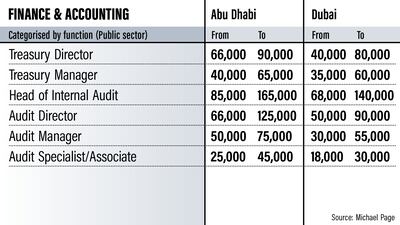
Emiratisation salary guide 2022 -
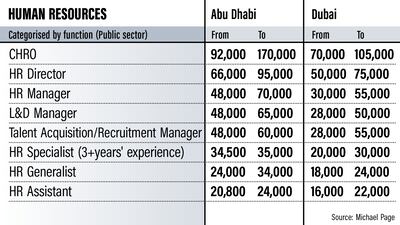
Emiratisation salary guide 2022 -
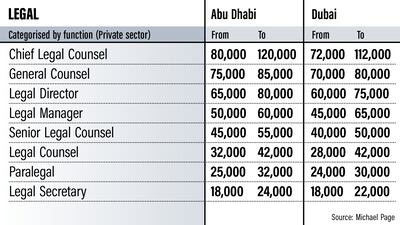
Emiratisation salary guide 2022 -
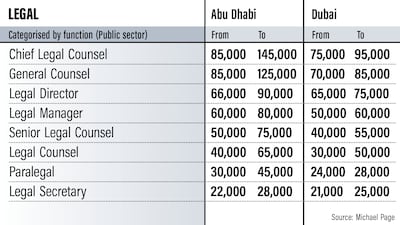
Emiratisation salary guide 2022 -
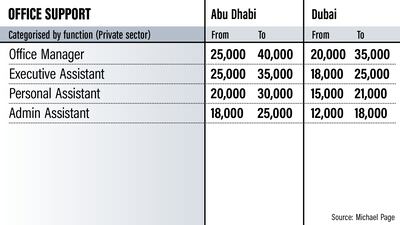
Emiratisation salary guide 2022 -
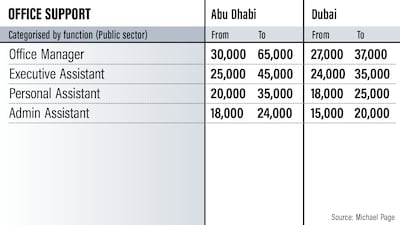
Emiratisation salary guide 2022 -
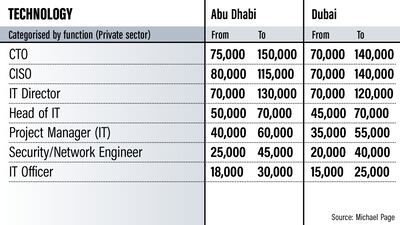
Emiratisation salary guide 2022 -

Emiratisation salary guide 2022 -
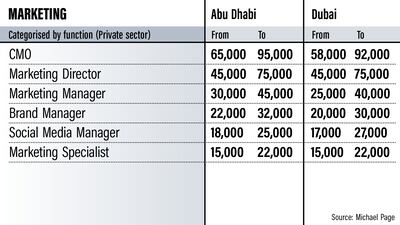
Emiratisation salary guide 2022 -
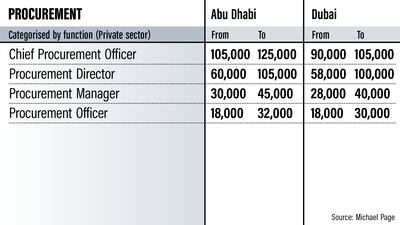
Emiratisation salary guide 2022 -
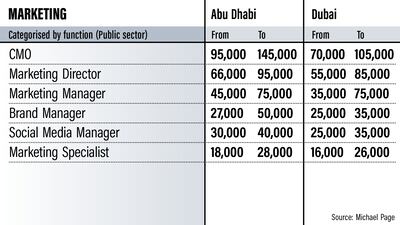
Emiratisation salary guide 2022 -
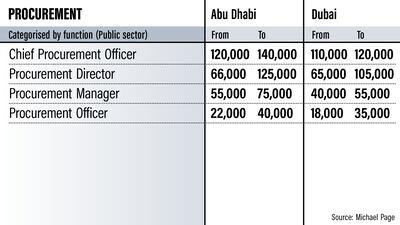
Emiratisation salary guide 2022


Pay levels expected to increase across Dubai, Abu Dhabi and other emirates
According to the Hays 2022 Salary Guide, which was released at the end of January, roughly 73 per cent of UAE employers expected their salaries in their organisations to increase by up to 5 per cent this year, compared with 37 per cent in 2021.
The trend in previous years has shown that most company-wide pay increases represent a rise of less than 5 per cent but this is unlikely to be sufficient to retain candidates who are looking for a job change for the rest of 2022 based on salary, Ms Dixon says.
However, the "sentiment is very positive in the UAE and surrounding Gulf region", she notes.
“We have seen business confidence and hiring activity increase back to pre-pandemic levels and beyond, with much optimism as we go into 2022.”
In November, a report by Mercer found that employers in the UAE were predicted to go on a hiring spree in 2022 and raise salaries by an average 3.6 per cent as demand for jobs picks up amid the UAE's post-coronavirus economic recovery.
“Signs of growth abound and are evident in the increased hiring activity that we have seen in 2021 and the positive forecast for 2022,” Andrew El Zein, a career department associate for the Mena region at Mercer, said at the time.
“Employers are prioritising hires for in-demand skill sets that will support future business growth. However, the talent pool is still developing, causing somewhat of a talent war.”
Meanwhile, the Cooper Fitch UAE Salary Guide 2022, which was published in December 2021 and polled more than 600 companies in the country, found that 35 per cent of businesses plan to increase salaries by up to 5 per cent this year.
It also found that 4 per cent of companies would offer employees a raise of between 6 per cent to 9 per cent, while 5 per cent will boost wages by 10 per cent or more.
Will bonuses return in 2022?
Of the business leaders surveyed by Cooper Fitch for its salary guide, 74 per cent of companies in the UAE planned to offer bonus schemes in 2022, with 46 per cent saying they would pay one to two months’ gross salary and 21 per cent saying they would reward employees with three to five months' gross salary.
However, not all sectors will be offering bonuses to employees this year, Trefor Murphy, chief executive of Cooper Fitch, says.
“For bonus payouts, all sectors except real estate and the public sector said they will be paying bonuses in 2022.”

What benefits will jobseekers be offered in 2022?
Companies must offer a competitive benefits package to attract the best talent, according to the Robert Half 2022 salary guide.
“Candidates expectations have changed since the pandemic and they are expecting more beyond salaries and bonuses,” the report says.
“Employers are adjusting benefits and perks to attract and retain the new ‘anywhere’ workforce. Efforts to bolster workplace culture and avoid digital burnout [will] see companies introduce mental health hotlines and remote working initiatives.”
Some of the most common benefits UAE employers are offering jobseekers include flexible and remote working, airline tickets, an education allowance and family visas.
However, since the outbreak of Covid-19, job candidates are increasingly requesting to work from home at least two days a week, as well as asking for flexible hours and training opportunities, the Robert Half report says.
“Businesses are adding to their benefits to retain and attract staff,” Gareth El Mettouri, Robert Half’s associate director of the Middle East, says in the salary report.
“Many local businesses are keen to get back to the office, but with candidates demanding flexible working, they may lose out on the best talent to multinationals.”
chief executive of Cooper Fitch
However, child education allowances are a significant “pull factor” for professionals in the UAE when considering a new role, Ms Dixon of Hays Middle East says.
“With so many expats uprooting family and relocating to the region from home countries for jobs, child education fees represents a significant proportion of their incomes and candidates will favour an employer that offers to cover these,” she says.
“This is a challenge to organisations as school fees are relatively expensive in the UAE and from our experiences, child education allowances are generally only offered to senior-level candidates. They also vary by way in which they are offered – some employers provide an annual lump sum, while others cover up to two children, or are capped at a certain level of spend.”
What will be the most resilient sectors in 2022?
The most resilient sectors this year will include technology, human resources, health care and life sciences, while there will be accelerated demand for skilled workers in digital and data, and project management, recruitment specialist Michael Page says in its UAE Salary Guide & Hiring Insights 2022 report.
Meanwhile, there is still strong demand for talent in some of the “usual suspect sectors” such as consulting, advisory and recruitment, Mr Murphy of Cooper Fitch says.
“There is also a large base of activity around digital, technology and artificial intelligence, with an overall recovery in all UAE markets recovering to pre-Covid-19 levels,” he says.
“In terms of headcount and salaries in the UAE for 2022 based on our data, the sectors most likely to increase these are advisory, real estate, sales and marketing, technology and strategy.”
Challenges companies face when hiring in 2022
The Covid-19 pandemic has been a catalyst for long-term change in the workplace, with many companies now allowing employees to either work from home full-time or for one to three days a week.
However, maintaining employee motivation and engagement, and integrating new hires remotely are the main challenges employers are facing in 2022.
Many companies have also had to invest significant amounts of their budgets into technology to enable remote working, Ms Dixon says.
“With competition among employers high, attraction and retention of top talent is a big challenge for organisations,” she says.
“Salary remains the main motivator for changing jobs while career development is the number one reason why employees will stay with an employer.
“On top of these, we have seen professionals’ views on remote working change since the pandemic, with the majority expecting some form of working-from-home options to be offered as part of a standard employment contract going forward.”
What are the highest paid jobs in the UAE?
- Banking: head of consumer banking – Dh92,000-Dh98,000
- Legal: partner (5+ years) – Dh103,000-Dh227,000
- Oil and gas: operations manager – Dh40,000-Dh50,000
- Public sector: undersecretary – Dh128,800-Dh180,000
- Strategy: chief strategy officer – Dh90,000-Dh129,000
- Senior finance and tax: group chief financial officer – Dh93,000-Dh134,000
- Sales and marketing: general manager – Dh57,000-Dh72,000 (FMCG); head of corporate communications – Dh53,000-Dh67,000
- Manufacturing: managing director – Dh97,000-Dh134,000
- Supply chain: chief supply chain officer – Dh85,000-Dh165,000
- Investment management: chief investment officer – Dh82,000-Dh155,000+
- Technology: chief information officer – Dh70,000-Dh130,000
- HR and office support: chief shared services officer – Dh103,000-Dh144,000
- Accounting and finance: group/regional – CFO Dh100,000-Dh200,000
- Property and construction: chief development officer – Dh124,000-Dh247,000; executive director of sales Dh77,000-Dh113,000
- Secretary and office support: personal assistant – Dh20,000-27,000

