

India has a robust pipeline of companies set to list on the stock market in 2023. But analysts warn that while Indian bourses have proved to be relatively resilient this year, global risks persist and pose challenges.
Smaller ticket listings are likely to be the theme for the new year after several technology firms that came to market in large initial public offerings flopped in 2022, analysts say.
“While the sentiments have improved and the IPO pipeline looks strong, uncertainties still exist,” says Sumit Chanda, founder and chief executive of Jarvis Invest, an artificial intelligence-based stock advisory platform, based in Mumbai.
“The threat of a global recession still looms large.”
Despite the global economic headwinds, India’s economy grew 8.7 per cent in the country's 2021-2022 fiscal year, boosting its total output above pre-coronavirus levels despite global macroeconomic headwinds, the International Monetary Fund said.
India, Asia's third-largest economy, rebounded from the pandemic-induced downturn on the back of fiscal measures to address high prices and monetary policy tightening to address elevated inflation, the Washington-based lender said in a report on Friday.
In October, the IMF cut its global economic growth forecast for next year, amid the Ukraine conflict, broadening inflation pressures and a slowdown in China, the world’s second-largest economy.
The fund maintained its global economic estimate for this year at 3.2 per cent but downgraded next year's forecast to 2.7 per cent — 0.2 percentage points lower than its July forecast.
There is a 25 per cent probability that growth could fall below 2 per cent next year, the IMF said in its World Economic Outlook report at the time.
India has more than 20 companies that have applied to the market regulator for IPOs, while projections from RedSeer Strategy Consultants are that the country has a potential pipeline of some 80 start-ups that could be listed over the next five years.
For 2023, the most anticipated IPOs include Oyo Hotels and food delivery app Swiggy.
There are expectations that 2023 will break “the dry spell of India’s market and ... the next IPO frenzy is about to start”, said Narayani Ramachandran, a finance professor and the deputy director at university NMIMS Bengaluru.
This comes as India's stock markets have put in a solid performance in recent months to hit all-time highs, despite global headwinds.
The benchmark BSE Sensex is up 4.76 per cent compared to a year ago. By contrast, the US Dow Jones Industrial Average is down 8.54 per cent over the same period, Germany's DAX has slumped almost 12 per cent and Japan's Nikkei 225 has fallen 8.51 per cent.
But following a record-breaking year in 2021 for IPOs, the “Indian market experienced a state of pause in 2022 ... because of the concerns regarding high interest rates, rising inflation, the Russia-Ukraine war and strong US dollar”, says Ms Ramachandran.
However, the tide has shifted again now and interest in India’s IPO space “has been reignited in the past one quarter, as the uncertainties which dominated majority of 2022 are now starting to fade”, says Kaizad Hozdar, investment adviser at TrustPlutus Wealth, a wealth management company.
“Factors like high metal and crude prices, sharp and sustained rate hikes, FPI [foreign portfolio investment] outflows, high inflation, supply side disruptions and sharp rise in freight rates, which were the pain points in the first half of 2022, have now started cooling off.”
Mr Hozdar expects to see several small and medium sized deals in 2023 “since investors have grown wary about the performance of large IPOs listings”.
There has been a flurry of companies that have opened their IPOs for subscription this month, which have generally been smaller in size compared to 2021 - when a number of high-profile tech startups hit the stock markets.
This included the digital payments firm Paytm, which was India's biggest IPO ever when it listed in November 2021. But more than a year later, Paytm's shares are down some 78 per cent at about 475 rupees a share compared to the company's issue price of 2,150 rupees a share.
Analysts have attributed this to overvaluation and questions over its path to profitability, as well as the global environment.
Other tech firms that listed in 2021, including PolicyBazaar, Nykaa, and CarTrade are also down sharply on their issue prices.
India's state insurance giant, Life Insurance Corporation (LIC) — which listed in May and replaced Paytm to take the title of the largest IPO at $2.7 billion — has also performed poorly. It is trading at about 660 rupees a share, compared to its issue price of 949 rupees a share.
The fresh wave of recent IPOs includes Sula Vineyards, which made its stock market debut on Thursday and listed at a more than 1 per cent premium over its issue price.
“IPO pricing in recent IPOs has been rationalised,” says Prashant Rao, director and head, equity capital markets, Anand Rathi Investment Banking.
“Additionally, with tightening market liquidity, investors are more risk-averse and favour companies that can demonstrate robust business models in profitability and cash flows.”
This trend of smaller IPOs is expected to continue in 2023.
“The macros are also in their favour, with India being one of the fastest growing economies,” says Mr Rao.
“I believe that there will be buyers provided that the companies going public have a strong track record, good outlook, and reasonable pricing on their IPOs.”
Property technology firm Homesfy Realty, a mid-sized company, is among those that have opened their offering to investors recently. Its subscription ran between December 21 to December 23, with 805,200 equity shares offered at 197 rupees a share.

“We are a profitable company,” says Ashish Kukreja, founder and chief executive of Homesfy Realty.
“The size is small and there's decent upside in terms of what we can execute.”
The offer was three times oversubscribed by retail investors as of Thursday afternoon, according to Mr Kukreja.
Homesfy plans to use the funds from the offering for growth and its working capital requirements.
“I am very gung ho about the Indian economy,” says Mr Kukreja.
“This is also playing out in the markets because people have been able to raise good capital, balance sheets have improved in the last couple of years, the government has been pretty quick on reforms, which matter to corporates.”
Foxhog Ventures, which is focused on investment in rural India, is a company that is looking at going public in 2023 to raise 6.3 billion rupees.
The company’s offering aims to attract retail investors, where 70 per cent of the amount will be used for the lending division for smaller towns and villages, says Tarun Poddar, the India head and managing director of Foxhog.
Manish Chowdhury, the head of research at StoxBox, an Indian investment platform, warns that investors will be scrutinising opportunities carefully.
“With the global mood expected to turn sour, we feel that future listings with the right business model and a high margin of safety in terms of valuation would be very important to gain market interest,” he says.
“Barring near-term hiccups due to worries surrounding the US, Europe and China, Indian markets have all the right ingredients to continue outperforming its global peers,” says Mr Chowdhury. “With expectations of inflation tapering off, modest rate hikes by the RBI [Reserve Bank of India] and strong corporate earnings, India looks set to garner a large chunk of money from both domestic and foreign investors.”
Also encouraging investors is the fact that India has overtaken the UK to become the fifth largest economy.
“India has the best earnings growth outlook amongst the top five economies,” says Mr Hozdar. “That coupled with a weakening US dollar index, robust tax collections and high double digit credit growth make India better positioned versus other emerging economies.”
But there have also been some warning signs that India is far from immune to global volatility.
Indian equities have had a great year as compared to other global markets that are in the red in this calendar year, says Mr Rao.
-
-
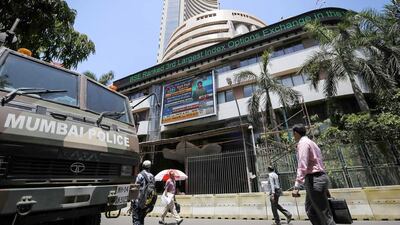
People walk past the Bombay Stock Exchange (BSE) building in Mumbai on May 13, 2014. Indian shares rose as much as 2.2 per cent on Tuesday, a third consecutive record high, as stocks of companies focussed on the domestic sector surged after exit polls showed the Bharatiya Janata Party and its allies winning a majority in the elections. Danish Siddiqui / Reuters -

An Indian tuberculosis patient rests at the Rajan Babu Tuberculosis Hospital in New Delhi. India must stop its doctors prescribing “irrational” treatments to cure tuberculosis, medical humanitarian group Medecins Sans Frontieres said, warning the practice is increasing drug-resistant strains of the disease. Chandan Khanna / AFP -

Indian labourers work on a road widening project in Bangalore, linking the city to the international airport. Dibyangshu Sarkar / AFP -
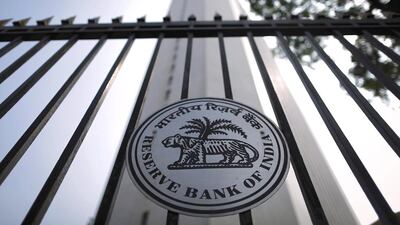
The Reserve Bank of India (RBI) seal is pictured on a gate outside the RBI headquarters in Mumbai. India’s central bank raised its policy interest rate for the second time in as many months in October, warning that inflation is likely to remain elevated for the rest of the fiscal year. Danish Siddiqui / REuter -

Employees sit working in the library of the Tata Consultancy Services campus in the State Industries Promotion Corporation of Tamil Nadu IT Park in the Siruseri area of Chennai, India. Dhiraj Singh / Bloomberg -

Workers grind iron bearings used in textile machinery inside a factory on the outskirts of the western Indian city of Ahmedabad on May 12, 2014. The country is on the cusp of political change that is widely expected to script an economic revival. Amit Dave / Reuters -

A labourer removes dust from wheat crops at a wholesale grain market in the northern Indian city of Chandigarh. Ajay Verma / Reuters -
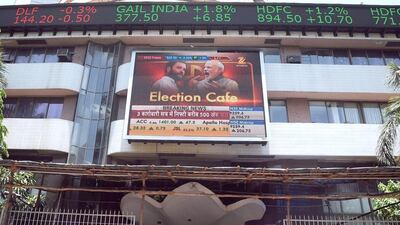
Indian officegoers walk past the Bombay Stock Exchange (BSE) as the digital broadcast shows the 30-share benchmark index SENSEX cross 24,000 points during intra-day trade in Mumbai on May 13, 2014. India’s stock market surged for the third straight day to a record high as exit polls indicated that Hindu nationalist party leader Narendra Modi was on course to become the country’s next prime minister. INDRANIL MUKHERJEE / AFP -

A worker levels the iron ore in a freight train at a railway station at Chitradurga in the southern Indian state of Karnataka. One of Narendra Modi’s main election planks is to crank up manufacturing to create millions of jobs by focusing on exporting steel, not iron ore. Danish Siddiqui / Reuters


“However, India is an open economy and therefore developments in the rest of the world impact India.”
“If there is a serious global growth slowdown, [the] cost of funds go up substantially due to continued monetary tightening and if global investors turn risk averse, like most of the countries of the world, India can also witness outflow of foreign portfolio equity investment,” Mr Rao says.
Industry experts warn that some companies could postpone their plans for IPOs if market conditions were to deteriorate sharply.
Start-up Oyo delayed plans from this year to 2023 for its IPO.
For now, India is “better placed than global peers” to face the possible challenges the new year could bring, says Mr Chanda.
“While the threat of a global recession looms large, we have, over the past one year, showcased the resilience of the stock markets,” he says.

