
Opec inched closer to an agreement that would allow an oil-supply increase after positive talks between Saudi Arabia and Iran.
Iranian oil minister Bijan Namdar Zanganeh said he had a good meeting with his Saudi counterpart in Vienna and he wasn’t feeling pessimistic about the possibility for a compromise, a reversal of his position on Thursday night.
Ministers have gathered in the Austrian capital to discuss a supply increase that would be equivalent to about 600,000 barrels a day, or 0.5 per cent of global supply.
_______________
Read more:
Opec's Vienna meet could prove bullish for oil markets, say analysts
Opec's new game as rivalries surface over oil production
Business Extra podcast: Russia, Saudi Arabia and the state of oil markets
_______________
Saudi Arabia and Iran were drafting language for a compromise agreement as a result of their private talks, said one delegate, who asked not to be named because the information wasn’t public. Neither ministers commented on the details of their deal.
The kingdom’s energy minister Khalid Al-Falih said he is still pushing for a 1 million-barrel-a-day adjustment to the supply cuts that the Organisation of Petroleum Exporting Countries and its allies agreed in 2016. That volume would be distributed proportionally between all 24 nations participating in the deal, he told reporters.
Some nations, notably Venezuela and Mexico, are currently unable to increase output, so about a third of that oil wouldn’t actually return the market, according to Bloomberg calculations based on data from the International Energy Agency.
-
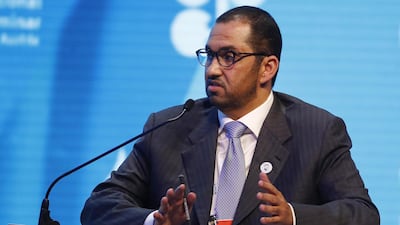
Sultan Al Jaber, chief executive officer of ADNOC, gestures as he speaks during the opening day of the 7th OPEC international seminar in Vienna, Austria. Stefan Wermuth / Bloomberg -

Mohammed Barkindo, Opec secretary general. Stefan Wermuth / Bloomberg -

Opec inched closer to an agreement that would allow an oil-supply increase after positive talks between Saudi Arabia and Iran. Stefan Wermuth / Bloomberg -

Khalid Al Falih, Saudi Arabia's energy minister. Stefan Wermuth / Bloomberg -

Mustapha Guitouni, Algeria's energy minister. Stefan Wermuth / Bloomberg -

Parviz Shahbazov, Azerbaijan's energy minister. Stefan Wermuth / Bloomberg -

Aldo Flores Quiroga, Mexico's deputy energy minister. Stefan Wermuth / Bloomberg -

Ministers have gathered in the Austrian capital to discuss a supply increase that would be equivalent to about 600,000 barrels a day, or 0.5 per cent of global supply. Stefan Wermuth / Bloomberg -
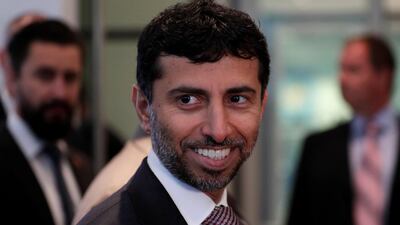
UAE's Energy Minister Suhail Mohamed Al Mazrouei arrives for the Opec meeting in Vienna. Heinz-Peter Bader / Reuters


By the end of summer, additional crude should be flowing into the market, Al Falih said.
Earlier, oil price gains of more than one per cent on Friday held as talks continued.
Suhail Al Mazrouei, the UAE's oil minister, said he was optimistic that a deal will be reached on supply.
"Opec has had "many more difficult times than now," Mr Al Mazrouei said in Vienna. "We are not going to destroy what we have built."

