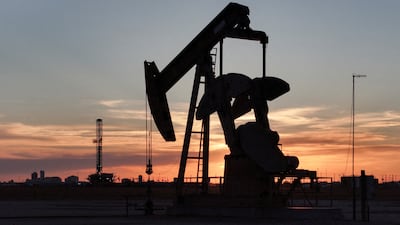

US shale executives are growing more frustrated by the Iran war's disruptive effects on oil markets interfering with their ability to plan for the future.
In a quarterly survey published by the Federal Reserve Bank of Dallas, anonymous comments from oil executives showed increasing concerns on how the war is driving market volatility.
“We are getting to the point in this global conflict and its effect on commodity markets that it is tough to predict what the remainder of 2026 and also 2027 will potentially look like,” one respondent said.

The survey is closely monitored by the energy industry. The Dallas Fed encompasses Texas, northern Louisiana and southern New Mexico, which cover key geological areas including the Permian Basin.
The survey, which covered September 16 to 24, showed the respondents anticipated the price of West Texas Intermediate crude to settle at an average of $88 a barrel at the end of this year. Responses ranged from $70 to $126 a barrel.
WTI crude prices rose $1.27 on Wednesday to $90.65 a barrel on stalled talks to end the Iran conflict. WTI crude has risen by about 35 per cent a barrel since the conflict began on February 28.
They also anticipate a Henry Hub natural gas price of $3.29 per million British thermal units by the end of 2026, the survey showed.
“There is still too much chaos but it is leading to a bullish oil price sentiment because of all of the ramifications of what has taken place in the Middle East,” one respondent said.
Another executive expected WTI to end the year somewhere between $75 and $100 a barrel.
“Pricing volatility is near an all-time high given the backdrop of Iran. Swings of $5, $10 and $20 up or down are common. It is very challenging to select a planning price or budgeting price,” said a third respondent.
Another executive also questioned if market volatility from the 2012-2020 period will repeat itself.
“One hundred dollars per barrel to extreme lows of -$30 per barrel. What an economic turmoil that was. Is 2026 a repeat?” they asked.
The survey also showed growing frustrations with US President Donald Trump's administration.
“My oil price crystal ball broke when the administration first hit Iran,” one respondent said.
Another said: “Decisions by the executive branch of our Federal Government seem to be driven primarily by concerns over midterm election results."
The survey received responses from 125 energy companies, among which were 83 exploration and production firms, while 42 were oilfield service companies.

