

UAE state energy company Adnoc's plan for $150 billion in capital expenditure over the next five years is a “big commitment” and its focus on gas is a safe play for the short and long term, say analysts.
Adnoc on Monday said its board has approved the capex for the 2026-2030 period to maintain growth and operational processes.
Adnoc's spending trajectory is "considerably higher than that of most national oil firms outside the Gulf and roughly comparable to major international oil companies like ExxonMobil", said Vijay Valecha, chief investment officer at Century Financial.

Adnoc's investment amounts to roughly $30 billion per year, while global energy companies like ExxonMobil and Shell would invest about $20–$25 billion per year in total capex, though split between oil, gas and low-carbon ventures, said Ipek Ozkardeskaya, a senior analyst at Swissquote Bank.
Adnoc's $150 billion investment is a “big, big commitment and very much in line with global energy trends”, she said.
Adnoc said the UAE’s conventional reserves base has increased from 113 billion stock tank barrels (stb) of oil to 120 billion stb and from 290 trillion standard cubic feet (tscf) of natural gas to 297 tscf. The UAE has the world’s sixth-largest oil reserves and the seventh-largest gas reserves.
-
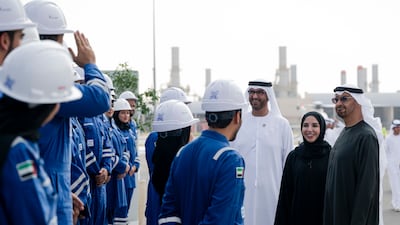
President Sheikh Mohamed with Adnoc employees after a board of directors meeting at the Habshan Complex. With him was Dr Sultan Al Jaber, Minister of Industry and Advanced Technology, and managing director and group chief executive of Adnoc. All photos: UAE Presidential Court -
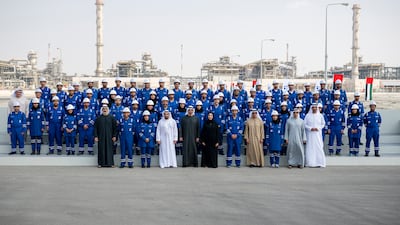
Sheikh Mohamed with Adnoc workers at Habshan Complex -
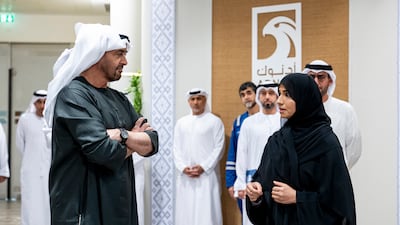
Sheikh Mohamed listens to a presentation before the Adnoc board of directors meeting -
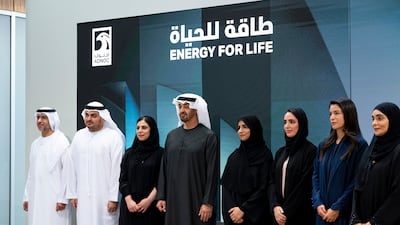
Sheikh Mohamed with Adnoc employees -
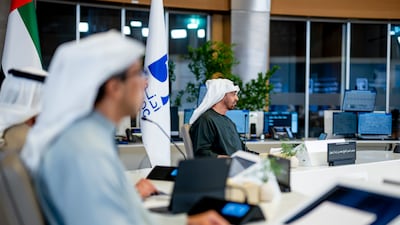
Sheikh Mohamed chairs the Adnoc board of directors meeting -
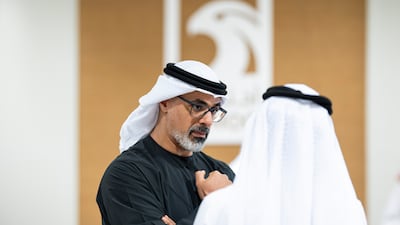
Sheikh Khaled bin Mohamed, Crown Prince of Abu Dhabi and Chairman of the Abu Dhabi Executive Council, speaks with Suhail Al Mazrouei, Minister of Energy and Infrastructure -
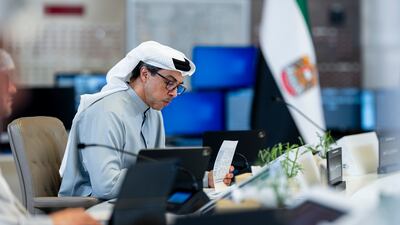
Sheikh Mansour bin Zayed, Vice President, Deputy Prime Minister and Chairman of the Presidential Court, at the board of directors meeting -
The Adnoc logo and UAE flags at the Habshan Complex


The company's board, which held its annual meeting at the Habshan gas processing facility, also approved the establishment of Adnoc Ghasha, a new operating company for the Ghasha concession which includes the Hail, Ghasha, Dalma, SARB and Nasr fields.
The concession is set to produce 1.8 billion scf of gas and 150,000 barrels per day of oil and condensates. Construction of the Hail and Ghasha project is progressing at pace, Wam reported.
Growing demand for gas
Demand for gas is growing globally, with the Middle East, which has 40 per cent of the world’s gas resources, experiencing the highest growth in output of any region, consultancy Wood Mackenzie said in a recent report.
It expects natural gas production across the Middle East to more than double to 98 billion cubic feet per day by 2030, from about 45 bcfd in 2010.
“This means the region will account for 23 per cent of global sales [of] gas by 2030, second only to North America, at 32 per cent. Production will flow from conventional onshore and offshore gasfields, as well as unconventional and sour gas resources,” the report found.
Ms Ozkardeskaya said that gas is "seen as a transition fuel that could help economies shift away from coal while supporting renewables”.
“The UAE wants to position itself as a key global gas supplier, especially in LNG [liquefied natural gas] markets,” she said.
The move towards gas comes as the US moves away from renewable energy sources under President Donald Trump's administration.
“The U-turn from the White House in favour of traditional energies has shifted the 'Big Oil' companies' focus back to cash-making fossil fuel sources,” Ms Ozkardeskaya said.
“As such, we expect the clean energy projects to lose support during the Trump administration. In this context, gas remains a safe play because it’s politically and commercially viable as a bridging fuel.”
LNG exports, domestic gas-to-power projects and petrochemicals are all growth areas.
“Gas also helps traditional energy companies to build a dual strategy: maintain cash flow from oil and gas while positioning for energy transition. So yes, the political and geopolitical set-up makes gas a safe focus for traditional companies, both in the short, medium and long term, and both in the context of traditional and cleaner energy,” she added.
Tech and new discoveries
Adnoc also said it has made new oil and gas discoveries totalling more than 1.2 billion barrels of oil equivalent. The discoveries were enabled by technology including a 3D seismic survey and artificial intelligence-powered data interpretation that “unlocked previously inaccessible structures and formations”, Wam reported.
New technology will enhance further discoveries by making the identification of reserves easier and faster, and by making production more efficient and cost-effective, Ms Ozkardeskaya said.
Advanced technology will lead to reduced drilling costs and increased recovery rates for existing sites, she added.
Mr Valecha agreed that the new technology will continue to support the discovery of many more untapped oil and gas resources in the region. "The technology provides high accuracy and fast exploration cycles, improving the efficiency of operations for the company," he said.

