

Lebanon is close to signing a pan-Arab power agreement that could help prevent severe blackouts in the country as it faces reconstruction amid a fragile ceasefire deal with Israel.
The Lebanese Ministry of Energy and Water has approved the electricity market agreement and is now awaiting the government's final approval to “authorise the signature”, minister Walid Fayad told The National in an emailed statement.
“This is expected to happen soon and we will then sign the agreements. These agreements are strategic for Lebanon and for the Arab region,” he added.
This month, the Arab League announced the launch of the Arab Common Electricity Market, a Gulf-led drive promoting regional grid integration.
Two deals were signed: one outlining the market's goals and development, the other establishing framework, governance and co-operation between member countries.
The market aims to stabilise electricity supplies, reduce costs, promote renewable energy, position Arab countries as global clean energy exporters, improve energy efficiency and support national energy strategies, the Arab League said.
-
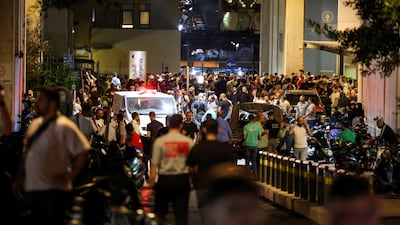
Panic at a Beirut hospital after thousands, including Hezbollah fighters and medics, were injured when the pagers they used to communicate exploded across Lebanon. Several people were killed. Reuters -
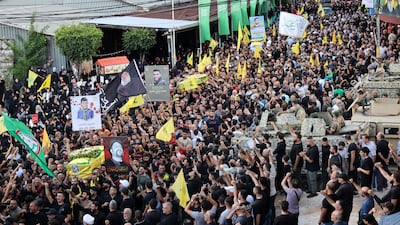
Mourners in Beirut's southern suburbs carry the coffins of people killed after hundreds of paging devices exploded, in a mass funeral on September 18, 2024. AFP -
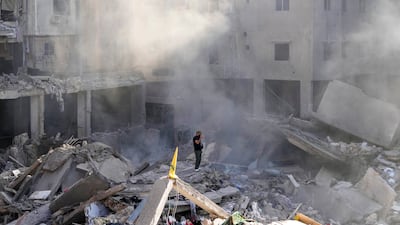
A man stands on the rubble of buildings near the site of the assassination of Hezbollah leader Hassan Nasrallah in Beirut's southern suburbs on September 29, 2024. AP -
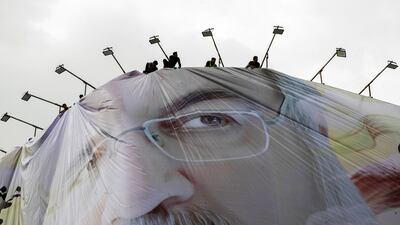
Workers drape a building in a vast banner depicting Nasrallah in Tehran, two days after his assassination by Israeli forces in Beirut. Getty Images -
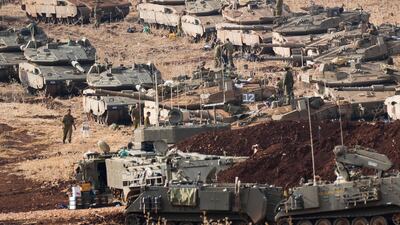
Israeli soldiers work on tanks at a staging post near the border with Lebanon on October 1, 2024. AP -
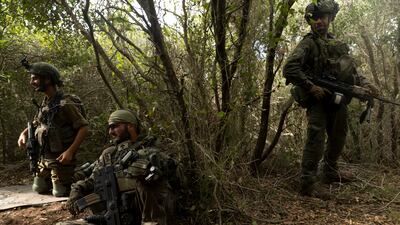
Israeli soldiers rest in an operation zone near Naqoura, southern Lebanon on October 13, 2024, after a ground invasion was launched. Getty Images -
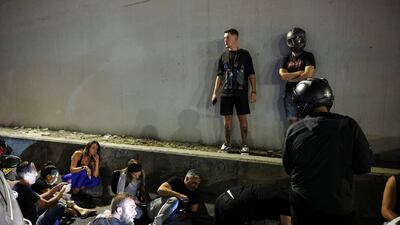
People take cover by a roadside in Tel Aviv as a siren sounds after Iran fired a salvo of ballistic missiles at Israel. Reuters -
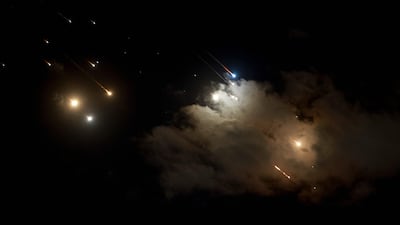
Iranian-launched projectiles being intercepted by Israel above Jerusalem on October 1, 2024. AFP -

The aftermath of a rocket salvo in Petah Tikva, near Tel Aviv, on November 24, 2024. Hezbollah said it launched the missiles from Lebanon at an Israeli army intelligence base. AFP -
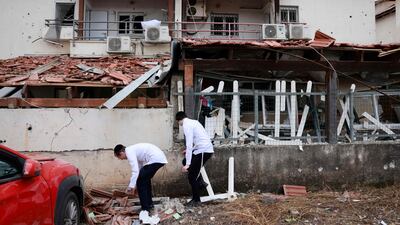
Residents in Petah Tikva check the damage after the rockets were fired from Lebanon. AFP


The UAE, Kuwait, Palestine, Syria, Egypt, Saudi Arabia, Qatar, Libya, Sudan, Yemen, Morocco and Jordan signed the deal.
Lebanon has increasingly suffered frequent and prolonged power cuts, sometimes lasting for hours or even days. These disruptions have severely affected businesses, hospitals and homes, forcing many to switch to expensive private generators that pollute the air.
The Lebanese government is working to address the electricity crisis by exploring options such as importing power, boosting renewable energy and reforming the sector, but progress is hindered by political instability and economic challenges.
Last month, a ceasefire agreement was signed between Israel and Hezbollah after a 13-month long conflict in Lebanon that killed nearly 4,000 people and destroyed entire villages.
Reconstruction could cost Lebanon $10 billion due, Nasser Yassin, the country’s Environment Minister, told The National in an interview last week.
Besides Lebanon, several countries in the Middle East and North Africa have been grappling with power cuts and energy shortages due to ageing infrastructure, fuel shortages and surging demand in the summer.
This year’s summer was particularly challenging, as the region experienced record-high temperatures, leading to increased demand for electricity for cooling purposes.
Francesco Sassi, a researcher at Ricerche Industriali Energetiche in Bologna, Italy, highlighted the significance of including countries vulnerable to domestic and international conflicts, such as Palestine, Lebanon, Syria, Egypt, Libya, Sudan and Yemen, in the electricity agreement.
“The possibility to co-operate with major electricity producers such as Saudi Arabia, the UAE and eventually gain from green electricity output in Morocco or others is an alluring perspective,” Mr Sassi told The National.
Boost to regional ties
In the initial phases of the project, electricity will be traded largely between the Gulf and other Arab countries.
“Gulf rulers have an interest in political stability in Arab countries and energy infrastructure is their opportunity to support it,” said Ilan Zalayat, Gulf researcher at the Institute for National Security Studies and Tel Aviv University's Moshe Dayan Centre.
Gulf nations have become increasingly proactive in regional affairs, aiming to foster stability and mediate conflicts. They have offered financial assistance to struggling nations, invested in regional infrastructure programmes and participated in diplomatic efforts to settle disputes.
However, the groundwork for the agreement was laid decades ago when Bahrain, the UAE, Kuwait, Saudi Arabia, Qatar and Oman commissioned a study in 1986 to explore the idea of connecting electricity grids across the Middle East.
Subsequent research laid out a road map and in 2001, the GCC Interconnection Authority (GCCIA) was formed. By 2011, all GCC countries were connected, with the exception of Oman, which was linked up the following year.
The GCCIA operates a 400-kilovolt grid, which links the electricity grids of the six member countries.
The latest agreement “solidifies” the link between Qatar, Saudi Arabia and other Gulf states, which was “far from obvious only a few years ago during the Gulf blockade on Doha”, Mr Zalayat said.
Iraq, a major oil producer often plagued by power shortages, could be among the first to benefit from electricity trade with the Gulf.
Last year, Saudi Arabia signed an agreement with Iraq that involves building a one-gigawatt transmission line between Arar in the kingdom’s north and Yusufiya near Baghdad.
The GCCIA plans to start exporting electricity to the country next year and is finalising details with the Iraqi government, Ahmed Al Ebrahim, chief executive of the regulator, told The National last month.
The agreement could reduce Iraq's reliance on power and gas imported from Iran, which supplies about a third of its total power, while also countering Tehran’s political influence in the predominantly Shiite country, Mr Zalayat said.
Diversified power
The deal comes as Gulf countries are shifting from fossil fuels in their electricity mix.
Renewable energy sources such as solar and wind power are increasingly contributing. However, their intermittent nature, where power output varies with the weather, can lead to excess production that can overload the grid.
The agreement could help the Gulf deal with the excess power coming from renewables to sell to “other regions in need”, Mr Al Ebrahim said.
The UAE and Saudi Arabia – two of the largest economies in the Arab world – are investing heavily in renewable energy to meet their growing needs. The UAE aims to triple its renewable energy output by 2030, while Saudi Arabia wants half of its electricity from renewable sources by the same year.
However, the interconnection agreement depends on modernising power grids and infrastructure in many economically disadvantaged Middle Eastern countries, Mr Sassi said.
“[This would] guarantee an integration in the system and not generate an electricity dependency, which could become a new source of leverage in a dysfunctional electricity market,” he added.

