

Austrian energy company OMV can meet its gas supply commitments even if Russian flows come to a complete halt, the company's chief executive and chairman has said.
The Vienna-based company has been diversifying its sources of natural gas since the start of the Ukraine war last year, which resulted in Moscow sharply reducing its gas exports to Europe.
“We can now supply all our customers also when Russian supply stops, so in that sense, we are no longer dependent on the Russian supply,” Alfred Stern told The National in an interview on the sidelines of Adipec on Monday.
“Across Europe, one big thing that needs to happen is investment in infrastructure because the gas flows have changed … from the East to the West,” Mr Stern said.
Last year, the US became the world’s largest exporter of liquefied natural gas as European demand soared.
“It's going to be more LNG from the West also flowing in the East direction, and that will require some investments to make sure we can do that under all kinds of supply and demand conditions,” Mr Stern said.
Last month, OMV signed a five-year agreement with Equinor for the supply of gas. The Norwegian company is expected to deliver 12 terawatt hours of natural gas starting this month.
In July, OMV signed a long-term sale and purchase agreement with BP for the supply of up to a million tonnes of LNG a year for 10 years, starting from 2026.
This year, OMV made Austria’s largest gas discovery in 40 years. It expects the find to boost its domestic natural gas production by 50 per cent after full development.
“In the global scheme, it's not a big discovery, but it's local production and it will help us to diversify our gas supply more,” Mr Stern said.
OMV’s gas storage, which accounts for a fifth of Austria’s storage capacity, is 98 per cent full, he said.
Meanwhile, European natural gas prices have fallen drastically since surging to a record high of €345 ($361.05) a megawatt hour last year in March.
Dutch Title Transfer Facility gas futures, the benchmark European contract, was last trading at €39.34 a megawatt hour on Monday.
“It [the price] has come down significantly, but it's still higher than it was before the war in Ukraine,” Mr Stern said.
Reduced gas demand and diversified supply sources led to the price reduction but “external factors can drive and change the situation”, he added.
“We don't know what the next winter will look like. It could be a very cold winter,” Mr Stern said. “At the moment, the Asian economy is not very strong, so they don't pull as much energy as they would when the economy goes up … that can change in the future.”
Much like its peers in the industry, OMV is decarbonising its existing operations while investing in renewable energy, particularly geothermal heating.
The company plans to produce 1.5 million tonnes of sustainable fuels and feedstock, with almost half of it being sustainable aviation fuels (SAF).
OMV, which has begun supplying SAF to some airlines, has also signed initial agreements with operators such as Austrian Airlines, Lufthansa and Wizz Air.
This year’s Adipec comes weeks before the start of the Cop28 climate conference, where oil and gas companies are expected to have a bigger say, unlike previous summits.
On Monday, Cop28 President-designate Dr Sultan Al Jaber said more than 20 oil and gas companies had “positively answered the call” to take steps to curb emissions.
Mr Stern said the challenge “we all have in front of us is that with an increasing population on this globe and improving living standards, the energy consumption goes up a lot”.
“We need to provide all this energy in a reliable, affordable [way], but because of the climate change, in a … decarbonised way and that is the big challenge,” he said.
“This transformation can only happen through the energy industry.”
-
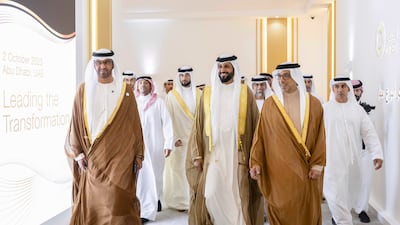
Sheikh Mansour bin Zayed, Vice President, Deputy Prime Minister and Chairman of the Presidential Court, opened the 39th edition of Adipec on October 2. Dr Sultan Al Jaber, Cop28 President-designate, Sheikh Nahyan bin Mubarak, Minister of Tolerance and Coexistence, and Suhail Al Mazrouei, Minister of Energy and Infrastructure, were also present. All photos: Wam -

Sheikh Mansour opened the event under the patronage of President Sheikh Mohamed -
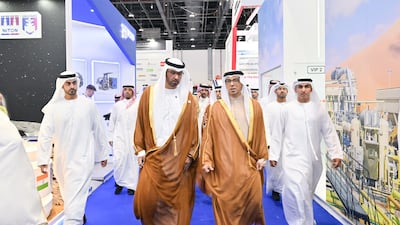
Sheikh Mansour with Dr Al Jaber, who is also Minister of Industry and Advanced Technology and managing director and group chief executive of Adnoc -

Sheikh Mansour hailed the huge efforts of Sheikh Mohamed to enhance the UAE's leading strategic position on energy -
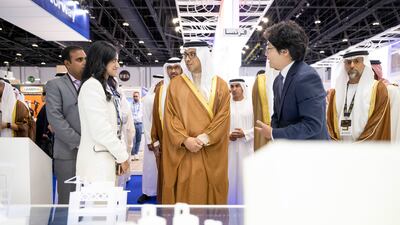
The UAE is playing a pioneering global role in reducing emissions, Sheikh Mansour said -
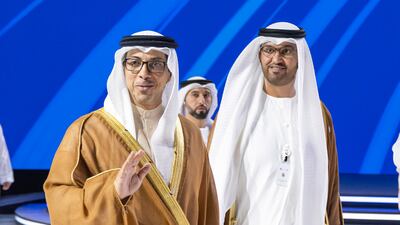
Sheikh Mansour at Adipec with Dr Al Jaber -

Sheikh Mansour urged the conference to achieve global strategic goals, enhance the energy system and support innovation and technology -
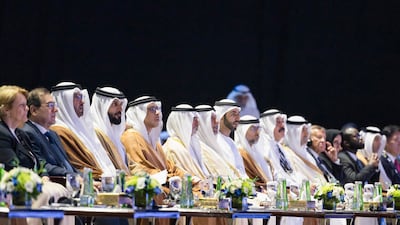
This, in addition to constructive co-operation, can contribute to radically reducing carbon emissions, Sheikh Mansour said -

Sheikh Mansour met several global leaders in the energy sector at the conference -
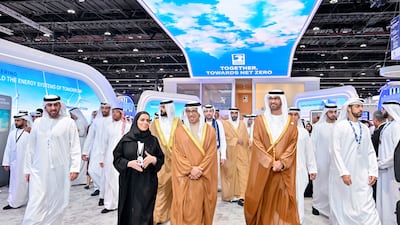
He also attended a key ministerial session under the theme of the conference, 'Decarbonising. Faster. Together'



