

Oman's Hydrom has signed agreements worth $10 billion to develop two new green hydrogen projects with a Posco-Engie consortium and the Hyport Duqm consortium.
The contracts are expected to yield a total production capacity of 250 kilotonnes per annum from more than 6.5 gigawatts of installed renewable energy capacity at the sites, state news agency ONA reported on Wednesday.
The projects will be located in Al Wusta province, the ONA reported.
“We are pleased to witness the signings of these new agreements with such prestigious international companies,” said Salim Al Aufi, Oman’s Energy Minister.
“The fast-paced efforts behind the announcement of these new projects reflect Oman’s commitment to reinforce its leading position in the global green hydrogen sector in line with its energy transformation strategy,” Mr Al Aufi said.
Oman, the largest non-Opec oil producer in the Middle East, aims to produce at least a million tonnes of renewable hydrogen a year by 2030 before ramping up capacity to 3.75 million tonnes by 2040 and 8.5 million tonnes by 2050.
In October, the sultanate set up Hydrom to oversee the development of hydrogen projects in the country.
The country has earmarked two blocks in the southern port city of Duqm and another four blocks in Salalah to be tendered for the development of green hydrogen projects.
Separately, on Thursday, French energy company Engie and South Korea’s Posco said the hydrogen produced from the project would be converted into about 1.2 million tonnes per annum of green ammonia for export.
Operations are expected begin by 2030, the companies said.
“This venture marks a significant leap forward in its worldwide dedication to expediting the transition to low-carbon energy,” said Frederic Claux, Engie's managing director responsible for flexible generation and retail in the Asia-Pacific, Middle East and Africa.
“By joining forces with our consortium partners, we aim to unlock Oman's extraordinary renewable energy potential while capitalising on their expertise and capabilities.
“Ultimately, this collaboration propels Engie towards its global ambitions of attaining a hydrogen capacity of 4 gigawatts by 2030.”
Hyport Duqum, which consists of Oman's state energy company OQ and Belgium’s DEME Group, aims to produce more than 50 kilotonnes per annum of green hydrogen by 2029 in the project’s first phase.
Hydrom, which also launched the second bid round of its green hydrogen auction process, aims to award up to three land blocks in the Dhofar region by the end of the first quarter of 2024.
Earlier this month, Hydrom signed agreements worth $20 billion with Amnah, Green Energy Oman, and BP Oman to establish three major green hydrogen projects in Al Wusta province.
“The signing of these agreements reflects Oman’s commitment towards stimulating the growth of its green hydrogen sector and cementing its leading position regionally and globally,” said Abdulaziz Al Shidhani, managing director of Hydrom.
“These accelerated steps [are] aimed at achieving the national objective of producing more than one [million tonnes per annum] of green hydrogen by 2030.”
The International Energy Agency has said that Oman could become one of the largest producers of hydrogen in the world by the end of the decade, thanks to ample renewable energy sources and vast tracts of available land.
Hydrogen, which can be produced from renewable energy and natural gas, is expected to become a critical fuel as economies and industries transition to a low-carbon world.
It comes in various forms, including blue, green and grey. Blue and grey hydrogen are produced from natural gas while green is derived from splitting water molecules through electrolysis.
French investment bank Natixis estimates that investment in hydrogen will exceed $300 billion by 2030.
-
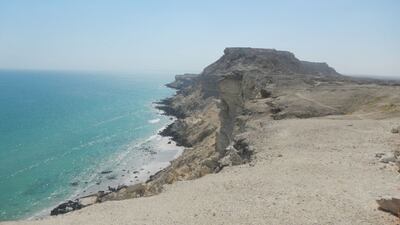
The Port of Duqm in Oman officially opened in February, 2022. Photo: Port of Duqm -

Oman plans to begin construction of the Middle East’s first space rocket launch facility in the port town of Duqm this year. The Etlaq Space Launch Complex, a project by the National Aerospace Services Company (Nascom), could see its first rocket launch early next year. Photo: Port of Duqm -
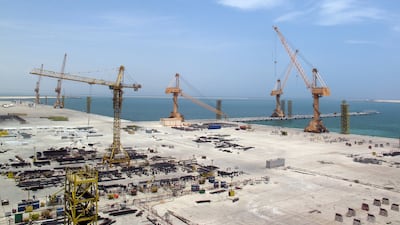
Saudi Arabia said it would invest US$120 million (Dh44.7m) in the development of Oman's Duqm port into a major industrial hub. Fatma Alarimi / Reuters -

This picture taken on April 27, 2021 shows a partial view of the Rock Garden, also known as Duqm Stone Park, in the port town of Duqm in al-Wusta province in central-eastern Oman, about 540 kilometres south of the Gulf sultanate's capital Muscat. The Rock Garden is one of Oman's major geological sites, featuring unusual rock formations. / AFP / Karim SAHIB -
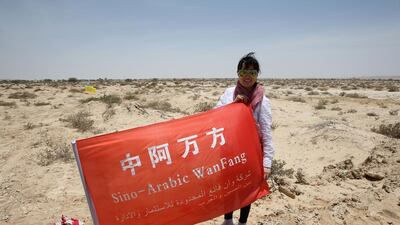
A Chinese investor poses for a picture on land in the Omani port town of Duqm where an industrial city, including an oil refinery, is due to be built following an economic agreement in 2016. Mohammed Mahjoub / AFP -
The Duqm port was officially opened in the presence of the Belgium’s King Philippe and Queen Mathilde.



