

Soaring commodity prices might be causing great economic pain to India, but the country's two richest men, Gautam Adani and Mukesh Ambani, are capitalising on the rally by expanding their fossil fuel portfolios.
For Mr Adani of Adani Group and Mr Ambani of Reliance Industries — both of whom built their businesses on coal and oil, respectively — the current surge in crude oil and coal, triggered by Russia’s invasion of Ukraine, offers a major business opportunity.
“It is more than a windfall for both Adani and Ambani in these times,” said Shailendra Singh Rao, founder of Creduce, a climate change, green energy and carbon trading advisory and service provider.
“The present scenario is more like making hay while the sun shines. No businessman would let go of this opportunity.”
Crude prices have surged more than 70 per cent since last year, due to tighter market conditions, under investment in the energy industry, higher demand as global economies recover rapidly from the pandemic and Russia's war in Ukraine. Meanwhile, soaring demand for power in India, the world's third-largest energy consuming country, is prompting it to turn to coal.

Earlier this month, Mr Adani outlined plans to ramp up coal mining at his group's facility in Australia, aiming to source 15 million tonnes of the fossil fuel from the mine in the current financial year.
At its Talabira mine in the Indian state of Odisha, the company plans to procure at least 10 million tonnes of coal this year, up from 6.7 million tonnes last year.
“Considering the current coal prices in India, we have been requested to increase from 10 million tonnes to 13 million tonnes or 15 million,” Vinay Prakash, chief executive of Adani Natural Resources and director at Adani Enterprises, said on a call with analysts on May 4.
“Coal prices are at the highest levels, so definitely we do see a good cash flow,” he said.
Meanwhile, Reliance Industries is buying crude oil from Moscow at discounted rates for its refining business, as other countries shun supplies from Russia.
India, which depends on Russia for defence equipment, has avoided publicly condemning Moscow's aggression in Ukraine and has increased its imports of oil from the country.
“India ramped up crude oil purchases from Russia despite warnings from Washington not to do so,” said Anup Garg, founder and director of the World of Circular Economy, an Indian firm that offers solutions to help companies offset emissions.
“Indian refiners are surely making money from buying discounted cargoes of crude.”
The global energy crunch has presented an opportunity for Reliance to increase exports of fuel. Soaring prices of petroleum products helped Reliance Industries post a 22 per cent increase in net income to 162 billion rupees ($2.1bn) in the quarter that ended in March. About 60 per cent of Reliance’s income is from oil.
Both Reliance and Adani have bucked a broader trend of decline seen in Indian stock markets. Shares in Reliance Industries are up almost 7 per cent since the start of the year, while Adani Enterprises' share price has risen more than 20 per cent.
Adani and Reliance are responding to demand in the market. There is a strong appetite for the fuels that the two companies are offering, as India's economy rebounds from the pandemic-induced lull.
“Current opportunities in fossil fuels will help these companies improve their cash flows and help them meet the growing energy demand,” said Mr Garg.
As India's demand for power is expected to rise over the coming years, it will still depend heavily on fossil fuels, despite its push to increase its use of renewables, analysts say.
The International Energy Agency projects that India's energy demand will almost double by 2040 compared to 2019, as the economy rapidly expands in a country with a population of almost 1.4 billion.
India depends on coal to generate most of its electricity.
“India is finding itself in a precarious position in the current global and domestic energy scenario,” said Barnik Maitra, managing partner and chief executive at global management consultancy Arthur D Little, India and South Asia.
“To meet its high electricity demands, India has had to increase its dependence on fossil fuels.”
A heatwave has further intensified the need for more power amid a surge in the use of air conditioning, leading to cuts in parts of India.
“Most power plants are running at full capacity but are unable to meet the peak load demand,” Mr Maitra said.
While Indian conglomerates are playing an important role in meeting energy needs through fossil fuels, Mr Ambani and Mr Adani will have to ensure that they balance this with their green energy ambitious.
Both Reliance and Adani are aggressively focusing on renewables, as India pledged to reduce emissions under the Paris climate change agreement. Last year, New Delhi committed to reaching a target of “net zero” by 2070.
-

India's capital New Delhi experiences off-the-chart pollution levels in winter months, prompting calls for the economy to phase out fossil fuels. AFP -

The Akshardham temple seen under heavy smog conditions in New Delhi during winter in 2019. The Indian capital was the most polluted city in the world for the second year in a row in 2019. AFP -

Traffic chokes a busy road in Amritsar in the country's Punjab state. Four Indian cities are among the top ten congested globally, according to TomTom Traffic Index 2019 .AFP -
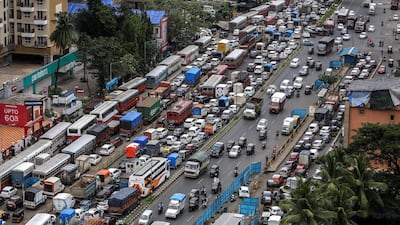
A general view of huge traffic jam on the Western Express Highway near Mumbai in June. The Indian commercial capital is the second most congested city in the country. EPA -

Heavy traffic is seen on a highway during heavy monsoon showers in Mumbai. India's most populous city surprisingly scores low on pollution rankings in the country, finishing 37th in a poll in 2018. AFP -

A visitor interacts with a representative next to a display of solar panels at a stall during "Inter Solar 2018", an international exhibition on solar technology and energy held in Bangalore. AFP -
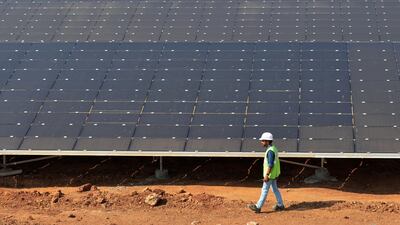
A worker conducts routine checks of solar panels at Shakti Sthala, the 2000MW solar power park in Pavagada Taluk, situated about 150 kms from the South Indian city of Bangalore. AFP -
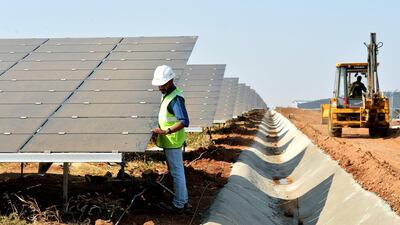
India, Asia's third-largest economy plans to add 100GW of solar capacity by 2022. AFP -

Commuters board the solar-powered DEMU (diesel electrical multiple unit) train at Sarai Rohilla railway station in New Delhi. AFP -
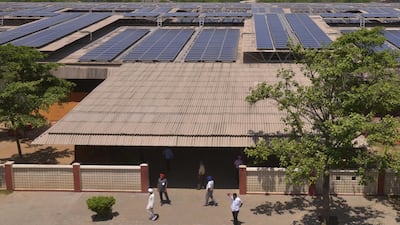
Rooftops covered in solar panels are seen at the Indian Solar Photovoltaic Power Plant, some 45kms from Amritsar. India generates just over a fifth of its power from renewables. AFP -

Kusumben Parmar works near recently installed solar panels, which help to pump water to irrigate her fields in the village of Dhundi, some 90kms from Ahmedabad in Gujarat state. AFP -
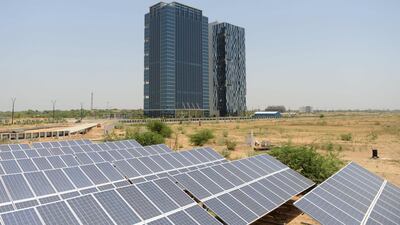
Buildings and solar panels, part of the Gujarat International Finance Tec-City are seen on the outskirts of Gandhinagar in Gujarat. India plans to derive 57% of electricity generation from renewables by 2027. AFP


At the World Economic Forum's annual meeting in Davos last week, the India chapter of the Alliance of CEO Climate Action Leaders, aimed at boosting the country's climate action and decarbonisation efforts, was launched.
Although it is proving challenging for India to wean itself off fossil fuels amid its rising energy needs, Reliance and Adani are playing a key role in the country's transition to green energy.
The two conglomerates have plans to invest a combined total of $142bn in clean power over the coming decades, including in solar, wind, and green hydrogen projects.
Industry experts say that the current push in the area of fossil fuels does not mean that the two billionaires will neglect their green energy ambitions. In fact, the extra revenue could help accelerate these plans.
“Additional cashflows, in fact, could be leveraged to expedite the development of renewable energy projects and carbon offsetting projects instead of tapping the market to fund the ambitious projects,” Mr Garg said.
Vinit Bolinjkar, head of research at Ventura Securities, agreed with this viewpoint.
“The disruption in global energy prices and increase in the production of fossil fuels will earn phenomenal profits for Reliance and Adani for the next two to three years,” he said.
“And these cash flows are expected to be utilised for creating a strong installed base for green energy for multiyear growth.”
The consensus is that the shift to renewables will still take a significant amount of time and India will not be able to reduce its dependence on fossil fuels in the foreseeable future.
“India is gradually shifting its electricity production towards renewable sources such as wind and solar,” Mr Bolinjkar said.
“However, in a growing and populated country like India, where the power demand is huge and it is growing annually, solar and wind alone could not handle the pressure.”
Despite the current environment and India's heavy dependence on fossil fuels, analysts remain optimistic about India's green energy plans.
“In spite of the opportunities in fossil fuels stoked by the Russia-Ukraine conflict, both the Adani Group and Reliance Industries have kept their green energy plans unaltered,” Mr Maitra said.
“We can safely say that India’s plans towards energy transition remain intact.”

