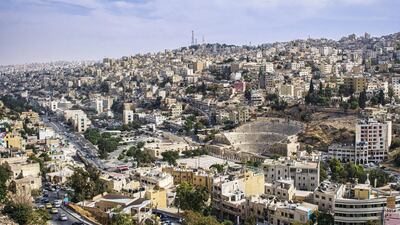
Jordan responded “quickly and decisively” to support its economy despite significant challenges posed by the Covid-19 pandemic and the kingdom continues to make progress on its economic and fiscal reform agenda, the International Monetary Fund's managing director said.
The Washington-based lender is committed to helping Jordanian authorities contain the economic and financial impact of the pandemic and build a stronger and more resilient economy, Kristalina Georgieva said in a statement on Monday to mark the kingdom's centenary.
“Timely and targeted fiscal measures have helped protect jobs and the vulnerable, while equitable tax reforms – aimed at tackling evasion, closing loopholes, and broadening the tax base – have helped maintain debt sustainability,” Ms Georgieva said.
“At the same time, a sizable monetary stimulus has supported the recovery, while financial stability and adequate reserve buffers have been preserved.”
Ms Georgieva said she has held a “very constructive discussion” with Jordan’s Finance Minister Mohamad Al Ississ and the kingdom’s central bank governor Ziad Fariz on "the strong reform progress made under the IMF-supported programme".
However, Jordan needs to address high unemployment – especially among the country’s youth and women – reform its electricity sector, boost business competitiveness and strengthen governance to deliver “durable, jobs-rich and inclusive growth”.
Jordan, which relies on foreign aid and grants to finance its fiscal and current account needs, is trying to overhaul its economy and cut state subsidies as public debt and unemployment are on the rise.
The kingdom is also looking to boost oil production and expand its non-oil economy, however, a large number of Syrian refugees and outbreak of Covid-19 have deepened its economic and fiscal woes.
Jordan’s debt-to-gross domestic product ratio widened to 109 per cent last year from 97.4 per cent in 2019, according to World Bank data. Unemployment hit a high of 25 per cent in the fourth quarter of 2020, with youth unemployment rising to 55 per cent, according to the IMF.
The recovery of tourism sector, a key source of foreign exchange, and some of the other contact intensive sectors has also slowed with delays in the kingdom's vaccination programme.
However, fiscal as well as monetary easing and the liquidity provided to the private sector have provided a floor to the economy, Jihad Azour, head of the IMF's Middle East and Central Asia department, told The National, earlier this week.
"What is needed going forward is that the fiscal strategy will remain anchored, an equitable tax reform that helps close loopholes, but also to maintain reforms that are introduced in order to reduce the cost of energy, reduce the cost of labour and allow the economy to become more competitive," Mr Azour said.
The fund is supporting the reform progamme of Jordan and it is on track, but "only by accelerating structural reforms [can] Jordan’s economy recover faster," he added.
Last month, the IMF increased the size of Jordan's existing loan facility by $200 million to help the country deal with “higher-than-expected Covid-related spending”.
The total amount disbursed to the kingdom, including the two-year Extended Fund Facility and money provided under the Covid-19 emergency loan programme, is about $1.95 billion for the 2020-2024 period.
With the IMF-backed programme and progress on reform agenda, Jordan’s economy is expected to grow by 2 per cent this year after contracting 2 per cent in 2020, according to the fund.
Jordan, which is hosting 1.3 million Syrian refugees, will still need “robust, timely and scaled-up donor assistance” to help it protect the lives and livelihoods of its citizens and refugees, Ms Georgieva said.

Ten tax points to be aware of in 2026
1. Domestic VAT refund amendments: request your refund within five years
If a business does not apply for the refund on time, they lose their credit.
2. E-invoicing in the UAE
Businesses should continue preparing for the implementation of e-invoicing in the UAE, with 2026 a preparation and transition period ahead of phased mandatory adoption.
3. More tax audits
Tax authorities are increasingly using data already available across multiple filings to identify audit risks.
4. More beneficial VAT and excise tax penalty regime
Tax disputes are expected to become more frequent and more structured, with clearer administrative objection and appeal processes. The UAE has adopted a new penalty regime for VAT and excise disputes, which now mirrors the penalty regime for corporate tax.
5. Greater emphasis on statutory audit
There is a greater need for the accuracy of financial statements. The International Financial Reporting Standards standards need to be strictly adhered to and, as a result, the quality of the audits will need to increase.
6. Further transfer pricing enforcement
Transfer pricing enforcement, which refers to the practice of establishing prices for internal transactions between related entities, is expected to broaden in scope. The UAE will shortly open the possibility to negotiate advance pricing agreements, or essentially rulings for transfer pricing purposes.
7. Limited time periods for audits
Recent amendments also introduce a default five-year limitation period for tax audits and assessments, subject to specific statutory exceptions. While the standard audit and assessment period is five years, this may be extended to up to 15 years in cases involving fraud or tax evasion.
8. Pillar 2 implementation
Many multinational groups will begin to feel the practical effect of the Domestic Minimum Top-Up Tax (DMTT), the UAE's implementation of the OECD’s global minimum tax under Pillar 2. While the rules apply for financial years starting on or after January 1, 2025, it is 2026 that marks the transition to an operational phase.
9. Reduced compliance obligations for imported goods and services
Businesses that apply the reverse-charge mechanism for VAT purposes in the UAE may benefit from reduced compliance obligations.
10. Substance and CbC reporting focus
Tax authorities are expected to continue strengthening the enforcement of economic substance and Country-by-Country (CbC) reporting frameworks. In the UAE, these regimes are increasingly being used as risk-assessment tools, providing tax authorities with a comprehensive view of multinational groups’ global footprints and enabling them to assess whether profits are aligned with real economic activity.
Contributed by Thomas Vanhee and Hend Rashwan, Aurifer
The%20specs
%3Cp%3E%3Cstrong%3EPowertrain%3A%20%3C%2Fstrong%3ESingle%20electric%20motor%0D%3Cbr%3E%3Cstrong%3EPower%3A%20%3C%2Fstrong%3E201hp%0D%3Cbr%3E%3Cstrong%3ETorque%3A%20%3C%2Fstrong%3E310Nm%0D%3Cbr%3E%3Cstrong%3ETransmission%3A%20%3C%2Fstrong%3ESingle-speed%20auto%0D%3Cbr%3E%3Cstrong%3EBattery%3A%20%3C%2Fstrong%3E53kWh%20lithium-ion%20battery%20pack%20(GS%20base%20model)%3B%2070kWh%20battery%20pack%20(GF)%0D%3Cbr%3E%3Cstrong%3ETouring%20range%3A%20%3C%2Fstrong%3E350km%20(GS)%3B%20480km%20(GF)%0D%3Cbr%3E%3Cstrong%3EPrice%3A%20%3C%2Fstrong%3EFrom%20Dh129%2C900%20(GS)%3B%20Dh149%2C000%20(GF)%0D%3Cbr%3E%3Cstrong%3EOn%20sale%3A%3C%2Fstrong%3E%20Now%3C%2Fp%3E%0A
How to register as a donor
1) Organ donors can register on the Hayat app, run by the Ministry of Health and Prevention
2) There are about 11,000 patients in the country in need of organ transplants
3) People must be over 21. Emiratis and residents can register.
4) The campaign uses the hashtag #donate_hope
The Pope's itinerary
Sunday, February 3, 2019 - Rome to Abu Dhabi
1pm: departure by plane from Rome / Fiumicino to Abu Dhabi
10pm: arrival at Abu Dhabi Presidential Airport
Monday, February 4
12pm: welcome ceremony at the main entrance of the Presidential Palace
12.20pm: visit Abu Dhabi Crown Prince at Presidential Palace
5pm: private meeting with Muslim Council of Elders at Sheikh Zayed Grand Mosque
6.10pm: Inter-religious in the Founder's Memorial
Tuesday, February 5 - Abu Dhabi to Rome
9.15am: private visit to undisclosed cathedral
10.30am: public mass at Zayed Sports City – with a homily by Pope Francis
12.40pm: farewell at Abu Dhabi Presidential Airport
1pm: departure by plane to Rome
5pm: arrival at the Rome / Ciampino International Airport
Sui Dhaaga: Made in India
Director: Sharat Katariya
Starring: Varun Dhawan, Anushka Sharma, Raghubir Yadav
3.5/5
The years Ramadan fell in May
