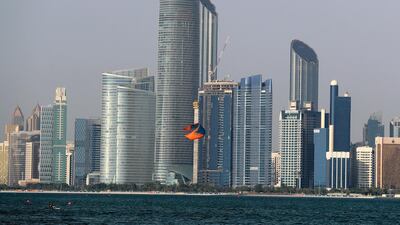
The Arab world's two largest economies continued to recover from the Covid-19 induced slowdown as pandemic restrictions eased and the number of infections continued to decline.
The headline seasonally adjusted IHS Markit Saudi Arabia Purchasing Managers’ Index – a composite gauge designed to give a single-figure snapshot of operating conditions in the non-oil private sector economy – rose to 50 in in July from 47.7 in June. The upturn is the highest in five months, signalling overall stability in operating conditions in the kingdom.
A reading above the neutral 50 mark indicates economic expansion, while anything below points to a contraction.
"The July PMI scoring exactly 50 is a clear indication that the Saudi non-oil private sector is over the worst of the disruption caused by the pandemic," Trevor Balchin, economics director at IHS Markit, said.
It however, still remains some way from 'normal' business conditions. The latest figure is the highest since February but well below the long-run trend level of 57.1, he added.
"UAE business activity continued to expand at a solid pace in July, as firms enjoyed another upturn in new work," David Owen, an economist at IHS Markit, said.
The volume of new orders placed with Saudi non-oil private sector companies, which declined in the previous four months as the government imposed a lockdown to curb the spread of the virus, was broadly stable in July. Data indicated resilient domestic demand, although new export orders continued to fall, according to the survey.
The level of total business activity neared stabilisation in July. Several firms surveyed said that improved conditions and focus on marketing activities had supported business levels.
Though non-oil private sector employment in Saudi Arabia fell for the fifth month running, it was at a slower rate than June's record. Firms continued to cut workforces on average and a number of companies said they laid off staff to reduce business overheads.
The 12-month outlook for non-oil business activity also improved in July, with the Future Output Index rising back above the 50 neutral mark to a five-month high.
The seasonally-adjusted IHS Markit UAE Purchasing Managers' Index advanced to 50.8 in July from 50.4 in June, to signal a second successive monthly improvement in business conditions. Rising new business drove a solid upturn in non-oil economic activity.
The further easing of movement restrictions helped improve customer demand at the start of the third quarter in the UAE. Following June's expansion, the latest increase was solid overall.
The rise in total demand encouraged UAE firms to expand output again in July. The rate of growth was the fastest seen in 10 months. According to survey respondents, the starting of new projects and an increase in marketing partly drove the rise in business activity.
"UAE business activity continued to expand at a solid pace in July, as firms enjoyed another upturn in new work," David Owen, an economist at IHS Markit, said. "The further reopening of the economy ... helped to reinvigorate consumer spending."
The future output sentiment, however, is dependent on how demand recovers in the coming months, as firms hope that the economy will make "strides back to pre-Covid-19 output levels over the second half of 2020", Mr Owen added.
Egypt's PMI also signalled a return to growth in July, as non-oil private sector output rose for the first time in a year, albeit mildly. New business also expanded as export conditions improved, leading to slower declines in employment and inventories.
The IHS Markit Egypt Purchasing Managers’ Index registered a reading of 49.6 in July, up from 44.6 in June and the closest to the neutral 50 mark in 12 months.
"While the headline index posted at 49.6, it was the output and new orders sub-indexes that gave confidence of the start of an economic recovery in July," Mr Owen said.
"Both indicated monthly expansions for the first time in 12 months, after the series signalled the worst economic downturn in its nine-year history during the Covid-19 crisis."
The improvement in non-oil economies of Saudi Arabia, the UAE and Egypt is in line with strengthening PMIs of some of emerging and developed markets.
China's factories expanded at the fastest pace in nearly a decade in July, on the back of higher domestic demand, pushing the Caixin/Markit Manufacturing Purchasing Managers' Index to 52.8 from June's 51.2.
The country's Business Activity Index on Wednesday slipped to 54.1 in July, down from 58.4 in June. While it was lower than the previous month's more than 10-year record, the index again signalled a marked rise in activity that was in line with the survey's long-term trend.
Eurozone factories have also mirrored the Chinese recovery last month, with IHS Markit Eurozone Manufacturing PMI registering 51.8, up from 47.4 in the previous month. Spain was the strongest-performing nation overall, with a 53.5 PMI.

more from Janine di Giovanni
ELECTION%20RESULTS
%3Cp%3EMacron%E2%80%99s%20Ensemble%20group%20won%20245%20seats.%26nbsp%3B%3C%2Fp%3E%0A%3Cp%3EThe%20second-largest%20group%20in%20parliament%20is%20Nupes%2C%20a%20leftist%20coalition%20led%20by%20Jean-Luc%20Melenchon%2C%20which%20gets%20131%20lawmakers.%26nbsp%3B%3C%2Fp%3E%0A%3Cp%3EThe%20far-right%20National%20Rally%20fared%20much%20better%20than%20expected%20with%2089%20seats.%3C%2Fp%3E%0A%3Cp%3EThe%20centre-right%20Republicans%20and%20their%20allies%20took%2061.%3C%2Fp%3E%0A
Global state-owned investor ranking by size
|
1.
|
United States
|
|
2.
|
China
|
|
3.
|
UAE
|
|
4.
|
Japan
|
|
5
|
Norway
|
|
6.
|
Canada
|
|
7.
|
Singapore
|
|
8.
|
Australia
|
|
9.
|
Saudi Arabia
|
|
10.
|
South Korea
|
How Islam's view of posthumous transplant surgery changed
Transplants from the deceased have been carried out in hospitals across the globe for decades, but in some countries in the Middle East, including the UAE, the practise was banned until relatively recently.
Opinion has been divided as to whether organ donations from a deceased person is permissible in Islam.
The body is viewed as sacred, during and after death, thus prohibiting cremation and tattoos.
One school of thought viewed the removal of organs after death as equally impermissible.
That view has largely changed, and among scholars and indeed many in society, to be seen as permissible to save another life.
COMPANY%20PROFILE
%3Cp%3ECompany%20name%3A%20Znap%3C%2Fp%3E%0A%3Cp%3EStarted%3A%202017%3C%2Fp%3E%0A%3Cp%3EFounder%3A%20Uday%20Rathod%3C%2Fp%3E%0A%3Cp%3EBased%3A%20Dubai%2C%20UAE%3C%2Fp%3E%0A%3Cp%3EIndustry%3A%20FinTech%3C%2Fp%3E%0A%3Cp%3EFunding%20size%3A%20%241m%2B%3C%2Fp%3E%0A%3Cp%3EInvestors%3A%20Family%2C%20friends%3C%2Fp%3E%0A
Biog
Age: 50
Known as the UAE’s strongest man
Favourite dish: “Everything and sea food”
Hobbies: Drawing, basketball and poetry
Favourite car: Any classic car
Favourite superhero: The Hulk original
If you go
The flights
There are direct flights from Dubai to Sofia with FlyDubai (www.flydubai.com) and Wizz Air (www.wizzair.com), from Dh1,164 and Dh822 return including taxes, respectively.
The trip
Plovdiv is 150km from Sofia, with an hourly bus service taking around 2 hours and costing $16 (Dh58). The Rhodopes can be reached from Sofia in between 2-4hours.
The trip was organised by Bulguides (www.bulguides.com), which organises guided trips throughout Bulgaria. Guiding, accommodation, food and transfers from Plovdiv to the mountains and back costs around 170 USD for a four-day, three-night trip.
Mercer, the investment consulting arm of US services company Marsh & McLennan, expects its wealth division to at least double its assets under management (AUM) in the Middle East as wealth in the region continues to grow despite economic headwinds, a company official said.
Mercer Wealth, which globally has $160 billion in AUM, plans to boost its AUM in the region to $2-$3bn in the next 2-3 years from the present $1bn, said Yasir AbuShaban, a Dubai-based principal with Mercer Wealth.
“Within the next two to three years, we are looking at reaching $2 to $3 billion as a conservative estimate and we do see an opportunity to do so,” said Mr AbuShaban.
Mercer does not directly make investments, but allocates clients’ money they have discretion to, to professional asset managers. They also provide advice to clients.
“We have buying power. We can negotiate on their (client’s) behalf with asset managers to provide them lower fees than they otherwise would have to get on their own,” he added.
Mercer Wealth’s clients include sovereign wealth funds, family offices, and insurance companies among others.
From its office in Dubai, Mercer also looks after Africa, India and Turkey, where they also see opportunity for growth.
Wealth creation in Middle East and Africa (MEA) grew 8.5 per cent to $8.1 trillion last year from $7.5tn in 2015, higher than last year’s global average of 6 per cent and the second-highest growth in a region after Asia-Pacific which grew 9.9 per cent, according to consultancy Boston Consulting Group (BCG). In the region, where wealth grew just 1.9 per cent in 2015 compared with 2014, a pickup in oil prices has helped in wealth generation.
BCG is forecasting MEA wealth will rise to $12tn by 2021, growing at an annual average of 8 per cent.
Drivers of wealth generation in the region will be split evenly between new wealth creation and growth of performance of existing assets, according to BCG.
Another general trend in the region is clients’ looking for a comprehensive approach to investing, according to Mr AbuShaban.
“Institutional investors or some of the families are seeing a slowdown in the available capital they have to invest and in that sense they are looking at optimizing the way they manage their portfolios and making sure they are not investing haphazardly and different parts of their investment are working together,” said Mr AbuShaban.
Some clients also have a higher appetite for risk, given the low interest-rate environment that does not provide enough yield for some institutional investors. These clients are keen to invest in illiquid assets, such as private equity and infrastructure.
“What we have seen is a desire for higher returns in what has been a low-return environment specifically in various fixed income or bonds,” he said.
“In this environment, we have seen a de facto increase in the risk that clients are taking in things like illiquid investments, private equity investments, infrastructure and private debt, those kind of investments were higher illiquidity results in incrementally higher returns.”
The Abu Dhabi Investment Authority, one of the largest sovereign wealth funds, said in its 2016 report that has gradually increased its exposure in direct private equity and private credit transactions, mainly in Asian markets and especially in China and India. The authority’s private equity department focused on structured equities owing to “their defensive characteristics.”
The specs: 2018 Mercedes-Benz S 450
Price, base / as tested Dh525,000 / Dh559,000
Engine: 3.0L V6 biturbo
Transmission: Nine-speed automatic
Power: 369hp at 5,500rpm
Torque: 500Nm at 1,800rpm
Fuel economy, combined: 8.0L / 100km
COMPANY%20PROFILE
%3Cp%3E%3Cstrong%3ECompany%20name%3C%2Fstrong%3E%3A%20ASI%20(formerly%20DigestAI)%3C%2Fp%3E%0A%3Cp%3E%3Cstrong%3EStarted%3A%3C%2Fstrong%3E%202017%3C%2Fp%3E%0A%3Cp%3E%3Cstrong%3EFounders%3A%3C%2Fstrong%3E%20Quddus%20Pativada%3C%2Fp%3E%0A%3Cp%3E%3Cstrong%3EBased%3A%3C%2Fstrong%3E%20Dubai%2C%20UAE%3C%2Fp%3E%0A%3Cp%3E%3Cstrong%3EIndustry%3A%3C%2Fstrong%3E%20Artificial%20intelligence%2C%20education%20technology%3C%2Fp%3E%0A%3Cp%3E%3Cstrong%3EFunding%3A%3C%2Fstrong%3E%20%243%20million-plus%3C%2Fp%3E%0A%3Cp%3E%3Cstrong%3EInvestors%3A%3C%2Fstrong%3E%20GSV%20Ventures%2C%20Character%2C%20Mark%20Cuban%3C%2Fp%3E%0A
More on animal trafficking
Killing of Qassem Suleimani
More from Neighbourhood Watch:
Read more about the coronavirus
The burning issue
The internal combustion engine is facing a watershed moment – major manufacturer Volvo is to stop producing petroleum-powered vehicles by 2021 and countries in Europe, including the UK, have vowed to ban their sale before 2040. The National takes a look at the story of one of the most successful technologies of the last 100 years and how it has impacted life in the UAE.
Read part four: an affection for classic cars lives on
Read part three: the age of the electric vehicle begins
Read part one: how cars came to the UAE
The biog
Name: Salem Alkarbi
Age: 32
Favourite Al Wasl player: Alexandre Oliveira
First started supporting Al Wasl: 7
Biggest rival: Al Nasr
Match info
Huddersfield Town 0
Chelsea 3
Kante (34'), Jorginho (45' pen), Pedro (80')
Ferrari 12Cilindri specs
Engine: naturally aspirated 6.5-liter V12
Power: 819hp
Torque: 678Nm at 7,250rpm
Price: From Dh1,700,000
Available: Now
World Cricket League Division 2
In Windhoek, Namibia - Top two teams qualify for the World Cup Qualifier in Zimbabwe, which starts on March 4.
UAE fixtures
Thursday February 8, v Kenya; Friday February 9, v Canada; Sunday February 11, v Nepal; Monday February 12, v Oman; Wednesday February 14, v Namibia; Thursday February 15, final
