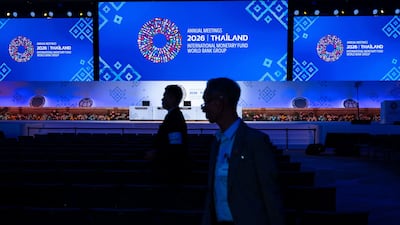

The world’s finance ministers and central bankers are set to gather for this year’s IMF and World Bank annual meetings as a new set of inflationary drivers descends on the global economy.
This year, representatives from the IMF and World Bank member countries will meet in Bangkok, Thailand, from Monday. The meetings are typically held in Washington for two consecutive years and in another member country every third year. The 2029 annual meetings will be held in Abu Dhabi.
During the meetings, the Bretton Woods institutions’ board of governors hold discussions on how international monetary issues should be addressed, while other talks are held on emerging economic trends and regional programmes.

This year's meetings come amid a renewed threat of inflation. Supply disruptions from the Iran war are pushing up energy prices, with the Strait of Hormuz’s prolonged partial closure driving the price for Brent crude roughly 30 per cent higher than prewar levels.
The expansion of artificial intelligence is placing additional pressure on electricity demand, and the massive debt issuance it requires partially accounts for the recent rise in bond yields, also driven by the US national debt reaching $40 trillion.
The global economy is still grappling with the inflationary after-effects of the Covid-19 pandemic and Russia’s 2022 invasion of Ukraine. Inflation has remained above 2 per cent in the US for more than five years.
“While this rise in inflation pales in comparison with what we saw in the immediate wake of the pandemic, it is large enough to be of real concern to central banks, many of whom hadn't wrestled inflation back to its target before this episode had begun,” Karen Dynan, non-resident senior fellow at the Peterson Institute, said during a round-table discussion on Tuesday in Washington.
Speaking in Singapore on Tuesday, IMF managing director Kristalina Georgieva said the environment was right for most countries to adopt a “prudently hawkish” posture.
The US Federal Reserve, the world’s most influential central bank, entered a new tightening cycle in September after it raised interest rates by a quarter point. The European Central Bank and Bank of Japan have also recently raised rates due to rising inflation. The Bank of England is expected to hike rates next month.
Meanwhile, US government borrowing costs have reached multi-decade highs. The yield on the 10-year US Treasury, a benchmark for global borrowing costs, recorded a 24-year high this week. Bond yields in Germany, the UK and Japan are also on the rise.
Against this backdrop, Ms Georgieva suggested austerity was back on the menu for advanced economies.
“After a succession of shocks where, each time, fiscal policy has had to step in to cushion the impact, populations have grown accustomed to state support. Some very tough political choices stare us in the face,” she said.
Meeting the moment?
The question persists whether the IMF and World Bank have done enough to support low-income and conflict-afflicted countries facing higher funding costs, slower growth and shrinking aid flows.
“We are living a perfect storm at this moment, especially for low-income countries,” said Marina Zucker-Marques, a senior academic researcher at Boston University's Global Economic Governance Initiative.
Since the Iran war broke out at the end of February, the World Bank has pledged up to $60 billion in financing to help countries absorb the impact of the conflict's energy shock.
The African Development Bank Group has launched a $5.1 billion framework to offset the impact of the war's energy and fertiliser crisis on the continent. The Asian Development Bank said it is mobilising $4 billion in financing to help countries withstand the war's impact.
The IMF last week said it would provide non-financial support to war-torn Yemen, and reached a staff-level agreement with Pakistan that would unlock $1.21 billion for the country that is dependent on Gulf energy imports. Bangladesh has also requested a programme due to the war's impact.
“The international financial institutions are weathering these crises remarkably well compared to other multilaterals,” Rachel Glennerster, president of the Centre for Global Development, said during a webinar.
However, Ms Zucker-Marques questioned how eager low-income countries might be for more funding from the IMF, citing the fund's conditionality for programmes.
Ms Georgieva said in April that the fund expected at least a dozen countries, including several in sub-Saharan Africa, to seek new loan programmes to respond to the war's impact on energy prices and supply chain disruptions.
The US central bank's new tightening cycle is also expected to lead to higher borrowing costs for low-income countries seeking loans.
The Federal Reserve's rate-setting activity directly influences borrowing costs from the IMF, World Bank and other multi-development banks.
Traders anticipate the Fed will raise interest rates three more times by July 2027, according to CME Group data.
“A lot of people are talking about the bond yields, which is quite important for countries that have access to markets, but also we need to pay attention that the interest rate hike in the US is actually increasing the tide to all types of lending,” Ms Zucker-Marques said.