

Lebanon cannot achieve economic growth without social stability, its Minister of Social Affairs has said, as the country seeks to lift itself out of its protracted economic crisis.
“My ministry is seeking to make sure that we have social stability while we're going through a difficult economic period,” Haneen Sayed told The National on the sidelines of the International Monetary Fund and World Bank Spring Meetings in Washington this week.
Lebanon has experienced a severe economic crisis since 2019, exacerbated by the 2020 Port of Beirut explosion, the pandemic and the Israel-Hezbollah war. The nation's poverty rate more than tripled between 2012 and 2022.
The election of President Joseph Aoun and appointment of Prime Minister Nawaf Salam in January ended more than two years of political impasse and raised hopes that the country can finally tackle its financial and political crises. A new government was formed in February.
Ms Sayed said she is seeking an additional $200 million from the World Bank and $100 million in grants from other donors to support Lebanon's Aman programme − which provides cash transfers to 800,000 of its poorest people.
The emergency social safety net initiative, funded by the World Bank, was launched in 2022 in an effort to reduce hardship caused by Lebanon's economic crisis.
Ms Sayed said the programme contributes $25 million to the country's economy every month. “So, it has both an economic and social impact,” she said, adding that the programme is “almost entirely digitalised”.
The minister said she is also holding discussions with the World Bank on labour market strategies to help lift people out of poverty.
“The social area is very much part of the economic reform,” she said. “In the end, I don't think you can have economic stability or economic growth without social stability.”
Lebanon's delegation to Washington this week comes as Mr Aoun's pro-reform government has raised optimism that the country can tackle its economic crisis.
On Thursday, Lebanon's parliament approved amendments to the country's banking secrecy law − a key condition to secure an economic programme from the IMF.
Earlier in the week, Lebanon and the World Bank signed a $250 million loan agreement to support the country's electricity crisis, part of a larger programme that is expected to reach $1 billion. Beirut is also seeking support for digitalisation, Ms Sayed said.
She anticipates a “difficult” two years where Lebanon will need assistance to support its social programmes before the government can finance them on its own.
“Hopefully, within a couple years, we're out of this hole,” said Ms Sayed.
USAID withdrawal
Further complicating Lebanon's recovery efforts is the slashing of funding to USAID – America’s foreign aid arm – by President Donald Trump. Lebanon received $219 million in assistance from USAID last year.
The agency invested more than $80 million in Lebanon's agricultural sector over the past decade, according to the US embassy in Lebanon, leveraging more than $40 million in private sector investment and supporting incomes of more than 40,000 households.
USAID cuts have also affected small and medium-sized enterprise programmes and university scholarships.
While the cuts create a new challenge, Ms Sayed said she's hopeful that Lebanon's economic reforms could make it an attractive place for the country's diaspora.
“In the end, we have to be sustainable on our own. We have to stand on our feet,” she said.
Meanwhile, reductions in funding for the UN’s refugee programme could also complicate efforts to assist the return of Syrian refugees in Lebanon to their own country, following the overthrow of the Assad regime at the end of 2024.
About 400,000 displaced Syrians in Lebanon have expressed an interest in returning home, according to Ms Sayed.
“This is a big change from years before, where 1 per cent would say they want to go back,” she said.
However, the office of the UN's refugee agency that Lebanon has been working with to support displaced Syrians is losing funding, Ms Sayed said. Lebanon's programme will be one of the casualties of this, she added.
Facing the prospect of a potential ceasing of funding in UNHCR support for refugees' education and health in Lebanon, their “return is going to have to really be accelerated”, she said.
Lebanon is working with UNHCR on costs and timeline for the 400,000 refugees to return to Syria this year, she added.
-

Beirut Port Blast Stories is a documentary that explores the aftermath of the August 2020 disaster. Photo: Cherine Yazbeck -

Produced over two and a half years, the 30-minute film first screened in May at Beirut’s Zoukak Theatre. Photo: AD Leb -

The film features testimony from families of the blast's victims, including Mariana Fodoulian who lost her sister Gaia in the explosion. Photo: Cherine Yazbeck -
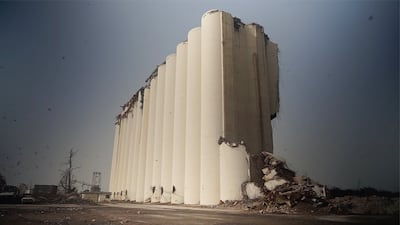
The silos of the Port of Beirut shielded much of West Beirut from the worst of the explosion, becoming an unofficial memorial. Photo: Cherine Yazbeck -

'We hope to move international audiences, because it's really important to keep these memories alive. People here have already put it in the past,' Vartivarian tells The National. Photo: AD Leb



