

A team from the International Monetary Fund held discussions with Ukrainian authorities this week and will work on their request for enhanced programme monitoring after Russia's invasion, IMF mission chief Gavin Gray said on Friday.
Mr Gray said IMF staff met for four days in Vienna with Ukrainian authorities, and discussed their findings with Finance Minister Serhiy Marchenko and National Bank of Ukraine governor Andriy Pyshnyi.
He said Ukrainian leaders deserved “considerable credit” for maintaining an “important degree of macroeconomic stability” after the invasion, which has caused a severe contraction in gross domestic product and a sharp rise in inflation, while sending the country's fiscal deficit to unprecedented levels.
“The Russian invasion of Ukraine that started over seven months ago has caused tremendous human suffering and had a severe economic impact,” Mr Gray said.
He added that the talks focused on recent macro-financial developments, the 2023 budget and associated external financing needs, financial sector issues and the mix of policies to support macroeconomic stability.
Mr Gray said IMF officials were encouraging Ukraine to refrain from measures that erode tax revenue as they worked to align expenditures with available financing, but gave no details.
He said both sides would continue work in coming weeks on Kyiv's request for Programme Monitoring with Board Involvement, a new option recently approved by the fund's board.
Such an agreement would set out the authorities’ policy intentions to support macroeconomic and financial stability and present an assessment of external financing needs for 2023, and could pave the way for a fully-fledged IMF programme, Mr Gray said.
-
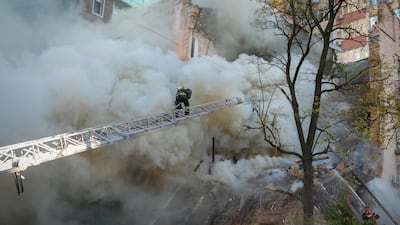
Firefighters in action after a drone fired on buildings in Kyiv, Ukraine. AP -
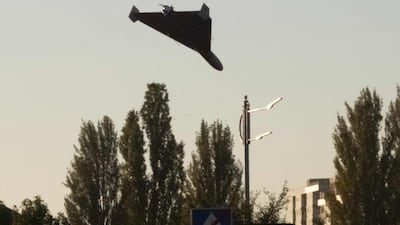
A drone approaches for an attack in the Ukraine capital. AFP -
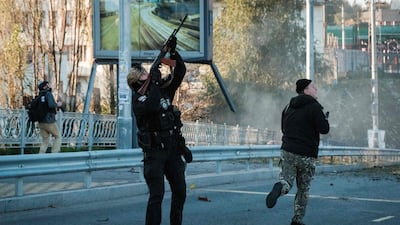
A police officer fires at a drone flying overhead. AFP -
Smoke rises from a building after a drone attack. AFP -
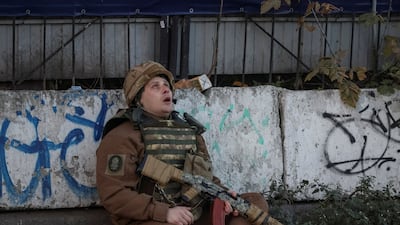
A Ukrainian serviceman takes cover as an air-raid siren sounds. Reuters -

Debris near the site of a drone attack. AFP -
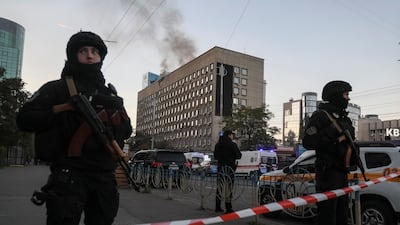
Police stand guard as smoke rises from buildings. Reuters -
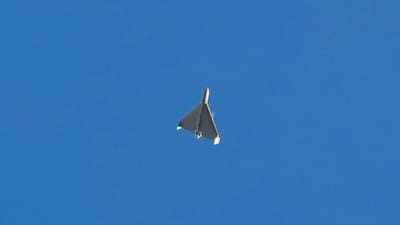
A drone in the sky seconds before it fired on buildings. AP -
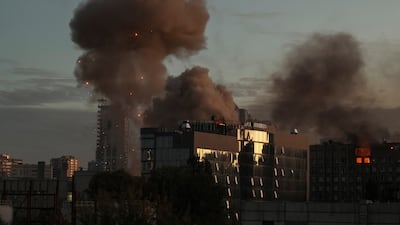
Plumes of smoke rise after a Russian drone strike. Reuters


The IMF this month approved $1.3 billion in emergency funding for Ukraine through a new food shock window, on top of $1.4bn in emergency aid approved in March.
Ukrainian authorities are seeking new IMF lending of around $20bn as part of a larger programme.
Ukrainian President Volodymyr Zelenskyy last week appealed to international donors for $55bn in additional financial support — $38bn to cover next year's estimated budget deficit, and another $17bn to start to rebuild critical infrastructure.

