

Pakistan's new finance minister Ishaq Dar said on Friday he will seek rescheduling of some $27 billion worth of non-Paris Club debt largely owed to China, but will not pursue haircuts as part of any restructuring.
In an interview, Mr Dar ruled out the possibility of a default on Pakistan's debt, an extension of the maturity date on bonds due in December or a renegotiation of Pakistan's current International Monetary Fund programme.
The veteran finance minister said multilateral development banks and international donors have been "quite flexible" with ways to meet Pakistan's external financing needs estimated at about $32bn after devastating floods.
Some of this may come from reallocating funds from previously approved, slower-disbursing development loans, he said.
Mr Dar, who participated in the IMF and World Bank annual meetings just over two weeks after taking office, said that Pakistan will seek restructuring on equal terms for all bilateral creditors.
He declined to comment when asked whether he thought it would be difficult to persuade China, creditor for about $23bn of the debt, to participate.
But asked whether Pakistan would seek to reduce debt principal, he said "rescheduling is fine, but we are not seeking a haircut. That's not fair".
Mr Dar, who served as Pakistan's finance minister three previous times — most recently from 2013 to 2017 — is known as a staunch defender of the rupee.
He said Pakistan has not engaged in physical intervention in the currency, which has been battered this year by a strong US dollar, but which has rallied some 10 per cent since his appointment.
Mr Dar said that he views the "true value" of the rupee at a level under 200 to the dollar. It last traded at 219.
"I am for a stable currency, I am for a realistic rate. I am for market-based, but not subject to a currency being taken hostage" and making speculators billions of dollars.
Asked whether he discussed with IMF officials the possibility of borrowing from the fund's new Resilience and Sustainability Trust for middle-income countries, Mr Dar said: "We have discussed all options."
-

People affected by floods queue to receive food distributed by the Red Crescent Society in Larkana, Pakistan. EPA -

Al Mahmood Social Welfare Association workers prepare food aid in Larkana, Pakistan. EPA -
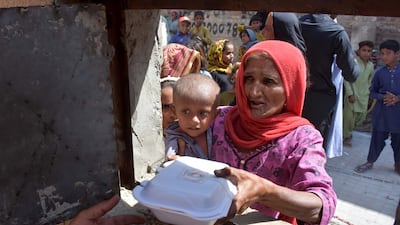
More than 33 million people have been affected by floods since June 2022, Pakistan's Climate Change Minister Sherry Rehman says. EPA -

A Pakistan Red Crescent Society worker sorts food parcels to be distributed to people affected by floods in Larkana. EPA -
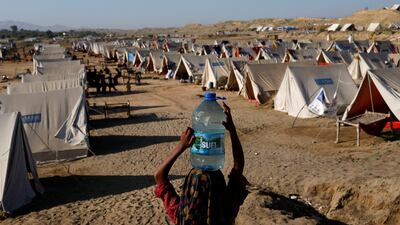
A girl carries a bottle filled with floodwater at a camp for displaced people in Sehwan, Pakistan. Reuters -
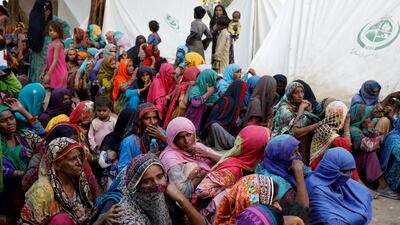
Women affected by the floods wait for food aid at a camp for displaced people in Sehwan. Reuters -
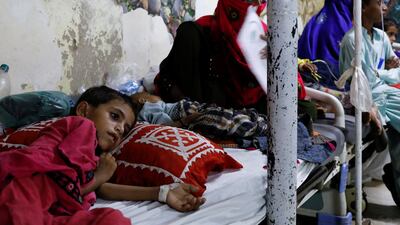
Flood-affected children suffering from malaria receive treatment at the Sayed Abdullah Shah Institute of Medical Sciences in Sehwan. Reuters -
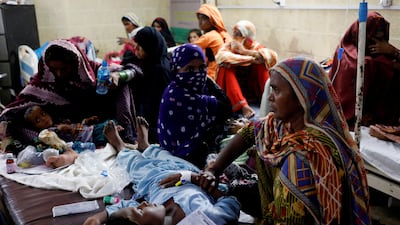
Women wait with their sick children at the medical institute in Sehwan. Reuters -
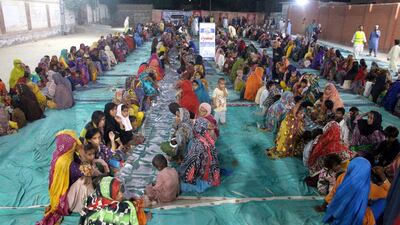
Flood-affected people eat food distributed by Al Mahmood Social Welfare Association in Larkana. EPA


The minister added that the IMF's new emergency "food shock" borrowing window may also be a good fit for the country, which has lost crops due to devastating floods and may need to import up to half-million of tonnes of wheat in the next year.
"In this scenario, we have the possibility to approaching and accessing this facility," he said.
In a separate interview, Mr Dar estimated that it could take “close to three years" for the South Asian country to recover from devastating floods that killed more than 1,700 people and displaced another 7.9 million.
Losses from the floods were estimated to surpass $32bn and that the cost of rebuilding damaged infrastructure will exceed $16bn, he said.
Monsoon rains, likely made worse by climate change, hammered Pakistan for months starting in mid-June, damaging or washing away 2 million homes.
Rebuilding, Mr Dar said, “can’t be done overnight'' and will take “maybe close to three years: though he acknowledged that he was "not an engineer". The World Bank last month pledged $2bn in flood aid.

