


The UAE has engaged in a new round of talks with the Chinese Business Council in Dubai to enhance investments and expand partnerships as the two countries seek to align their economic vision for the future.
China, the world's second-largest economy, is a “very important” strategic partner for the Emirates in South-East Asia, with both having common economic fields of interest, Dr Thani Al Zeyoudi, Minister of State for Foreign Trade, said in a meeting with the Chinese Business Council in Dubai.
Dr Al Zeyoudi and representatives from the ministry met Wang Guihai, chairman of the CBC, and representatives from the Chinese companies that are part of the council.
The UAE and China “share the strategic visions and objectives through which a golden era of comprehensive economic relations between the two countries was established”, Dr Al Zeyoudi said.
“During the next stage, we look forward to expanding and diversifying the existing economic and commercial partnerships between the two countries.
“We intend to stimulate the flow of mutual investments, especially in the sectors of the future economy which serve the business communities and the development agenda of both the countries and support their transformation towards a more flexible and sustainable economy.”
The UAE and China have long-standing relations and share a strategic vision to co-operate in energy, technology, the green economy and the digital economy.
Bilateral trade during the first nine months of 2021 exceeded $49 billion, which is a 38 per cent increase on the same period in 2020, Chinese ambassador to the UAE Ni Jian told state news agency Wam in December.
Chinese non-financial direct investment flows to the UAE in 2020 were valued at $570 million, accounting for more than 47 per cent of the total Chinese investment in the Arab world, Mr Ni said.
More than 6,000 Chinese companies are present in the UAE's energy, ports, infrastructure, communications and finance sectors.
The UAE continued to prove its resilience during and after the coronavirus pandemic, moving up a place to 14th in the latest Foreign Direct Investment Confidence Index compiled by consulting company Kearney.
The nation is also strengthening its trade relations with partners. Last week, Dr Al Zeyoudi said that the Comprehensive Economic Partnership Agreement, a landmark deal between the UAE and India, will take effect on May 1.
During the meeting in Dubai, the UAE and the CBC discussed ways to enhance commercial activities between Chinese companies and their Emirati counterparts, and sought new measures to support investments and co-operation.
-
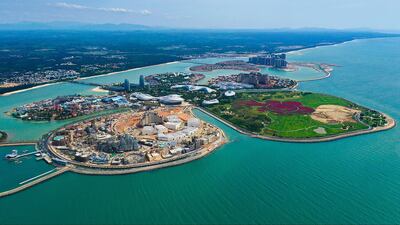
Ocean Flower Island, the artificial archipelago off the north coast of Danzhou in Hainan, China. All photos: Alamy -

The group of islands was built by the Evergrande Group. -
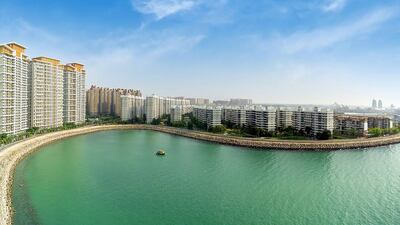
The artificial archipelago off the coast of Danzhou is made up of three islets with a total area of 381 hectares. -
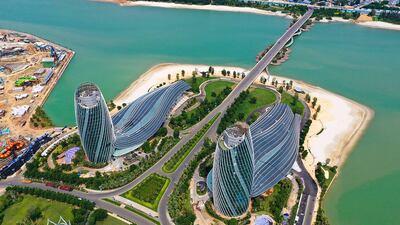
A local politician, who was later convicted of corruption charges, approved the reclamation project despite it conflicting with environmental laws. -
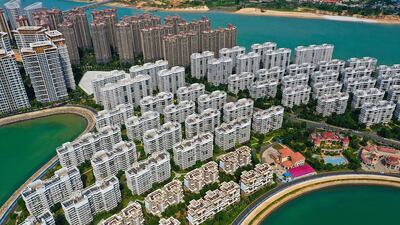
Building the archipelago damaged coral reefs and oyster populations. -
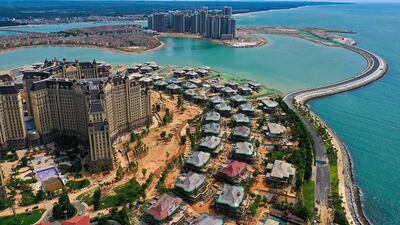
In December last year, about 40 buildings were demolished because they flouted planning regulations. -
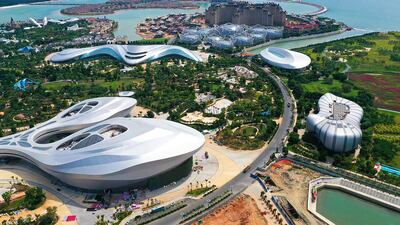
Evergrande said the demolitions would not affect further development on the islands. -
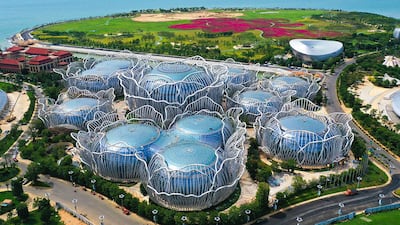
Evergrande shares climbed in January 4 trading after the company announcement that the demolitions would not stop progrees.


They emphasised their focus on sectors such as artificial intelligence, clean energy and infrastructure, and discussed a creation of a joint strategy to attract talent in technology and other sectors of the future economy.
China is the UAE's first global trading partner and accounts for 12 per cent of its non-oil foreign trade, Dr Al Zeyoudi said, quoting Ministry of Economy data.
The Emirates, meanwhile, is China's second-largest trading partner in the Arab world, accounting for 20 per cent of total trade, he said.
The volume of UAE investments in China was estimated at around Dh2bn ($540 million) at the end of 2020.
The Emirates, on the other hand, ranks first in the Arab world among the list of the 20 most important countries in which China invests, with total investments in the country amounting to more than Dh34bn in the same period, Dr Al Zeyoudi said.
Non-oil intraregional trade between the two countries rose 27 per cent to Dh220bn in 2021.
“The comprehensive partnership between the UAE and China has been reflected through their innovative co-operation,” Dr Al Zeyoudi said.
The CBC, which is registered with the Dubai Chamber, was established in June 2004 and has 186 member companies investing in the UAE in sectors including energy, construction, communications, textiles, shipping, air transport, logistics, finance, services, furniture and exhibitions, among others.

