

Turkey’s central bank revised some reserve requirement rules for banks in an effort to keep loan growth in check and encourage conversion of foreign exchange into the local currency.
The monetary authority said banks’ local currency-denominated commercial cash lending – excluding that which involves small and medium-sized enterprises, and export and agricultural loans – will be subject to reserve requirements.
Commercial loans that have been extended in four-week periods since April 1 shall be subject to a reserve requirement of 10 per cent, the central bank said.
It also raised reserve requirements for personal accounts at lenders that did not meet the target of converting foreign currency-denominated accounts into lira. The monetary authority increased the ratio for foreign currency deposits by 500 basis points for banks with a conversion rate below 5 per cent, and 300 basis points for those with a rate of between 5 per cent and 10 per cent.
The changes will be effective from the calculation date of May 27, with the maintenance period starting on June 10, it said.
The revision of reserve requirements came after the central bank kept its benchmark rate at 14 per cent for a fourth straight month despite inflation exceeding 60 per cent. Rather than adding to Turkey’s rate buffer, authorities are leaning more heavily on other policies that could bring in more hard currency and boost the central bank’s reserves.
Deepening trade imbalances and the world’s most negative borrowing costs when adjusted for prices have made the $800 billion economy increasingly vulnerable at a time of intensifying global tightening led by the US Federal Reserve.
-
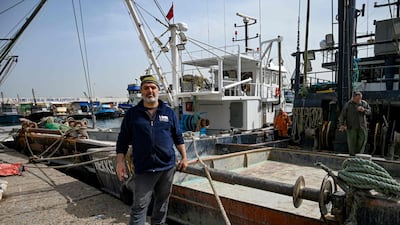
Fisherman and boat owner Sefki Deniz, 42, says '90 per cent of people that we know have stopped' going out to sea'. Turkish officials have banned fishing at night, and with the price of diesel reaching spectacular heights, many fishermen ended the fishing season three weeks early, a wise decision considering the recent discovery of stray mines in the Black Sea. All photos: AFP -
![Boat owner Sahin Afsut, at the Rumelifeneri dockside in northern Istanbul, says 'if you hit [a mine], you're finished'. Mr Afsut usually catches whiting, red mullet and anchovies from his small trawler. A mine was found recently in the Black Sea a few kilometres from the port. Another was discovered 100km farther west, and a third one in Romanian waters, 300km north.](https://www.thenationalnews.com/resizer/v2/Z67CACQCBUIMEY3CHJCSKGYRMU.jpg?smart=true&auth=ad0c24c2e3d29a88ce13babf9cbcb642a3ccd59d7f1f961d2f7b179c68837de0&width=400&height=225)
Boat owner Sahin Afsut, at the Rumelifeneri dockside in northern Istanbul, says 'if you hit [a mine], you're finished'. Mr Afsut usually catches whiting, red mullet and anchovies from his small trawler. A mine was found recently in the Black Sea a few kilometres from the port. Another was discovered 100km farther west, and a third one in Romanian waters, 300km north. -

Rumeli lighthouse and fishing boats in Rumelifeneri, a seaport at the entrance of the Bosphorus north of Istanbul. The Turkish Navy on March 21 warned of the risk of mines coming from Ukrainian waters, which may have been unmoored by a storm. -

The Yavuz Sultan Selim Bridge over the Bosphorus. -
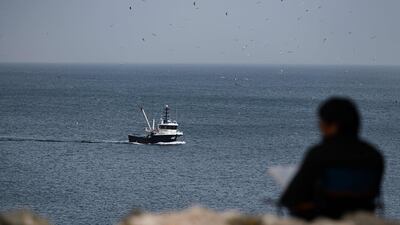
A fishing boat returns to port on the Sea of Marmara, which connects the Black Sea to the Agean Sea. -
![Fisherman and boat owner Ahmet Tarlaci, 55, describes the mine spotted near Rumelifeneri: 'It was large, like half a barrel. We watched from above there, the [special Turkish Navy] units neutralised it.'](https://www.thenationalnews.com/resizer/v2/EH5SO4M7M7F7H6PEXQMI5AJMSE.jpg?smart=true&auth=b10dc787dd8120ac125b525101e5f7c771edd909c98899a5db4afdcd6d429053&width=400&height=225)
Fisherman and boat owner Ahmet Tarlaci, 55, describes the mine spotted near Rumelifeneri: 'It was large, like half a barrel. We watched from above there, the [special Turkish Navy] units neutralised it.' -

A fisherman fixes his net in Rumelifeneri, where most of the fishermen have stayed ashore since a mine was found a week ago drifting in the Black Sea a few kilometres away. -

Saban Ucar is another Rumelifeneri boat owner who has chosen to stay ashore. -
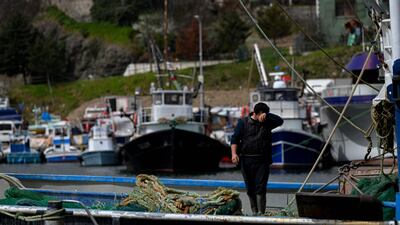
The risk of mines used in the Russia-Ukraine conflict drifting towards Turkey is keeping many fishermen from plying their trade. -
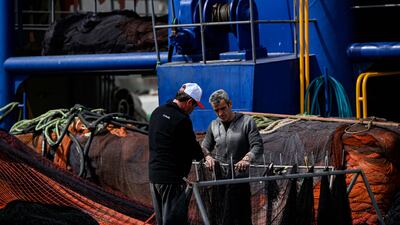
Of the mine risk, fisherman Sefki Deniz says 'we already have financial losses, there shouldn't be any human losses'. -
![Turkish President Recep Tayyip Erdgan says 'for the time being, [the mines] are not a problem, but we won't let our guard down'. Fishermen, however, particularly those on small boats without sonar or radar, recalled two incidents in the 1980s when Second World War mines killed nine people, five in an explosion in the port and four when fishermen were pulling in their nets at sea.](https://www.thenationalnews.com/resizer/v2/7UI2MY7AVLDTZUORI2MJHMCALM.jpg?smart=true&auth=71c5707d4fe68c0211513b790a1220129837a01d830b8be04ed977e6b318bd7a&width=400&height=225)
Turkish President Recep Tayyip Erdgan says 'for the time being, [the mines] are not a problem, but we won't let our guard down'. Fishermen, however, particularly those on small boats without sonar or radar, recalled two incidents in the 1980s when Second World War mines killed nine people, five in an explosion in the port and four when fishermen were pulling in their nets at sea.

![Boat owner Sahin Afsut, at the Rumelifeneri dockside in northern Istanbul, says 'if you hit [a mine], you're finished'. Mr Afsut usually catches whiting, red mullet and anchovies from his small trawler. A mine was found recently in the Black Sea a few kilometres from the port. Another was discovered 100km farther west, and a third one in Romanian waters, 300km north.](https://www.thenationalnews.com/resizer/v2/Z67CACQCBUIMEY3CHJCSKGYRMU.jpg?smart=true&auth=ad0c24c2e3d29a88ce13babf9cbcb642a3ccd59d7f1f961d2f7b179c68837de0&width=800&height=450)


![Fisherman and boat owner Ahmet Tarlaci, 55, describes the mine spotted near Rumelifeneri: 'It was large, like half a barrel. We watched from above there, the [special Turkish Navy] units neutralised it.'](https://www.thenationalnews.com/resizer/v2/EH5SO4M7M7F7H6PEXQMI5AJMSE.jpg?smart=true&auth=b10dc787dd8120ac125b525101e5f7c771edd909c98899a5db4afdcd6d429053&width=800&height=450)


![Turkish President Recep Tayyip Erdgan says 'for the time being, [the mines] are not a problem, but we won't let our guard down'. Fishermen, however, particularly those on small boats without sonar or radar, recalled two incidents in the 1980s when Second World War mines killed nine people, five in an explosion in the port and four when fishermen were pulling in their nets at sea.](https://www.thenationalnews.com/resizer/v2/7UI2MY7AVLDTZUORI2MJHMCALM.jpg?smart=true&auth=71c5707d4fe68c0211513b790a1220129837a01d830b8be04ed977e6b318bd7a&width=800&height=450)
The Monetary Policy Committee said in its April rate decision text it is weighing the prospect of growth in long-term investment loans against the need to keep the current-account in check.
“In this context, the committee decided to strengthen the macroprudential policy set,” the bank said, signalling a possible move on reserve requirements.
Opting for unorthodox policies has limited the central bank’s coffers though so far this year. The nation’s gross reserves excluding gold holdings stood at about $69bn in the week ending April 15, down about 5 per cent from the end of 2021.

