


The Ukraine war and ensuing sanctions on Russia have led the International Monetary Fund to lower its global economic growth forecast this year for 143 countries, accounting for 86 per cent of the world's output, with widely varying prospects.
Economies facing downgrades include net importers of food and fuel — in Africa, the Middle East, Asia and Europe, Kristalina Georgieva, the IMF's managing director, said on Thursday.
For many exporters of oil, natural gas and metals, rising commodity prices will lift their growth prospects, but they will face higher uncertainty and their gains are insufficient to offset an overall global slowdown driven mainly by the war.
“The outlook has deteriorated substantially, largely because of the war and its repercussions. Inflation, financial tightening and frequent, wide-ranging lockdowns in China — causing new bottlenecks in global supply chains — are also weighing on activity,” the IMF chief said.
-
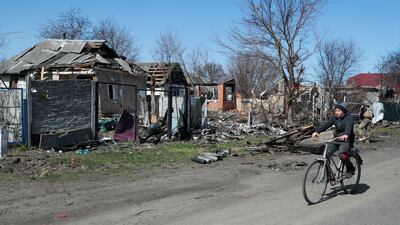
A boy rides a bicycle past a house that was damaged by shelling in Andriivka village, not far from Kyiv. EPA -
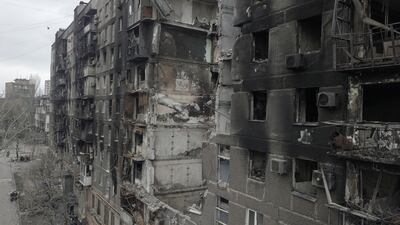
A destroyed residential building in Mariupol, south-eastern Ukraine. Reuters -
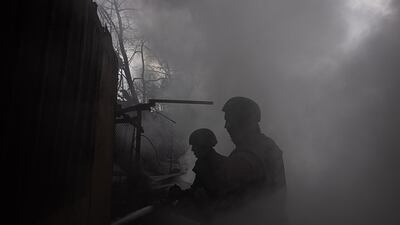
Firefighters at work on the outskirts of Kharkiv, north-east Ukraine. EPA -
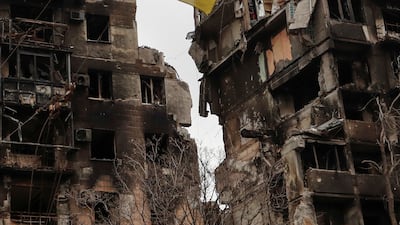
A torn Ukrainian flag in front of a ruined Mariupol apartment building. Reuters -
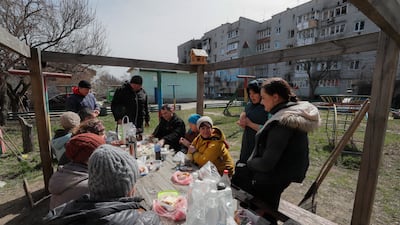
Residents who cleared debris after Russian shelling eat lunch outside a damaged building in Makariv, near Kyiv. EPA -

Children play with a therapeutic dog at a shelter organised by volunteers in Zaporizhzhya, Ukraine. Reuters -
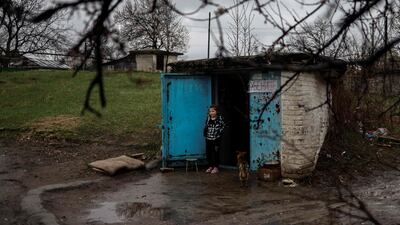
A girl stands by the door of a bunker in Severodonetsk, in eastern Ukraine's Donbas region, as Russian troops intensify a campaign to take the strategic port city of Mariupol. AFP -

A firefighter at work following a missile attack near Kharkiv International Airport. Reuters -
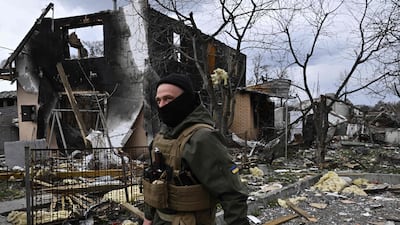
A Ukrainian fighter walks in front of a destroyed house in Bohdanivka village, north-east of Kyiv. AFP -

Two women hug outside a heavily damaged apartment block following an artillery attack in Kharkiv. Reuters -

Ukrainian soldiers guard the village of Barvinkove, as Russia's invasion on Ukraine continues. Reuters -
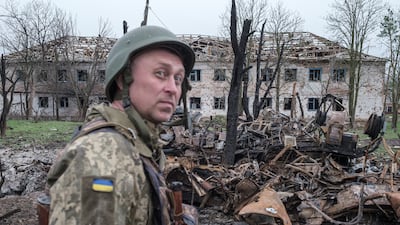
Leonid Serdiuchenko, a Ukrainian commander, stands next to destroyed vehicles outside Barvinkove. Reuters -

A woman carries the portrait of Dmytro Stefienko, 32, a civilian killed during the war, during his funeral in Bucha, Ukraine. AP -
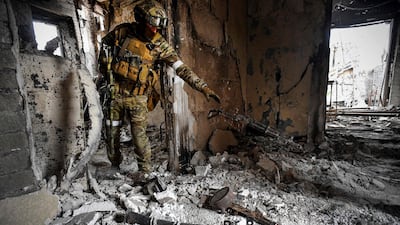
A Russian soldier collects weapons from inside the Mariupol drama theatre in Ukraine. AFP -
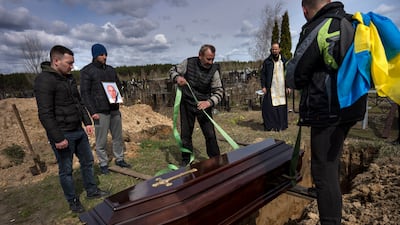
Relatives and friends attend the funeral of Andriy Matviychuk, 37, who served as a territorial defence soldier, who was captured and killed by the Russian army in Bucha, Ukraine. AP -
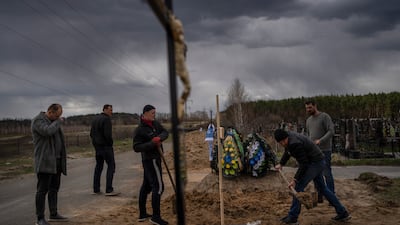
Anatoliy Morykin, 45, left, mourns the death of his mother, Valentyna Morykina, 82, who died in a retirement home in Bucha during the Russian invasion. AP -
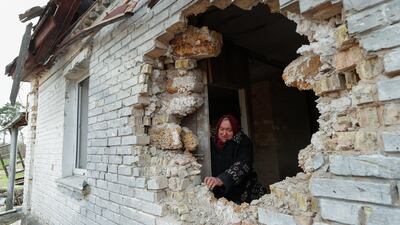
Nadiya, 65, shows a hole in a wall of a building after shelling in Zalissya, Ukraine. EPA -

A booby trap found by locals near their home in Zalissya. EPA -
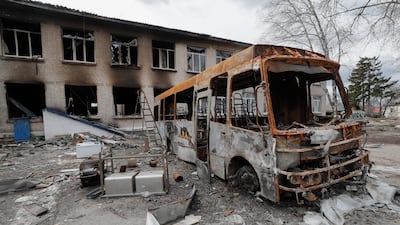
Debris of a school bus near a damaged school that was a base for Russian troops in Bohdanivka, Ukraine. EPA -
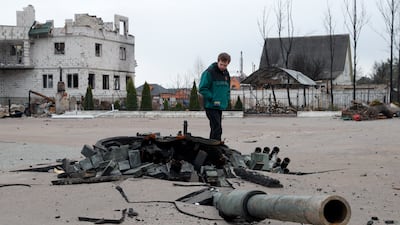
A man examines the debris of a destroyed Russian tank in Bohdanivka. EPA -
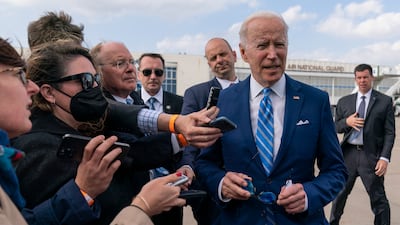
President Joe Biden speaks to the media before boarding Air Force One at Des Moines International Airport, en route to Washington. AP -

Valentina Saroyan sits in the basement of a school in Yahidne, near Chernihiv, Ukraine. AP -
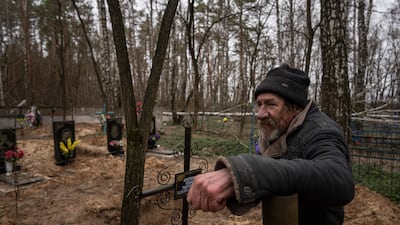
Vasyl Cherepenko stands next to a mass grave at a cemetery in Yahidne, near Dnipro, Ukraine. AP -
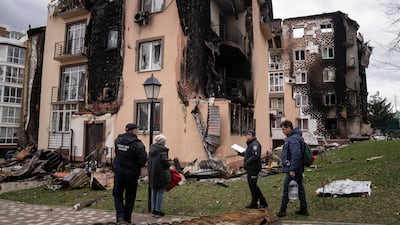
Oksana, second from left, and Yevhen, right, talk with police officers next to their apartment building damaged by shelling in Irpin, Ukraine. AP -
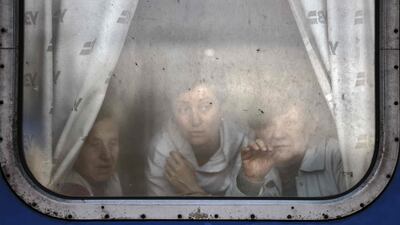
Women bid farewell to relatives as they leave the Slovyansk central station in the Donbas region. AFP -
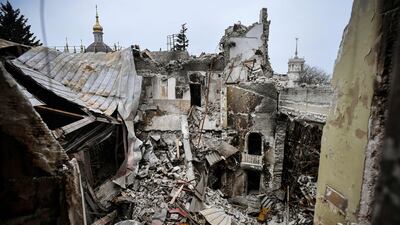
The partially destroyed Mariupol drama theatre in Ukraine, hit on March 16 by an air strike. AFP -
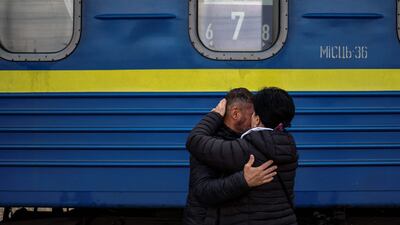
A man embraces his wife as she prepares to board a train at Slovyansk central station in the Donbas region. AFP -
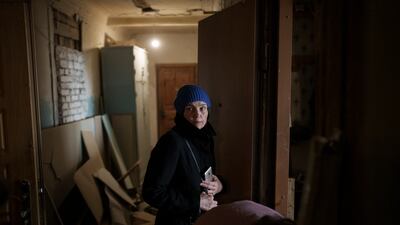
A woman walks through a damaged apartment building after a Russian attack in Kharkiv, Ukraine. AP -
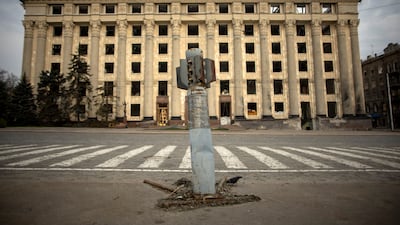
A missile pierces the road in front of the Kharkiv Regional State Administration building amid Russia's attack on Ukraine. Reuters -
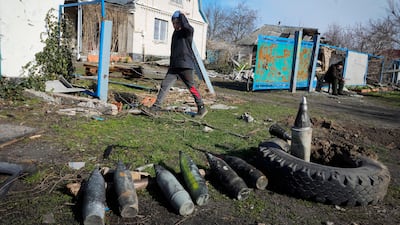
A boy walks by unexploded Russian shells in the village of Andriyivka close to Kyiv, Ukraine. AP -

Ukrainian tanks move down a street in Irpin, on the outskirts of Kyiv. AP -
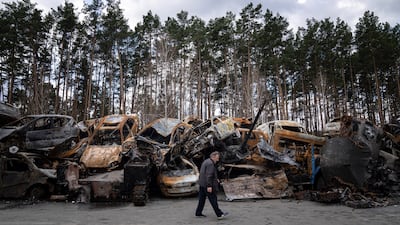
A man walks past a storage place for burned armed vehicles and cars, on the outskirts of Kyiv. AP -
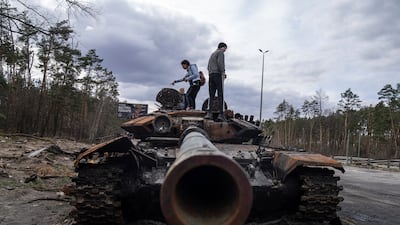
Local residents stand on top of a Russian tank on the outskirts of Kyiv. AP -
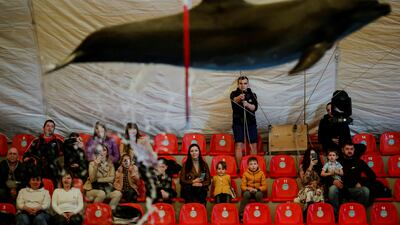
Ukrainian families, who have fled Kherson amid the Russian invasion, watch a dolphin show at a hotel in Odesa, Ukraine. Reuters -
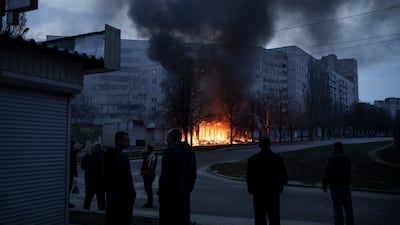
Residents stand outside their apartments as shops burn after a Russian attack in Kharkiv, Ukraine. AP -
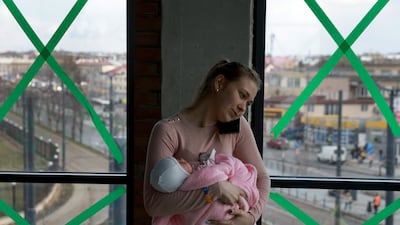
Irina Szymanska holds her baby in a temporary shelter at the central train station for displaced people heading to Poland in Lviv, Ukraine. Getty Images -
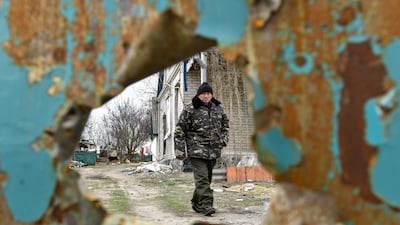
A man walks in his yard, damaged by shelling, in the village of Andriivka, Ukraine. EPA -

Sixty-two-year-old Luba hugs a Ukrainian servicewoman in Andriivka. EPA -
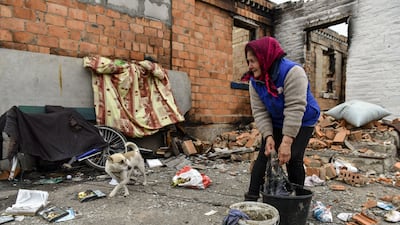
A woman washes clothes in the yard of a ruined house in Andriivka. EPA -
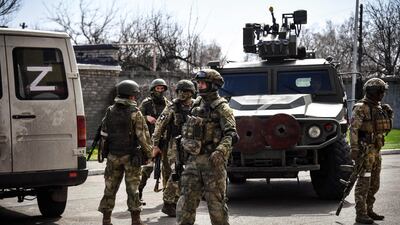
Russian soldiers patrol a street in Volnovakha, in the self-proclaimed Donetsk People's Republic. The picture was taken during a trip organised by the Russian military. AFP -
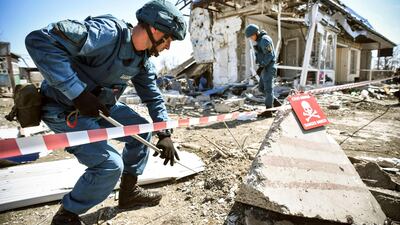
Russian mine clearers search for explosive objects in a building the Russian authorities say was damaged by Ukrainian shelling. AFP -
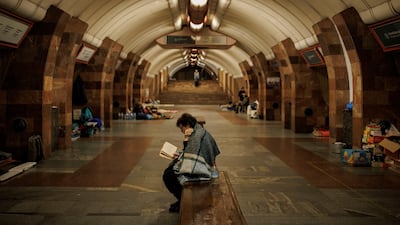
A woman reads a book as residents find shelter from shelling in a metro station in Kharkiv. Reuters -
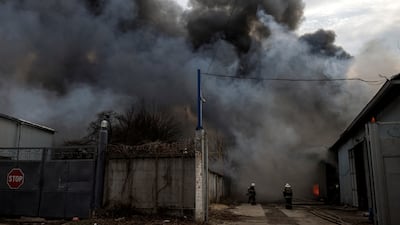
Firefighters try to contain a fire at a plant in Kharkiv following Russian shelling. Reuters -
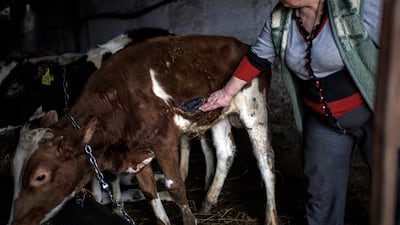
Farm owner Zlobina Lubov tends to her animals in the village of Malaya Rohan, Ukraine. Reuters -
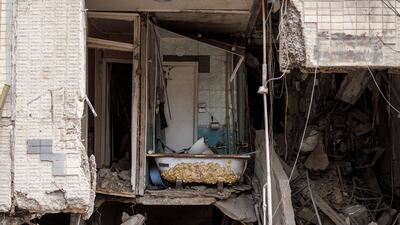
A bathtub is seen inside a building that was heavily damaged by shelling in Kharkiv. Reuters -
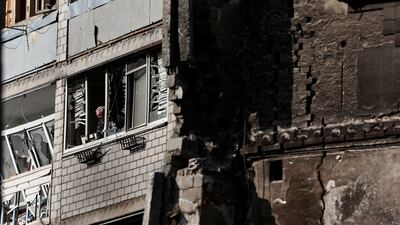
A man looks out of his window, amid Russia's invasion of Ukraine, in Borodianka. Reuters -
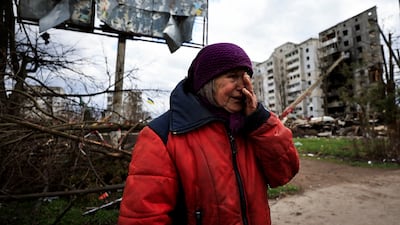
Soldiers 'came to my house and said go to the basement' Zinaida Makishaiva, 82, said, before they started to shoot around her. 'God saved my life,' she said. Reuters -
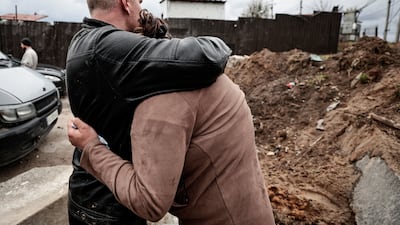
A mother waits for police officers to exhume the body of her son from a well at a fuel station in Buzova, Kyiv region. According to the head of the village, he was killed by Russian soldiers. Reuters


“Fortunately, for most countries, growth will still remains in positive territory. That said, the impact of the war will contribute to forecast downgrades for 143 economies this year.”
The IMF chief’s remarks came ahead the spring meetings of the IMF and World Bank scheduled for April 18 to 24.
In January, the Washington-based lender projected global economic growth would reach 4.4 per cent this year, a downgrade of 0.5 percentage point from its October estimates, due to Omicron-related disruptions.
The fund is expected to lower its projections further for 2022 and 2023 in its World Economic Outlook next week as the Russian war in Ukraine sends shock waves throughout the global economy, raising energy and food prices and threatening to further increase inequalities.
“Prospects vary greatly across countries: from catastrophic economic losses in Ukraine, to a severe contraction in Russia, to countries facing spillovers from the war through commodity, trade, and financial channels,” Ms Georgieva said.
The medium-term outlook has also worsened.
For most countries, output is now expected to take even longer to return to its pre-pandemic levels, the IMF chief said.
Emerging markets and developing economies are not only grappling with the impact of the war but also the “scarring effects” of the Covid-19 pandemic, including job losses and education challenges that are borne mostly by women and youth, she said.
“The recovery remains deeply divergent between rich and poor,” Ms Georgieva said.
The IMF chief painted a dire picture of a future marred by weaker growth, rising inflation, concerns about food security and greater hardships for people.
“The outlook is extraordinarily uncertain — well beyond the normal range. The war and sanctions could escalate. New Covid variants could emerge. Crops could fail,” she said.

Inflation, a “clear and present danger” for many countries, is a massive setback for the global economic recovery, she said.
Soaring energy and food prices and supply chain disruptions continue to push up inflation, squeezing real incomes of households around the world.
“For advanced economies, inflation is already reaching a four-decade high. And we now project it to remain elevated for longer than previously estimated,” the IMF chief said.
The Russia-Ukraine conflict has also raised concerns about food security worldwide as the two warring countries used to provide 28 per cent of global wheat exports. Russia and Belarus supplied 40 per cent of exports of potash, which is used primarily in fertilisers.
Food security is a “grave concern” and the world must act immediately with a multilateral initiative to bolster food supplied, the fund warned.
“The alternative is dire: more hunger, more poverty, and more social unrest — especially for countries that have struggled to escape fragility and conflict for many years,” Ms Georgieva said.

Policymakers are facing a tough balance between reining in high inflation and rising debt, while maintaining critical spending and building foundations for sustainable growth.
“We face bigger challenges and more difficult choices,” she said.
The immediate priorities are to end the war in Ukraine, deal with the pandemic and tackle inflation and debt, the IMF said.
Deploying Covid-19 vaccines, tests and antiviral treatments can be done for $15 billion this year, and $10bn each year afterwards, IMF staff analysis showed.
“If we have learned anything from the pandemic, it is that health security is economic security,” Ms Georgieva said.
To address inflation, central banks must act decisively, keeping their finger on the pulse of the economy and adjust policy appropriately, she said.
Developing countries facing higher borrowing costs and risks of capital outflows must consider extending debt maturities and using exchange rate flexibility to foreign exchange interventions and capital flow management measures, she added.
The IMF's lending currently stands at more than $300bn to help its members maintain access to liquidity.
To address mounting debt, countries' spending must be carefully prioritised on safety nets, health and education while ensuring equitable tax policies.
For some countries — especially among the 60 per cent of low-income nations already in or near debt distress — debt restructuring will be required, she said.
The world is facing “a crisis on top of a crisis” with the devastating humanitarian and economic effects of the war following two years of the pandemic, that risks eroding the recovery progress made so far.
“In a world where war in Europe creates hunger in Africa; where a pandemic can circle the globe in days and reverberate for years; where emissions anywhere mean rising sea levels everywhere — the threat to our collective prosperity from a breakdown in global cooperation cannot be overstated,” she said.

