

Iran, whose economy has been battered by US sanctions, reached out to the International Monetary Fund for emergency funding to fight off the coronavirus that has ravaged the country.
"In a letter last week to the head of the IMF, I called for Iran's right to benefit from the fund's $50 billion (Dh183bn) rapid facility program to prevent, treat and counteract the economic impact of the corona virus," Abdulnaser Hemmati, the governor of the Central Bank of Iran said in a statement on the website of the regulator.
"The widespread prevalence of coronavirus in our country and the need for continued strong prevention, treatment and economic measures, calls for the use of 'fast financing facilities, RFI' of around $5bn, given the size of the Islamic Republic of Iran's quota in the fund," he added.
The coronavirus, which started in the Chinese city of Wuhan, and was declared a pandemic by the World Health Organisation, has killed 429 people and infected more than 10,000 across Iran including a vice president, government ministers and lawmakers. The virus has spread to more than 113 countries so far, infecting more than 126,000 people and killing more than 4,600 globally. South Korea, Italy and Iran have recorded the largest surge in infections outside of China.
Last week the IMF allotted $50bn in emergency funding to poor and middle-income countries that may need assistance in responding to the coronavirus outbreak, as the lender sees global growth in 2020 falling below last year’s level.
Low-income countries can avail emergency financing of up to $10bn without a full-fledged IMF programme at zero interest through the fund’s Rapid Credit Facility. Other member countries can access emergency financing of $40bn through the Rapid Financing Instrument, IMF Managing Director Kristalina Georgieva said. The fund has about $1 trillion in overall lending capacity.
The World Bank has also set up an initial fund of $12bn to disburse grants and low-interest loans to help member-countries cope with the health and economic impact of the outbreak, which presents the greatest challenge to the global economy since the 2008 financial crisis.
The IMF and the World Bank have been leading calls for a co-ordinated global monetary policy action to reduce the impact of the outbreak on the global economy. Concerns over the virus led to an investor sell-off across markets globally over the past two weeks that wiped $10tn from stock markets and led to the worst decline since the 2008 financial crisis.
In a tweet on Thursday the country's foreign minister Javad Zarif called on the IMF to extend support to Iran who is a member state of the Washington-based lender.
Ms Georgieva "has stated that countries affected by #COVID19 will be supported via Rapid Financial Instrument. Our Central Bank requested access to this facility immediately," Mr Zarif said. The "IMF/IMF Board should adhere to fund's mandate, stand on right side of history and act responsibly."
US sanctions implemented by President Donald Trump, who unilaterally withdrew from the 2016 nuclear agreement that was supposed to check Iran's nuclear capabilities, curtailed Tehran’s ability to sell oil, its primary source of revenue and crippled its economy. The Opec member's production has declined to less than 1 million barrels per day of crude from 3.2 mbpd in 2016. At least a quarter of Iran’s oil rigs are idle because of US sanctions, according to Reuters.
Iran's economy was projected to have contracted 9.5 per cent last year after shrinking 4.8 per cent in 2018 and will flat line in 2020, according to the IMF. Inflation in Iran is forecast to rise to 31 per cent this year, according to the fund.
The value of the rial has plummeted against the dollar since the US withdrew from the nuclear agreement and imposed sanctions on the country. The dollar is selling for 154,500 rials on Thursday, below Iran's official rate of 42,000 rials, according to foreign exchange website Bonbast.com.
-

Pedestrians wear protective masks and surgical gloves while walking in central Tehran, Iran, March 15, 2020. Bloomberg -

A pedestrian wears a protective face mask while walking in central Tehran, March 15. Bloomberg -
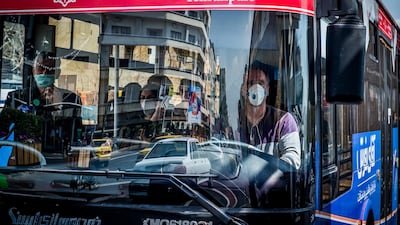
A public bus driver wears a protective face mask while working in central Tehran, March 15. Bloomberg -
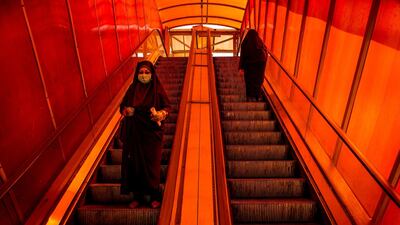
A pedestrian wears a protective face mask while travelling down a walkway escalator in Tehran, March 15. Bloomberg -

A woman wearing a face mask inspects clothes at a store in Bamland shopping mall, in Western Tehran, March 15. AP Photo -

A pedestrian wears a protective face mask in Tehran, March 15. Bloomberg -
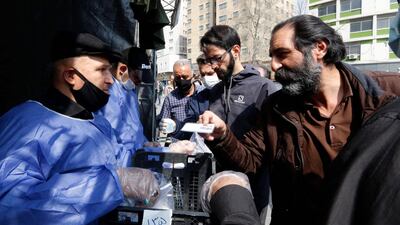
People queue in line to receive packages for precautions against coronavirus by the Basij, a militia loyal to Iran's Islamic republic establishment, from a booth outside Meydane Valiasr metro station in the capital Tehran, March 15. AFP -

A man wearing a protective mask carries boxes containing disinfectants, March 15. AFP -

People queue in line to receive packages for precautions against coronavirus disease, March 15. AFP -

Iranian firefighters prepare to disinfect streets in an effort to halt the spread of coronavirus in Tehran on March 13, 2020. EPA -
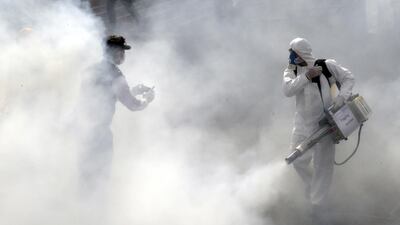
Firefighters disinfect streets in an effort to halt the spread of coronavirus in Tehran, March 13. EPA -
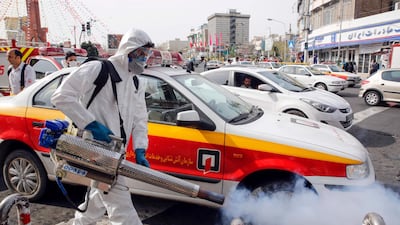
An Iranian firefighter disinfects a street in the capital Tehran, March 13. AFP -
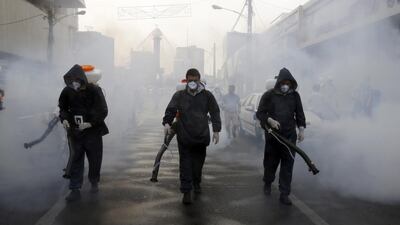
Firefighters disinfect streets in an effort to stop the spread of coronavirus in Tehran, March 13. EPA -

A Revolutionary Guard member takes part in disinfecting the city in Tehran, Iran, March 4. AP -

A Revolutionary Guard member disinfects an ATM in Tehran, Iran, March 4. AP -
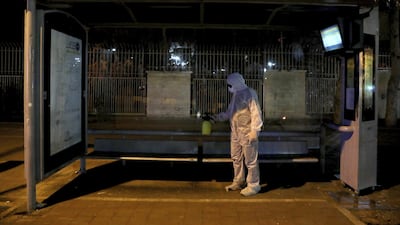
A Revolutionary Guard member disinfects a bus station in Tehran, Iran, March 4. AP -
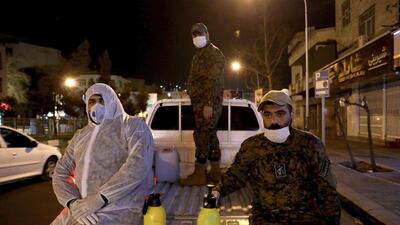
Members of Iran's Revolutionary Guard spray down streets and hospitals with disinfectants, March 4. AP -
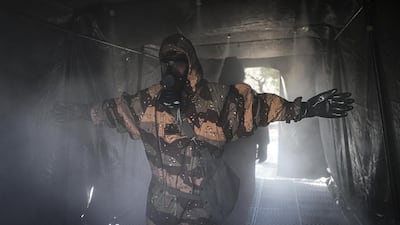
Members of Iran's Revolutionary Guard spray down streets and hospitals with disinfectants, March 1. Tasnim News Agency via AP -

Revolutionary Guard members take part in disinfecting the city, in Sanandaj, western Iran, March 1. Tasnim News Agency via AP -
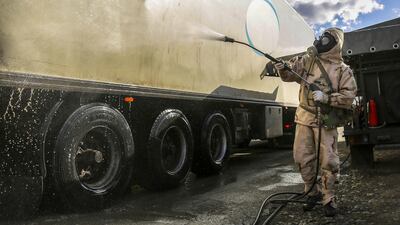
A Revolutionary Guard member disinfects a truck in the city of Sanandaj, western Iran, March 1. Tasnim News Agency via AP



