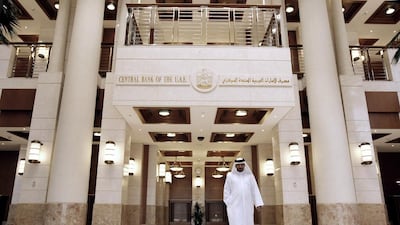
The Central Bank of the UAE praised the UAE leadership for its efforts in aiding the country's economic recovery. Ryan Carter / The National

UAE's Tess scheme benefits more than 300,000 customers, Central Bank says


Deepthi Nair
  • English
  • Arabic

More than 300,000 individuals have benefited from the Targeted Economic Support Scheme (Tess) rolled out to mitigate the impact of Covid-19, the UAE Central Bank said on Thursday following a meeting with some of the country's largest banks.

About 10,000 small and medium-sized enterprises (SMEs) and more than 1,500 private sector companies also used the economic stimulus, the banking regulator said.

Separately, state news agency Wam reported that banks and financial institutions have availed Dh44.72 billion of the Dh50bn worth of interest-free loans as part of the Tess facility until the end of July.

The central bank first rolled out Tess in March as it unveiled a Dh100bn stimulus package to support companies and individuals affected by movement restrictions and other measures taken to stop the spread of the Covid-19 pandemic. This included Dh50bn of zero-cost collateralised loans and a loosening of banks' capital requirements, giving them more firepower to lend. Further loosening of capital and liquidity buffers has since increased the size of this stimulus to Dh256bn. The Tess scheme ends on December 31.

“The Central Bank of UAE reaffirms its commitment towards enhancing monetary and financial stability in the country through effective supervision, partnership with financial institutions and a sustained and robust financial infrastructure,” Abdulhamid Saeed, governor of the Central Bank of the UAE, said.

“The continuous focus of banks on key financial ratios coupled with the need to provide assistance to impacted customers was required to ensure systemic financial stability in the country.”

Participating banks were instructed to use the funding to offer temporary relief to the private sector and retail customers for a period of up to six months. Banks also increased the loan-to-value ratio on mortgages to 20 per cent for first-time expatriate buyers and 15 per cent for Emiratis.

For businesses, the regulator ordered lenders to remove requirements for SMEs to have a minimum account balance of Dh10,000 before opening accounts and urged them to speed up account opening times to two days.

The Central Bank of UAE reaffirms its commitment towards enhancing monetary and financial stability in the country

According to the Central Bank statistics, lenders availed Dh44.38bn from the Tess facility until the end of June, Dh42.33bn until the end of May and Dh31.85bn by the end of April.

The meeting also discussed banks’ systemic stability and the importance of having robust controls to mitigate the risks of money laundering and financing of terrorism in the UAE.

The central bank also updated the chief executives on the results of the sanctions screening tests conducted by the newly created Anti Money Laundering and Combating the Financing of Terrorism unit on licensed financial institutions in the UAE.

“CBUAE’s supervisory and regulatory initiatives are also focused on verifying UAE banks comply with their legal obligations under the UAE anti money laundering legislation to ensure the country’s commitment to applying the Financial Action Task Force standards and its standing as a financial centre of repute,” Mr Saeed added.

THE%20HOLDOVERS
%3Cp%3E%3Cstrong%3EDirector%3A%20%3C%2Fstrong%3EAlexander%20Payne%3C%2Fp%3E%0A%3Cp%3E%3Cstrong%3EStarring%3A%3C%2Fstrong%3E%20Paul%20Giamatti%2C%20Da'Vine%20Joy%20Randolph%2C%20Dominic%20Sessa%3C%2Fp%3E%0A%3Cp%3E%3Cstrong%3ERating%3A%3C%2Fstrong%3E%204.5%2F5%3C%2Fp%3E%0A
In-demand jobs and monthly salaries
  • Technology expert in robotics and automation: Dh20,000 to Dh40,000 
  • Energy engineer: Dh25,000 to Dh30,000 
  • Production engineer: Dh30,000 to Dh40,000 
  • Data-driven supply chain management professional: Dh30,000 to Dh50,000 
  • HR leader: Dh40,000 to Dh60,000 
  • Engineering leader: Dh30,000 to Dh55,000 
  • Project manager: Dh55,000 to Dh65,000 
  • Senior reservoir engineer: Dh40,000 to Dh55,000 
  • Senior drilling engineer: Dh38,000 to Dh46,000 
  • Senior process engineer: Dh28,000 to Dh38,000 
  • Senior maintenance engineer: Dh22,000 to Dh34,000 
  • Field engineer: Dh6,500 to Dh7,500
  • Field supervisor: Dh9,000 to Dh12,000
  • Field operator: Dh5,000 to Dh7,000

Mercer, the investment consulting arm of US services company Marsh & McLennan, expects its wealth division to at least double its assets under management (AUM) in the Middle East as wealth in the region continues to grow despite economic headwinds, a company official said.

Mercer Wealth, which globally has $160 billion in AUM, plans to boost its AUM in the region to $2-$3bn in the next 2-3 years from the present $1bn, said Yasir AbuShaban, a Dubai-based principal with Mercer Wealth.

Within the next two to three years, we are looking at reaching $2 to $3 billion as a conservative estimate and we do see an opportunity to do so,” said Mr AbuShaban.

Mercer does not directly make investments, but allocates clients’ money they have discretion to, to professional asset managers. They also provide advice to clients.

“We have buying power. We can negotiate on their (client’s) behalf with asset managers to provide them lower fees than they otherwise would have to get on their own,” he added.

Mercer Wealth’s clients include sovereign wealth funds, family offices, and insurance companies among others.

From its office in Dubai, Mercer also looks after Africa, India and Turkey, where they also see opportunity for growth.

Wealth creation in Middle East and Africa (MEA) grew 8.5 per cent to $8.1 trillion last year from $7.5tn in 2015, higher than last year’s global average of 6 per cent and the second-highest growth in a region after Asia-Pacific which grew 9.9 per cent, according to consultancy Boston Consulting Group (BCG). In the region, where wealth grew just 1.9 per cent in 2015 compared with 2014, a pickup in oil prices has helped in wealth generation.

BCG is forecasting MEA wealth will rise to $12tn by 2021, growing at an annual average of 8 per cent.

Drivers of wealth generation in the region will be split evenly between new wealth creation and growth of performance of existing assets, according to BCG.

Another general trend in the region is clients’ looking for a comprehensive approach to investing, according to Mr AbuShaban.

“Institutional investors or some of the families are seeing a slowdown in the available capital they have to invest and in that sense they are looking at optimizing the way they manage their portfolios and making sure they are not investing haphazardly and different parts of their investment are working together,” said Mr AbuShaban.

Some clients also have a higher appetite for risk, given the low interest-rate environment that does not provide enough yield for some institutional investors. These clients are keen to invest in illiquid assets, such as private equity and infrastructure.

“What we have seen is a desire for higher returns in what has been a low-return environment specifically in various fixed income or bonds,” he said.

“In this environment, we have seen a de facto increase in the risk that clients are taking in things like illiquid investments, private equity investments, infrastructure and private debt, those kind of investments were higher illiquidity results in incrementally higher returns.”

The Abu Dhabi Investment Authority, one of the largest sovereign wealth funds, said in its 2016 report that has gradually increased its exposure in direct private equity and private credit transactions, mainly in Asian markets and especially in China and India. The authority’s private equity department focused on structured equities owing to “their defensive characteristics.”

Alan%20Wake%20Remastered%20
%3Cp%3E%3Cstrong%3EDeveloper%3A%20%3C%2Fstrong%3ERemedy%20Entertainment%3Cbr%3E%3Cstrong%3EPublisher%3A%3C%2Fstrong%3E%20Microsoft%20Game%20Studios%3Cbr%3E%3Cstrong%3EConsoles%3A%3C%2Fstrong%3E%20PlayStation%204%20%26amp%3B%205%2C%20Xbox%3A%20360%20%26amp%3B%20One%20%26amp%3B%20Series%20X%2FS%20and%20Nintendo%20Switch%3Cbr%3E%3Cstrong%3ERating%3A%3C%2Fstrong%3E%204%2F5%3C%2Fp%3E%0A

The Book of Collateral Damage

Sinan Antoon

(Yale University Press)

Who's who in Yemen conflict

Houthis: Iran-backed rebels who occupy Sanaa and run unrecognised government

Yemeni government: Exiled government in Aden led by eight-member Presidential Leadership Council

Southern Transitional Council: Faction in Yemeni government that seeks autonomy for the south

Habrish 'rebels': Tribal-backed forces feuding with STC over control of oil in government territory

Dust and sand storms compared

Sand storm

  • Particle size: Larger, heavier sand grains
  • Visibility: Often dramatic with thick "walls" of sand
  • Duration: Short-lived, typically localised
  • Travel distance: Limited 
  • Source: Open desert areas with strong winds

Dust storm

  • Particle size: Much finer, lightweight particles
  • Visibility: Hazy skies but less intense
  • Duration: Can linger for days
  • Travel distance: Long-range, up to thousands of kilometres
  • Source: Can be carried from distant regions
Muslim Council of Elders condemns terrorism on religious sites

The Muslim Council of Elders has strongly condemned the criminal attacks on religious sites in Britain.

It firmly rejected “acts of terrorism, which constitute a flagrant violation of the sanctity of houses of worship”.

“Attacking places of worship is a form of terrorism and extremism that threatens peace and stability within societies,” it said.

The council also warned against the rise of hate speech, racism, extremism and Islamophobia. It urged the international community to join efforts to promote tolerance and peaceful coexistence.

What can victims do?

Always use only regulated platforms

Stop all transactions and communication on suspicion

Save all evidence (screenshots, chat logs, transaction IDs)

Report to local authorities

Warn others to prevent further harm

Courtesy: Crystal Intelligence

The specs

Engine: 5.0-litre supercharged V8

Transmission: Eight-speed auto

Power: 575bhp

Torque: 700Nm

Price: Dh554,000

On sale: now

Company name: Play:Date

Launched: March 2017 on UAE Mother’s Day

Founder: Shamim Kassibawi

Based: Dubai with operations in the UAE and US

Sector: Tech 

Size: 20 employees

Stage of funding: Seed

Investors: Three founders (two silent co-founders) and one venture capital fund

Poland Statement
All people fleeing from Ukraine before the armed conflict are allowed to enter Poland. Our country shelters every person whose life is in danger - regardless of their nationality.

The dominant group of refugees in Poland are citizens of Ukraine, but among the people checked by the Border Guard are also citizens of the USA, Nigeria, India, Georgia and other countries.

All persons admitted to Poland are verified by the Border Guard. In relation to those who are in doubt, e.g. do not have documents, Border Guard officers apply appropriate checking procedures.

No person who has received refuge in Poland will be sent back to a country torn by war.
