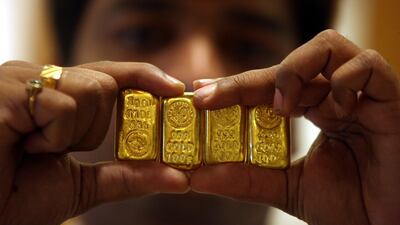
The Fed meeting and reversal in their policy outlook triggered the drop in gold prices. Photo: Reuters

UAE Central Bank issues guidance to lenders working with property and precious metals dealers


Michael Fahy
  • English
  • Arabic

The Central Bank of the UAE (CBUAE) issued new guidance on anti-money laundering and combatting the financing of terrorism (AML/CFT) for financial institutions dealing with property brokers and dealers of precious metals and stones.

The guidance sets out some of the issues associated with high-value assets potentially being used by criminals "to conceal, transfer and/ or invest their illicit proceeds" through the financial system.

“A critical part of CBUAE’s mandate is to ensure that all licensed financial institutions have a deep comprehension of their role in mitigating and addressing the risk of illicit activities in the UAE’s financial system," CBUAE governor Khaled Al Tameemi said.

There is a strong awareness about anti-money laundering rules in the Middle East and North Africa, with 76 per cent of institutions in the region stating they have an AML programme in place, according to Refinitiv's Financial Crime Mena survey published on Tuesday. A quarter of respondents highlighted money laundering as the financial crime that represents the biggest risk to their organisation, more than any other issue such as fraud or cyber crime.

The guidance issued by the central bank says dealers of precious metals pose a risk to licensed financial institutions "because they are themselves at high risk of abuse". Precious metals such as gold are "easy to exchange and transfer, and may provide anonymity when processing transactions".

Precious metals and stones can be illegally mined or used to legitimise the proceeds of drug trafficking and other illegal activities, as well as for sanctions evasion or as security for fraudulent loans, the guidance points out.

Property can be used to launder large sums of cash in one transaction, sometimes through various shell companies or intermediaries.

The guidance reiterates that financial institutions "are required to perform appropriate customer due diligence and report any behaviour that they reasonably suspect may be linked to money laundering" or other criminal offences to the UAE’s Financial Intelligence Unit through the "goAML" platform.

"This guidance serves as a key point of reference for those providing services to real estate and precious metals and stones sectors and is set to further increase the efficacy of licensed financial institutions in contributing to the stringent national efforts in the field of AML/CFT,” Mr Al Tameemi said.


Tips on buying property during a pandemic

Islay Robinson, group chief executive of mortgage broker Enness Global, offers his advice on buying property in today's market.

While many have been quick to call a market collapse, this simply isn’t what we’re seeing on the ground. Many pockets of the global property market, including London and the UAE, continue to be compelling locations to invest in real estate.

While an air of uncertainty remains, the outlook is far better than anyone could have predicted. However, it is still important to consider the wider threat posed by Covid-19 when buying bricks and mortar. 

Anything with outside space, gardens and private entrances is a must and these property features will see your investment keep its value should the pandemic drag on. In contrast, flats and particularly high-rise developments are falling in popularity and investors should avoid them at all costs.

Attractive investment property can be hard to find amid strong demand and heightened buyer activity. When you do find one, be prepared to move hard and fast to secure it. If you have your finances in order, this shouldn’t be an issue.

Lenders continue to lend and rates remain at an all-time low, so utilise this. There is no point in tying up cash when you can keep this liquidity to maximise other opportunities. 

Keep your head and, as always when investing, take the long-term view. External factors such as coronavirus or Brexit will present challenges in the short-term, but the long-term outlook remains strong. 

Finally, keep an eye on your currency. Whenever currency fluctuations favour foreign buyers, you can bet that demand will increase, as they act to secure what is essentially a discounted property.

GIANT REVIEW

Starring: Amir El-Masry, Pierce Brosnan

Director: Athale

Rating: 4/5

Results:

6.30pm: Maiden Dh165,000 2,000m - Winner: Powderhouse, Sam Hitchcott (jockey), Doug Watson (trainer)

7.05pm: Handicap Dh165,000 2,200m - Winner: Heraldic, Richard Mullen, Satish Seemar

7.40pm: Conditions Dh240,000 1,600m - Winner: Walking Thunder, Connor Beasley, Ahmed bin Harmash

8.15pm: Handicap Dh190,000 2,000m - Winner: Key Bid, Fernando Jara, Ali Rashid Al Raihe

8.50pm: The Garhoud Sprint Listed Dh265,000 1,200m - Winner: Drafted, Sam Hitchcott, Doug Watson

9.25pm: Handicap Dh170,000 1,600m - Winner: Cachao, Tadhg O’Shea, Satish Seemar

10pm: Handicap Dh190,000 1,400m - Winner: Rodaini, Connor Beasley, Ahmed bin Harmash

UAE currency: the story behind the money in your pockets

Mercer, the investment consulting arm of US services company Marsh & McLennan, expects its wealth division to at least double its assets under management (AUM) in the Middle East as wealth in the region continues to grow despite economic headwinds, a company official said.

Mercer Wealth, which globally has $160 billion in AUM, plans to boost its AUM in the region to $2-$3bn in the next 2-3 years from the present $1bn, said Yasir AbuShaban, a Dubai-based principal with Mercer Wealth.

Within the next two to three years, we are looking at reaching $2 to $3 billion as a conservative estimate and we do see an opportunity to do so,” said Mr AbuShaban.

Mercer does not directly make investments, but allocates clients’ money they have discretion to, to professional asset managers. They also provide advice to clients.

“We have buying power. We can negotiate on their (client’s) behalf with asset managers to provide them lower fees than they otherwise would have to get on their own,” he added.

Mercer Wealth’s clients include sovereign wealth funds, family offices, and insurance companies among others.

From its office in Dubai, Mercer also looks after Africa, India and Turkey, where they also see opportunity for growth.

Wealth creation in Middle East and Africa (MEA) grew 8.5 per cent to $8.1 trillion last year from $7.5tn in 2015, higher than last year’s global average of 6 per cent and the second-highest growth in a region after Asia-Pacific which grew 9.9 per cent, according to consultancy Boston Consulting Group (BCG). In the region, where wealth grew just 1.9 per cent in 2015 compared with 2014, a pickup in oil prices has helped in wealth generation.

BCG is forecasting MEA wealth will rise to $12tn by 2021, growing at an annual average of 8 per cent.

Drivers of wealth generation in the region will be split evenly between new wealth creation and growth of performance of existing assets, according to BCG.

Another general trend in the region is clients’ looking for a comprehensive approach to investing, according to Mr AbuShaban.

“Institutional investors or some of the families are seeing a slowdown in the available capital they have to invest and in that sense they are looking at optimizing the way they manage their portfolios and making sure they are not investing haphazardly and different parts of their investment are working together,” said Mr AbuShaban.

Some clients also have a higher appetite for risk, given the low interest-rate environment that does not provide enough yield for some institutional investors. These clients are keen to invest in illiquid assets, such as private equity and infrastructure.

“What we have seen is a desire for higher returns in what has been a low-return environment specifically in various fixed income or bonds,” he said.

“In this environment, we have seen a de facto increase in the risk that clients are taking in things like illiquid investments, private equity investments, infrastructure and private debt, those kind of investments were higher illiquidity results in incrementally higher returns.”

The Abu Dhabi Investment Authority, one of the largest sovereign wealth funds, said in its 2016 report that has gradually increased its exposure in direct private equity and private credit transactions, mainly in Asian markets and especially in China and India. The authority’s private equity department focused on structured equities owing to “their defensive characteristics.”

Top 10 most polluted cities
  1. Bhiwadi, India
  2. Ghaziabad, India
  3. Hotan, China
  4. Delhi, India
  5. Jaunpur, India
  6. Faisalabad, Pakistan
  7. Noida, India
  8. Bahawalpur, Pakistan
  9. Peshawar, Pakistan
  10. Bagpat, India
The Voice of Hind Rajab

Starring: Saja Kilani, Clara Khoury, Motaz Malhees

Director: Kaouther Ben Hania

Rating: 4/5

Scoreline:

Manchester City 1

Jesus 4'

Brighton 0