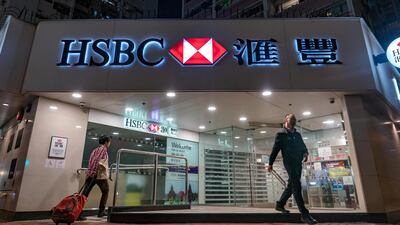
HSBC will develop tailored financial products to help reduce greenhouse gas emissions. Bloomberg

HSBC commits to become a net zero emissions bank


Deepthi Nair
  • English
  • Arabic

HSBC has announced that it will prioritise financing and investment that supports the transition to a net zero global economy.

The British bank said in a statement on Friday that it would align its financed emissions – the carbon emissions generated by its customers’ portfolio – with the Paris Agreement goal to achieve net zero by 2050 or sooner. The bank also aims to be net zero in its operations and supply chain by 2030.

“As we enter a pivotal decade of change, we have a landmark opportunity to accelerate our efforts to build a healthier, more resilient and more sustainable future. Our net zero ambition represents a material step up in our support for customers as we collectively work towards building a thriving low carbon economy,” said HSBC Group chief executive Noel Quinn.

We have a landmark opportunity to accelerate our efforts to build a healthier, more resilient and more sustainable future

Fifty-five firms, including HSBC, BNP Paribas, Societe Generale, banks and insurance companies, committed to a framework last week to set climate goals specific to mortgages, bonds and other asset classes in their portfolios.

The 2015 Paris climate agreement asks countries to aim to limit Earth’s temperature increase to no more than 1.5 degrees Celsius (2.7 degrees Fahrenheit).

HSBC will develop tailored financial products to help reduce greenhouse gas emissions. The bank will also prioritise financing and investment that contributes to the low carbon transition, the statement added.

The bank aims to support customers with between $750 billion and $1 trillion of finance and investment by 2030 to help with their transition. It will also work in partnership with its peers, customers, regulators, governments and wider society to effect change across the financial system.

The financial institution has already created the HSBC Pollination Climate Asset Management which will establish a series of funds that will invest in activities that preserve and enhance nature over the long term and address climate change.

HSBC has also set up a $100 million venture debt fund for CleanTech innovation. It also aims to roll out a philanthropic programme to donate $100m to scale climate innovation ventures and renewable energy solutions between now and 2025.

In 2017, HSBC had committed $100bn of sustainable finance by 2025.

“However, the bank recognises that achieving the Paris Agreement goal will require extra effort, at a faster pace, and plans to use its scale and global reach to seek to accelerate the transition to net zero,” the statement added.


RACE CARD

6.30pm: Handicap (TB) $68,000 (Dirt) 1,600m

7.05pm: Meydan Sprint – Group 2 (TB) $163,000 (Turf) 1,000m

7.40pm: Curlin Stakes – Listed Handicap (TB) $88,000 (D) 2,200m

8.15pm: UAE Oaks – Group 3 (TB) $125,000 (D) 1,900m

8.50pm: Zabeel Mile – Group 2 (TB) $163,000 (T) 1,600m

9.25pm: Balanchine – Group 2 (TB) $163,000 (T) 1,800m

10pm: Al Shindagha Sprint – Group 3 (TB) $130,000 (D) 1,200m

Mercer, the investment consulting arm of US services company Marsh & McLennan, expects its wealth division to at least double its assets under management (AUM) in the Middle East as wealth in the region continues to grow despite economic headwinds, a company official said.

Mercer Wealth, which globally has $160 billion in AUM, plans to boost its AUM in the region to $2-$3bn in the next 2-3 years from the present $1bn, said Yasir AbuShaban, a Dubai-based principal with Mercer Wealth.

Within the next two to three years, we are looking at reaching $2 to $3 billion as a conservative estimate and we do see an opportunity to do so,” said Mr AbuShaban.

Mercer does not directly make investments, but allocates clients’ money they have discretion to, to professional asset managers. They also provide advice to clients.

“We have buying power. We can negotiate on their (client’s) behalf with asset managers to provide them lower fees than they otherwise would have to get on their own,” he added.

Mercer Wealth’s clients include sovereign wealth funds, family offices, and insurance companies among others.

From its office in Dubai, Mercer also looks after Africa, India and Turkey, where they also see opportunity for growth.

Wealth creation in Middle East and Africa (MEA) grew 8.5 per cent to $8.1 trillion last year from $7.5tn in 2015, higher than last year’s global average of 6 per cent and the second-highest growth in a region after Asia-Pacific which grew 9.9 per cent, according to consultancy Boston Consulting Group (BCG). In the region, where wealth grew just 1.9 per cent in 2015 compared with 2014, a pickup in oil prices has helped in wealth generation.

BCG is forecasting MEA wealth will rise to $12tn by 2021, growing at an annual average of 8 per cent.

Drivers of wealth generation in the region will be split evenly between new wealth creation and growth of performance of existing assets, according to BCG.

Another general trend in the region is clients’ looking for a comprehensive approach to investing, according to Mr AbuShaban.

“Institutional investors or some of the families are seeing a slowdown in the available capital they have to invest and in that sense they are looking at optimizing the way they manage their portfolios and making sure they are not investing haphazardly and different parts of their investment are working together,” said Mr AbuShaban.

Some clients also have a higher appetite for risk, given the low interest-rate environment that does not provide enough yield for some institutional investors. These clients are keen to invest in illiquid assets, such as private equity and infrastructure.

“What we have seen is a desire for higher returns in what has been a low-return environment specifically in various fixed income or bonds,” he said.

“In this environment, we have seen a de facto increase in the risk that clients are taking in things like illiquid investments, private equity investments, infrastructure and private debt, those kind of investments were higher illiquidity results in incrementally higher returns.”

The Abu Dhabi Investment Authority, one of the largest sovereign wealth funds, said in its 2016 report that has gradually increased its exposure in direct private equity and private credit transactions, mainly in Asian markets and especially in China and India. The authority’s private equity department focused on structured equities owing to “their defensive characteristics.”

The National's picks

4.35pm: Tilal Al Khalediah
5.10pm: Continous
5.45pm: Raging Torrent
6.20pm: West Acre
7pm: Flood Zone
7.40pm: Straight No Chaser
8.15pm: Romantic Warrior
8.50pm: Calandogan
9.30pm: Forever Young

MATCH INFO

Uefa Champions League last 16, second leg
Liverpool (0) v Atletico Madrid (1)
Venue: Anfield
Kick-off: Thursday, March 12, midnight
Live: On beIN Sports HD

Episode list:

Ep1: A recovery like no other- the unevenness of the economic recovery 

Ep2: PCR and jobs - the future of work - new trends and challenges 

Ep3: The recovery and global trade disruptions - globalisation post-pandemic 

Ep4: Inflation- services and goods - debt risks 

Ep5: Travel and tourism