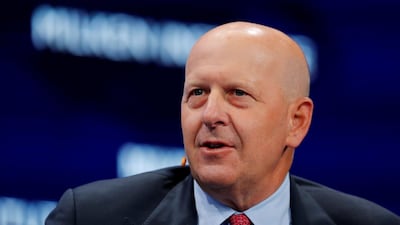
Goldman Sachs chief executive David Solomon said the bank is looking for ways to expand its capabilities to support its clients’ crypto needs. Reuters

Goldman Sachs CEO says digital currencies 'important' to future of financial systems as lender posts record profit


Alkesh Sharma
  • English
  • Arabic

Goldman Sachs chief executive David Solomon underscored the importance of cryptocurrencies as the US’ fifth largest bank posted record first quarter net profit and revenue on the strong performance of its investment banking and trading businesses.

The lender's net income rose an annual 464 per cent to $6.8 billion in the three months to March 31. Its revenue more than doubled to $17.7bn on an annualised basis, topping analysts' expectations of $12.6bn.

As activities in the areas of "cryptocurrency, blockchain and the digitisation of money" accelerate, there will be "significant disruption and change in the way money moves around the world", Mr Solomon said during the bank's earnings call.

“Many central banks are looking at digital currencies … working to apply this technology to their local markets and determine the longer term impact on global payment systems.”

“There is also significant focus on cryptocurrencies like Bitcoin, where the trajectory is less clear as market participants evaluate their possibility as a store of value,” he added.

As a bank, Goldman Sachs is looking for ways to expand its capabilities to support its clients’ crypto needs while operating “within the regulatory guidelines”, Mr Solomon said. Digital currencies are “important to the future of global financial systems,” he added.

His comments came the same day Coinbase, a trading platform for cryptocurrencies, went public on the Nasdaq. Its shares opened at $381 and rallied as high as $429.54, before dropping to close at $328.28, giving the crypto exchange a market cap of about $86bn.

In a virtual interview on Wednesday, the US Federal Reserve Chairman Jerome Powell compared cryptocurrencies to gold and said they are “vehicles for speculation”.

“They are really vehicles for speculation … they are not really being actively used as payments. For thousands of years, human beings have given gold a special value that it doesn’t have,” he said.

Goldman Sachs is reportedly working to offer its first investment vehicles for Bitcoin, the world’s biggest cryptocurrency, and other digital currencies to its private wealth management clients.

The bank restarted its cryptocurrency trading desk in February.

Last month, the world's biggest electric vehicle company Tesla started accepting Bitcoin as payment for its cars.

FinTech company PayPal is also offering its US customers an option to use digital currencies in their wallets to pay for purchases at online merchants.

During the January-March period, Goldman Sachs gained across all four of its major business units. Its investment banking arm generated record quarterly net revenues of $3.8bn, 73 per cent higher than the first quarter of last year. The global markets business added $7.6bn, almost 47 per cent more than the same period a year ago.

Asset management earned $4.6bn in three months, compared with only $96 million last year. Whereas, revenue in consumer and wealth management surged 16 per cent annually to $1.7bn.

“Our first quarter results underscore the ongoing strength … evidenced our successful execution towards the strategic priorities. We delivered the best performance in global markets in a decade,” Mr Solomon said.

“We maintained our leading global positions across M&A [mergers and acquisitions] and equity underwriting.”

Goldman Sachs' revenue more than doubled to $17.7 billion on an annualised basis in the first quarter. AP

Mr Solomon said the global economic recovery will depend on the progress around Covid-19.

He said while the roll out of vaccines is well underway in the US and the UK, the distribution has been challenged in a number of other countries.

“We remain vigilant to risks across markets. We are mindful of elevated valuation levels across certain asset classes, increased volatility in certain single name stocks and are aware of the inflationary risks.”


Dubai World Cup factbox

Most wins by a trainer: Godolphin’s Saeed bin Suroor(9)

Most wins by a jockey: Jerry Bailey(4)

Most wins by an owner: Godolphin(9)

Most wins by a horse: Godolphin’s Thunder Snow(2)

Mercer, the investment consulting arm of US services company Marsh & McLennan, expects its wealth division to at least double its assets under management (AUM) in the Middle East as wealth in the region continues to grow despite economic headwinds, a company official said.

Mercer Wealth, which globally has $160 billion in AUM, plans to boost its AUM in the region to $2-$3bn in the next 2-3 years from the present $1bn, said Yasir AbuShaban, a Dubai-based principal with Mercer Wealth.

Within the next two to three years, we are looking at reaching $2 to $3 billion as a conservative estimate and we do see an opportunity to do so,” said Mr AbuShaban.

Mercer does not directly make investments, but allocates clients’ money they have discretion to, to professional asset managers. They also provide advice to clients.

“We have buying power. We can negotiate on their (client’s) behalf with asset managers to provide them lower fees than they otherwise would have to get on their own,” he added.

Mercer Wealth’s clients include sovereign wealth funds, family offices, and insurance companies among others.

From its office in Dubai, Mercer also looks after Africa, India and Turkey, where they also see opportunity for growth.

Wealth creation in Middle East and Africa (MEA) grew 8.5 per cent to $8.1 trillion last year from $7.5tn in 2015, higher than last year’s global average of 6 per cent and the second-highest growth in a region after Asia-Pacific which grew 9.9 per cent, according to consultancy Boston Consulting Group (BCG). In the region, where wealth grew just 1.9 per cent in 2015 compared with 2014, a pickup in oil prices has helped in wealth generation.

BCG is forecasting MEA wealth will rise to $12tn by 2021, growing at an annual average of 8 per cent.

Drivers of wealth generation in the region will be split evenly between new wealth creation and growth of performance of existing assets, according to BCG.

Another general trend in the region is clients’ looking for a comprehensive approach to investing, according to Mr AbuShaban.

“Institutional investors or some of the families are seeing a slowdown in the available capital they have to invest and in that sense they are looking at optimizing the way they manage their portfolios and making sure they are not investing haphazardly and different parts of their investment are working together,” said Mr AbuShaban.

Some clients also have a higher appetite for risk, given the low interest-rate environment that does not provide enough yield for some institutional investors. These clients are keen to invest in illiquid assets, such as private equity and infrastructure.

“What we have seen is a desire for higher returns in what has been a low-return environment specifically in various fixed income or bonds,” he said.

“In this environment, we have seen a de facto increase in the risk that clients are taking in things like illiquid investments, private equity investments, infrastructure and private debt, those kind of investments were higher illiquidity results in incrementally higher returns.”

The Abu Dhabi Investment Authority, one of the largest sovereign wealth funds, said in its 2016 report that has gradually increased its exposure in direct private equity and private credit transactions, mainly in Asian markets and especially in China and India. The authority’s private equity department focused on structured equities owing to “their defensive characteristics.”