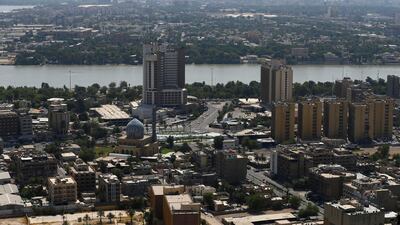
An aerial view of Baghdad. Iraq, Opec’s second-largest producer, depends on oil revenue to meet 90 per cent of government expenditure. Reuters

Fitch assigns Iraq’s Region Trade Bank CCC+ rating due to weak operating environment and low profitability


Fareed Rahman
  • English
  • Arabic

Fitch Ratings assigned Iraq's Region Trade Bank for Investment and Finance (RTB) a "CCC+" Long-Term Issuer Default Rating, citing its weak operating environment, unstable business model and low profitability.

The coronavirus pandemic, social, economic and political instability, as well as high dependence of the economy on oil and a weak regulatory framework, will also continue to put pressure on the bank's operating environment, the ratings agency said on Thursday.

Iraq, Opec’s second-largest producer, depends on oil revenue to meet 90 per cent of government expenditure.

“RTB's profitability is weak, owing to large non-to-low-interest earning liquid assets, large non-earning fixed assets, the low-yielding loan portfolio and high impairment charges reflecting the constantly high provisioning level,” Fitch said.

The cost-to-income ratio is also reasonably high but has improved since 2018, according to the agency.

RTB is a privately owned bank, in the Kurdistan Region of Iraq, and is regulated by the Central Bank of Iraq.

Non-interest income represents the main operating income source, comprising mainly fees and commissions on international transfers, discounting of bills of exchange and trade finance transactions, as well as fees on credit cards.

Cash lending is minimal and the bank does not have financial investments, Fitch said.

“Operating profit originates mainly from non-interest income, but RTB's profitability is likely to remain volatile, sensitive to the political and economic developments that impact the level of the economic activity and ultimately RTB's business volumes,” it said.

Iraq's economy, which shrank by about 11 per cent last year due to Covid-19 and a sharp decline in oil revenue, is poised to return to pre-pandemic levels by 2024, the International Monetary Fund said earlier this year.

The bank's funding is highly sensitive to government deposits, which have proved volatile in the past five years, according to the Fitch report.

Retail deposits are also small, due to RTB's small branch network and Iraqis' lack of confidence in the banking sector, especially private banks.

The Iraqi banking sector is dominated by three state-owned banks and private banks have small market shares.

Fitch earlier this year revised its outlook on Iraq’s sovereign debt from negative to stable and maintained the country's "B-" credit rating, citing higher oil prices and a smaller-than-expected decline in foreign reserves following devaluation of the Iraqi dinar.


Mercer, the investment consulting arm of US services company Marsh & McLennan, expects its wealth division to at least double its assets under management (AUM) in the Middle East as wealth in the region continues to grow despite economic headwinds, a company official said.

Mercer Wealth, which globally has $160 billion in AUM, plans to boost its AUM in the region to $2-$3bn in the next 2-3 years from the present $1bn, said Yasir AbuShaban, a Dubai-based principal with Mercer Wealth.

Within the next two to three years, we are looking at reaching $2 to $3 billion as a conservative estimate and we do see an opportunity to do so,” said Mr AbuShaban.

Mercer does not directly make investments, but allocates clients’ money they have discretion to, to professional asset managers. They also provide advice to clients.

“We have buying power. We can negotiate on their (client’s) behalf with asset managers to provide them lower fees than they otherwise would have to get on their own,” he added.

Mercer Wealth’s clients include sovereign wealth funds, family offices, and insurance companies among others.

From its office in Dubai, Mercer also looks after Africa, India and Turkey, where they also see opportunity for growth.

Wealth creation in Middle East and Africa (MEA) grew 8.5 per cent to $8.1 trillion last year from $7.5tn in 2015, higher than last year’s global average of 6 per cent and the second-highest growth in a region after Asia-Pacific which grew 9.9 per cent, according to consultancy Boston Consulting Group (BCG). In the region, where wealth grew just 1.9 per cent in 2015 compared with 2014, a pickup in oil prices has helped in wealth generation.

BCG is forecasting MEA wealth will rise to $12tn by 2021, growing at an annual average of 8 per cent.

Drivers of wealth generation in the region will be split evenly between new wealth creation and growth of performance of existing assets, according to BCG.

Another general trend in the region is clients’ looking for a comprehensive approach to investing, according to Mr AbuShaban.

“Institutional investors or some of the families are seeing a slowdown in the available capital they have to invest and in that sense they are looking at optimizing the way they manage their portfolios and making sure they are not investing haphazardly and different parts of their investment are working together,” said Mr AbuShaban.

Some clients also have a higher appetite for risk, given the low interest-rate environment that does not provide enough yield for some institutional investors. These clients are keen to invest in illiquid assets, such as private equity and infrastructure.

“What we have seen is a desire for higher returns in what has been a low-return environment specifically in various fixed income or bonds,” he said.

“In this environment, we have seen a de facto increase in the risk that clients are taking in things like illiquid investments, private equity investments, infrastructure and private debt, those kind of investments were higher illiquidity results in incrementally higher returns.”

The Abu Dhabi Investment Authority, one of the largest sovereign wealth funds, said in its 2016 report that has gradually increased its exposure in direct private equity and private credit transactions, mainly in Asian markets and especially in China and India. The authority’s private equity department focused on structured equities owing to “their defensive characteristics.”

Fireball

Moscow claimed it hit the largest military fuel storage facility in Ukraine, triggering a huge fireball at the site.

A plume of black smoke rose from a fuel storage facility in the village of Kalynivka outside Kyiv on Friday after Russia said it had destroyed the military site with Kalibr cruise missiles.

"On the evening of March 24, Kalibr high-precision sea-based cruise missiles attacked a fuel base in the village of Kalynivka near Kyiv," the Russian defence ministry said in a statement.

Ukraine confirmed the strike, saying the village some 40 kilometres south-west of Kyiv was targeted.

If you go

The flights
Etihad (etihad.com) flies from Abu Dhabi to Luang Prabang via Bangkok, with a return flight from Chiang Rai via Bangkok for about Dh3,000, including taxes. Emirates and Thai Airways cover the same route, also via Bangkok in both directions, from about Dh2,700.
The cruise
The Gypsy by Mekong Kingdoms has two cruising options: a three-night, four-day trip upstream cruise or a two-night, three-day downstream journey, from US$5,940 (Dh21,814), including meals, selected drinks, excursions and transfers.
The hotels
Accommodation is available in Luang Prabang at the Avani, from $290 (Dh1,065) per night, and at Anantara Golden Triangle Elephant Camp and Resort from $1,080 (Dh3,967) per night, including meals, an activity and transfers.


COMPANY PROFILE
Name: Kumulus Water
 
Started: 2021
 
Founders: Iheb Triki and Mohamed Ali Abid
 
Based: Tunisia 
 
Sector: Water technology 
 
Number of staff: 22 
 
Investment raised: $4 million