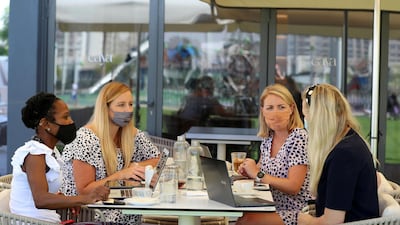
At Goldman Sachs Group and other US banks, staffers know that their bosses want them back in the office. Yet many of their colleagues at European firms are working about half the time from home, with their employers saying that flexibility is a competitive advantage.
Every one of the 12 top European banks surveyed by Bloomberg is continuing to allow employees to work remotely for part of the week. UBS Group even sees its embrace of hybrid working as a chance to hire talented staff from US competitors.
The Swiss bank is committed to offering employees the option of hybrid working and about 75 per cent of employees have roles that offer the necessary flexibility, a spokesman said.
Watch: the law firm where few people 'go to work'
Similarly, France’s Societe Generale, Spain’s Banco Santander and ING Groep of the Netherlands cited workplace flexibility as helping them attract and retain the best talent.
Contrast those approaches with Goldman Sachs, which led Wall Street’s return to its Manhattan towers last year. The company, and competitor Morgan Stanley, began removing some of their remaining Covid-19 mitigation efforts after this month’s US Labour Day holiday.
Earlier this year, Goldman executives emphasised their expectation that staff meeting Covid-protocol requirements will work from the office. The firm — and chief executive David Solomon — has been out in front trying to corral its highly paid staff to resume full-time office work.
A Goldman Sachs spokesman declined to comment on the bank’s policy. Mr Solomon said on an earnings call last year that achieving the goal of bringing staff back to the office “is not inconsistent with the desire to provide our people with the flexibility they need”.
The level of flexibility in Europe varies depending on roles, with traders more bound to offices than IT staff. Yet Deutsche Bank’s policy appears to be the norm, with staff allowed to work remotely up to 40 per cent of the time, rising to 60 per cent in “exceptional circumstances”. SocGen agreed to a similar approach for its France-based staff in 2021.
US-based banks may be trying to push staff in UK and European offices back to their desks, but they are meeting resistance, said Christine Armstrong, who researches the world of work.
“We’re hearing that in some cases, they are getting less than 50 per cent compliance and people are just not turning up,” Ms Armstrong said.
The impact of insisting people return to offices is being felt in increased pay demands and a higher risk of staff attrition, she added.
“Every time you encourage more people to go back to the office or mandate it, you’re increasing your cost of hiring and increasing the chance that people will leave to go somewhere with more flexibility.”
European banks do see the value of bringing staff back to physical meetings during part of the week. Credit Suisse Group wants to ensure employees “continue to be connected to an office and spend valuable time collaborating and team building” a spokesman said.
Still, several European banks are also supplying staff with the equipment to make working from home easier. Spain’s Banco Bilbao Vizcaya Argentaria is providing phones, laptops and, if requested, a chair, screen, mouse and keyboard.
While some tasks are done best in a physical team setting, others “are better done in a more calm space”, whether that is at home or in the office, said ABN Amro Bank of the Netherlands.
Staff are returning to offices, but “not yet at the rate that we had anticipated”, said Jarco de Swart, an ABN Amro spokesman.

COMPANY%20PROFILE
%3Cp%3E%3Cstrong%3ECompany%20name%3A%3C%2Fstrong%3E%203S%20Money%3Cbr%3E%3Cstrong%3EStarted%3A%3C%2Fstrong%3E%202018%3Cbr%3E%3Cstrong%3EBased%3A%3C%2Fstrong%3E%20London%3Cbr%3E%3Cstrong%3EFounders%3A%3C%2Fstrong%3E%20Ivan%20Zhiznevsky%2C%20Eugene%20Dugaev%20and%20Andrei%20Dikouchine%3Cbr%3E%3Cstrong%3ESector%3A%3C%2Fstrong%3E%20FinTech%3Cbr%3E%3Cstrong%3EInvestment%20stage%3A%3C%2Fstrong%3E%20%245.6%20million%20raised%20in%20total%3C%2Fp%3E%0A
Mercer, the investment consulting arm of US services company Marsh & McLennan, expects its wealth division to at least double its assets under management (AUM) in the Middle East as wealth in the region continues to grow despite economic headwinds, a company official said.
Mercer Wealth, which globally has $160 billion in AUM, plans to boost its AUM in the region to $2-$3bn in the next 2-3 years from the present $1bn, said Yasir AbuShaban, a Dubai-based principal with Mercer Wealth.
“Within the next two to three years, we are looking at reaching $2 to $3 billion as a conservative estimate and we do see an opportunity to do so,” said Mr AbuShaban.
Mercer does not directly make investments, but allocates clients’ money they have discretion to, to professional asset managers. They also provide advice to clients.
“We have buying power. We can negotiate on their (client’s) behalf with asset managers to provide them lower fees than they otherwise would have to get on their own,” he added.
Mercer Wealth’s clients include sovereign wealth funds, family offices, and insurance companies among others.
From its office in Dubai, Mercer also looks after Africa, India and Turkey, where they also see opportunity for growth.
Wealth creation in Middle East and Africa (MEA) grew 8.5 per cent to $8.1 trillion last year from $7.5tn in 2015, higher than last year’s global average of 6 per cent and the second-highest growth in a region after Asia-Pacific which grew 9.9 per cent, according to consultancy Boston Consulting Group (BCG). In the region, where wealth grew just 1.9 per cent in 2015 compared with 2014, a pickup in oil prices has helped in wealth generation.
BCG is forecasting MEA wealth will rise to $12tn by 2021, growing at an annual average of 8 per cent.
Drivers of wealth generation in the region will be split evenly between new wealth creation and growth of performance of existing assets, according to BCG.
Another general trend in the region is clients’ looking for a comprehensive approach to investing, according to Mr AbuShaban.
“Institutional investors or some of the families are seeing a slowdown in the available capital they have to invest and in that sense they are looking at optimizing the way they manage their portfolios and making sure they are not investing haphazardly and different parts of their investment are working together,” said Mr AbuShaban.
Some clients also have a higher appetite for risk, given the low interest-rate environment that does not provide enough yield for some institutional investors. These clients are keen to invest in illiquid assets, such as private equity and infrastructure.
“What we have seen is a desire for higher returns in what has been a low-return environment specifically in various fixed income or bonds,” he said.
“In this environment, we have seen a de facto increase in the risk that clients are taking in things like illiquid investments, private equity investments, infrastructure and private debt, those kind of investments were higher illiquidity results in incrementally higher returns.”
The Abu Dhabi Investment Authority, one of the largest sovereign wealth funds, said in its 2016 report that has gradually increased its exposure in direct private equity and private credit transactions, mainly in Asian markets and especially in China and India. The authority’s private equity department focused on structured equities owing to “their defensive characteristics.”
UAE currency: the story behind the money in your pockets
Biggest%20applause
%3Cp%3EAsked%20to%20rate%20Boris%20Johnson's%20leadership%20out%20of%2010%2C%20Mr%20Sunak%20awarded%20a%20full%2010%20for%20delivering%20Brexit%20%E2%80%94%20remarks%20that%20earned%20him%20his%20biggest%20round%20of%20applause%20of%20the%20night.%20%22My%20views%20are%20clear%2C%20when%20he%20was%20great%20he%20was%20great%20and%20it%20got%20to%20a%20point%20where%20we%20need%20to%20move%20forward.%20In%20delivering%20a%20solution%20to%20Brexit%20and%20winning%20an%20election%20that's%20a%2010%2F10%20-%20you've%20got%20to%20give%20the%20guy%20credit%20for%20that%2C%20no-one%20else%20could%20probably%20have%20done%20that.%22%3C%2Fp%3E%0A
BABYLON
%3Cp%3EDirector%3A%20Damien%20Chazelle%3C%2Fp%3E%0A%3Cp%3EStars%3A%20Brad%20Pitt%2C%20Margot%20Robbie%2C%20Jean%20Smart%3C%2Fp%3E%0A%3Cp%3ERating%3A%204%2F5%3C%2Fp%3E%0A
Avatar: Fire and Ash
Director: James Cameron
Starring: Sam Worthington, Sigourney Weaver, Zoe Saldana
Rating: 4.5/5
Who has been sanctioned?
Daniella Weiss and Nachala
Described as 'the grandmother of the settler movement', she has encouraged the expansion of settlements for decades. The 79 year old leads radical settler movement Nachala, whose aim is for Israel to annex Gaza and the occupied West Bank, where it helps settlers built outposts.
Harel Libi & Libi Construction and Infrastructure
Libi has been involved in threatening and perpetuating acts of aggression and violence against Palestinians. His firm has provided logistical and financial support for the establishment of illegal outposts.
Zohar Sabah
Runs a settler outpost named Zohar’s Farm and has previously faced charges of violence against Palestinians. He was indicted by Israel’s State Attorney’s Office in September for allegedly participating in a violent attack against Palestinians and activists in the West Bank village of Muarrajat.
Coco’s Farm and Neria’s Farm
These are illegal outposts in the West Bank, which are at the vanguard of the settler movement. According to the UK, they are associated with people who have been involved in enabling, inciting, promoting or providing support for activities that amount to “serious abuse”.
UAE v Gibraltar
What: International friendly
When: 7pm kick off
Where: Rugby Park, Dubai Sports City
Admission: Free
Online: The match will be broadcast live on Dubai Exiles’ Facebook page
UAE squad: Lucas Waddington (Dubai Exiles), Gio Fourie (Exiles), Craig Nutt (Abu Dhabi Harlequins), Phil Brady (Harlequins), Daniel Perry (Dubai Hurricanes), Esekaia Dranibota (Harlequins), Matt Mills (Exiles), Jaen Botes (Exiles), Kristian Stinson (Exiles), Murray Reason (Abu Dhabi Saracens), Dave Knight (Hurricanes), Ross Samson (Jebel Ali Dragons), DuRandt Gerber (Exiles), Saki Naisau (Dragons), Andrew Powell (Hurricanes), Emosi Vacanau (Harlequins), Niko Volavola (Dragons), Matt Richards (Dragons), Luke Stevenson (Harlequins), Josh Ives (Dubai Sports City Eagles), Sean Stevens (Saracens), Thinus Steyn (Exiles)