


A rising emissions trend in the aerospace and defence sectors can only be reversed through collaboration on decarbonising approaches to sustainability, the Farnborough International Air Show was told on Wednesday.
Despite efforts to decarbonise, the aerospace and defence sectors still have “issues” said Grant MacDonald, global aerospace and defence leader at the consultants, KPMG.
“Civil aviation is contributing about four per cent to global warming and the defence industry itself, including the armed forces, probably contributes around six per cent of greenhouse gas emissions,” he told the trade exhibition for the aerospace and defence industries in south-east England.
“These figures are expected to rise. Of course, we’re seeing increased orders of commercial aircraft and the level of geopolitical conflicts where operational readiness is always the top priority it is going to affect the defence side of aviation [emissions] as well.”
Priority was a point echoed by Dr Victoria Coleman, former chief scientist at the US Air Force, who said that efforts towards sustainability had to fit in with the primary mission objective of the US military, which is the protection of the US and its citizens.
But that’s not to say that sustainability was not being taken seriously and that climate change was a peripheral issue for the USAF, she said.
Dr Coleman used examples of an antenna station in Alaska having to be reinforced as melting permafrost had caused the foundations to sink and the damage wrought on US airbases from hurricanes.
‘We just don’t have the money’
However, Dr Coleman also pointed out certain fiscal realities, saying “we just don’t have the money” to widely adopt the use of sustainable aviation fuel – which at the moment is much more expensive than standard aviation fuel.
“By law, we [the USAF] are not allowed to exceed the cost of regular aviation fuel,” she said and added that if SAF production was to be scaled, the cost of it would fall.
As such, the sheer size of the US military and its mission means it’s a “complicated environment”, she said, and the integration of sustainability was “culturally a change, but we’re embracing it”.

Deborah Allen, group director of sustainability at BAE Systems told the air show that the challenge is embedding sustainability into “how the company does business” and pointed out that “without security, there is no sustainability.”
“One of the things that we struggle with most is the perception that sustainability is a cost, a burden and an added extra. It’s nice to have – something you do once you’ve done the important stuff.
“Hopefully we are moving on from that – there’re a lot of benefits that can come from it and it’s realising that.”
Value was at the centre of the discussion – demonstrating that sustainable strategies create value and are not a business cost, but a profit opportunity, both at the supply chain level and at the sales level.
The Farnborough International Airshow 2024 – in pictures
-
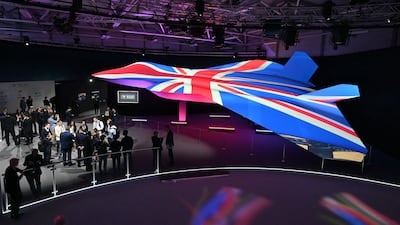
Delegates look at the Global Combat Air Programme sixth-generation fighter jet concept design, bathed in the colours of the British flag, on day two of the Farnborough International Airshow. AFP -
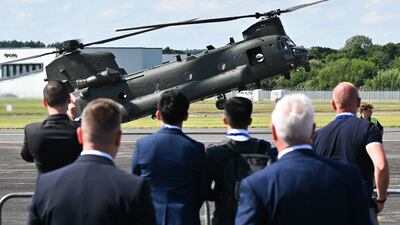
Visitors watch a Chinook helicopter land. AFP -
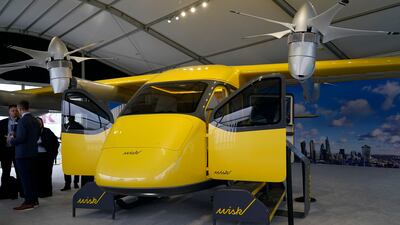
The Wisk pavilion showcasing its air taxi. AP -

The British Red Arrows aeronautics display team in action in the sky over Farnborough. Reuters -
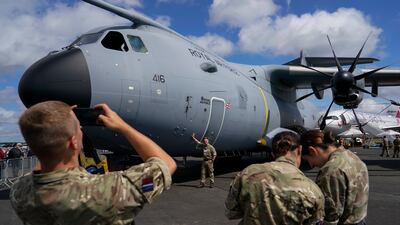
A UK Royal Air Force plane at the Farnborough International Air Show. The aerospace and defence sectors are still significant contributors to global warming. AP -
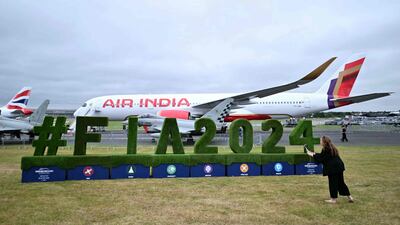
A visitor photographs the logo on the opening day. AFP -
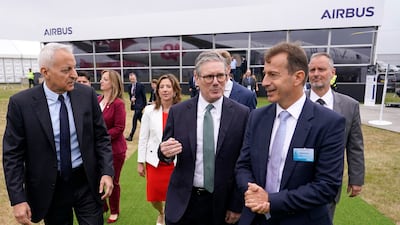
British Prime Minister Keir Starmer, centre, speaks to Guillaume Faury, right, Airbus chief executive, as he arrives at the annual event. PA -
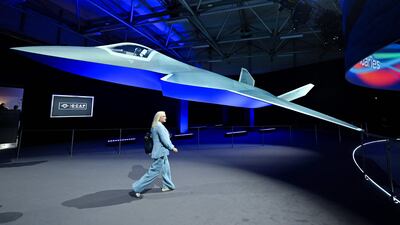
The Global Combat Air Programme sixth-generation fighter jet concept design. AFP -
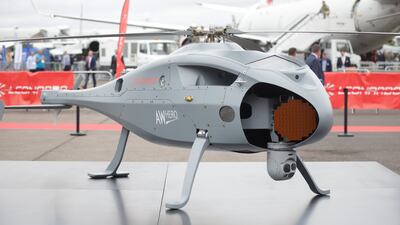
An AWHero drone displayed on the Leonardo SpA stand. Bloomberg -
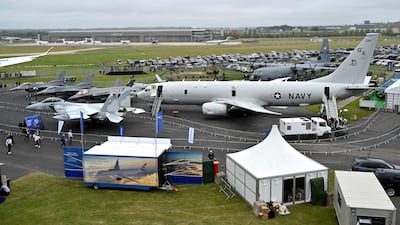
US military aircraft displayed on the opening day at Farnborough. AFP -

Falconworks unmanned aerial vehicles are displayed at the BAE Systems stand. AFP -
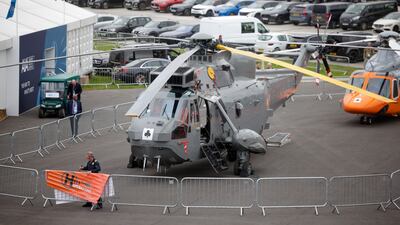
A Westland Sea King HU5 helicopter on display. Bloomberg -
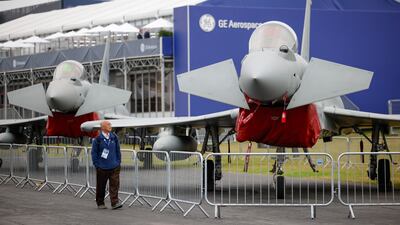
A Typhoon multirole combat aircraft on show. Bloomberg -
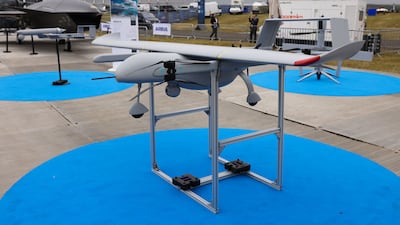
A drone made by Airbus on a stand at Farnborough. Bloomberg


“The customer won’t pay a premium for sustainability but will pay a premium for future-proofing their capabilities,” Ms Allen said.
Helene Gagnon, chief sustainability officer and senior vice president at the pilot training and simulator company CAE agreed.
“The more we can demonstrate that sustainability is a generator of value for our customers, the better,” she said.
‘A highly collaborative business’
That means collaboration between companies right across the aerospace and defence industries.
In its report on sustainability in aerospace and defence out this week, KPMG’s global ESG sector executive, Ebony Carmichael said that “sustainability is one of the greatest challenges facing our world today.
“It’s a challenge we must all work together to address.”
Graham Webb, chief sustainability officer for engine maker, Pratt & Whitney, echoed that sentiment adding that aerospace has “always been a highly collaborative business”.
“The value that we create as an industry is so much more than if we go at it [sustainability] individually,” he said.

In KPMG’s global sustainability in aerospace and defence report, 57 per cent of business leaders said collaboration between all the industry’s players was among the most important opportunities to progress the sector towards Net Zero.
Much of this comes down to supply chains and the need for aerospace and defence companies to engage with their suppliers on sustainability and decarbonisation.
“The supply chain is a very important part of our overall plan and a very significant part of our overall footprint.
“I recall Farnborough two years ago – there was a lot of discussion, and a lot of companies had their own particular way of engaging with their supply chains and asking them to contribute to sustainability progress.
“We’re very much a fan of collaboration and really pleased that we took the time to collaborate because the investment of that time has been repaid many times over, because we are now progressing faster.”
Regulators and governments
Collaboration with regulators and government was raised as being an important element of the efforts to decarbonise the whole aerospace and defence industry while maintaining the safety standards in place today.
For example, Mr Webb said that it was an “absolute mandate” that the safety record we have today be maintained when new technologies like SAF are introduced.
Likewise, with the advent of electric planes, Ms Gagnon said that “partnership with the regulators will be extremely important – it’ll be very different for them with a new all-electric industry”.
“We need the partnership with the regulators, and we need it quickly”.

