


As the Israel-Gaza war continues, there has been increasing support for Palestine from the technology industry, particularly for start-ups that have been affected.
In the coming weeks, an initiative backed by the Bank of Palestine is set to use more than $2 million in raised capital to support 20 well-established Palestinian start-ups affected by the crisis.
The tech industry contributed almost $500 million to the Palestinian economy in 2021, accounting for close to 3 per cent of the gross domestic product in the occupied West Bank and Gaza, a report by the World Bank showed.
In its latest report on Palestine’s economy, the World Bank said nearly half a million jobs have been lost since the start of the war in October, with more than 200,000 of those in the Gaza Strip and 148,000 due to commuters from the West Bank losing access to work in Israel.
Another 144,000 positions have been eliminated in the West Bank “due to escalating violence and the repercussions on supply chains, production capacity, and breadwinners’ ability to access their workplace”, the institution said.
Education programmes, such as those offered by Talent Acceleration Platform (TAP), a Dutch-Palestinian upskilling and job placement company, have been severely affected, but they are still working to assist those they can.
Jafar Shunnar, co-founder of TAP, said their programmes in software development, digital marketing and business development have been hit.
“All the people that we had in Gaza working with external companies are no longer working with these companies. And all the participants in our programme are no longer participating,” Mr Shunnar told The National from the West Bank.
Three weeks ago, “things started to look a bit calmer” and they started to re-engage with people in Gaza, but then violence erupted again and they had to put their plans on hold, he said.
TAP, which has created 150 jobs for Palestinians, has partnered with HopeHub – an NGO that offers co-working space for freelancers in Gaza – to allow people to work or access Tap Education. It also helps those who have left Gaza to go to Egypt.
It has also launched a campaign called Palestine Future, which aims to connect 1,000 Palestinian youths with 1,000 global professionals from companies such as Google, Meta, Microsoft, LinkedIn and Accenture to help them with career coaching, mentorship or even job opportunities.
Lifeline
The tech economy in Palestine has always been able to thrive better than other sectors, given its ability to bypass a lot of the physical restrictions on the movement of people and goods.
Ryan Sturgill, principal at Cross Boundary and investment adviser to the Bank of Palestine, said technology had been a “lifeline for many people”.
“Since October, I think it's become even more important, certainly for people in the West Bank,” Mr Sturgill said.
“You see lots of companies, physical or digital, unable to have the people come to work or to communicate or interact effectively with the violence occurring all across the West Bank.”

He said he has been in contact with some internet companies about re-establishing hotspot Wi-Fi for the camps in Gaza, where infrastructure has been decimated.
The violence has led to increased attention from regional and global investors towards start-ups in Palestine’s tech sector, he said.
“They [Palestinian start-ups] are high-quality companies that are targeting big regional and global markets,” Mr Sturgill said.
He is leading a Bank of Palestine initiative called Safe Palestine, which aims to raise $5 million for bridge equity investments for the “most promising” start-ups that have already demonstrated significant traction.
Launched in February, the fund has done its first close at just under $2.5 million and will shortly do a first disbursement to 20 start-ups.
“We're looking at start-ups that are kind of at an inflection point,” Mr Sturgill said.
“They're kind of at the seed stage going to like a Series A and have traction, real customers, they’re revenue-generating, but they also have the most to lose potentially by not being able to extend that runway and continue to do product development and things like that.”
The companies are digital, scalable product or service-oriented start-ups from sectors like logistics, B2C booking apps, construction tech, legaltech, FinTech and healthtech.
Details of the funding will be announced shortly but the money came from “big technology companies” as well as public and individual and venture firms in Silicon Valley and across the Middle East region, Mr Sturgill said.
Rallying support
However, support from the US tech sector for Palestine has been starkly divided.
Silicon Valley is the headquarters for 35 Israeli-founded unicorns – privately held companies valued at $1 billion or more – the US-Israel Business Alliance said last year.
Paul Biggar, co-founder and former chief executive of software company CircleCI, which had a valuation of $1.7 billion in 2021, wrote a blog post in December against the tech industry for being complicit in “genocide” in Gaza.
The I Can't Sleep blog post went viral and led to Mr Biggar being contacted by people telling him about their Palestinian projects. He promptly created Tech for Palestine, a community of tech industry experts that has grown to 5,000 since its launch in January.
“The way it works is people join and we help people get connected to projects to start projects that will help Palestine in some way,” Mr Biggar, who lives in New York, told The National.
“In many cases, it's a boycott tool to help … boycott different parts of society. For example, we have some people who focus on boycotting specific companies, some people focused on boycotting general consumer applications, some people doing that via mobile apps versus Chrome extensions versus web apps.”
-

Students at King's College Cambridge University camp out in solidarity with Palestinians, in Cambridge, Britain, on May 9. EPA -

A woman takes part in the King's College Cambridge University protest camp on May 9. EPA -
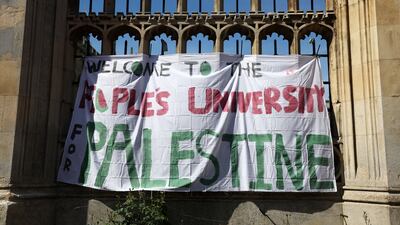
A banner at King's College shows the students' determination to support Palestinians under siege in Gaza. EPA -
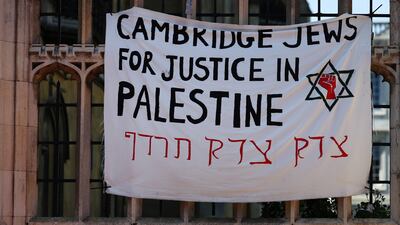
Another banner, from Jewish students at Cambridge University, supporting Gaza's Palestinians. EPA -

The pro-Palestinian camp at King's College. EPA -

Students at the university maintain their vigil. EPA -

A protest outside Senate House at Cambridge University on Wednesday over the Gaza conflict. PA


Adil Abbuthalha, creator of the app Boycat, is among those who joined Tech for Palestine, which he said helped to launch his product.
Launched in January, the app allows users to scan a product’s bar code to tell if it’s pro-Palestinian. If it’s not, the app will provide pro-Palestinian alternatives.
Mr Abbuthalha, who lives in the US, said the app has more than 100,000 monthly active users and estimates that its diverted sales are worth several million dollars.
“We've calculated that we're looking around just around $10 million diverted in one-time purchases, which doesn't count continuous purchases,” Mr Abbuthalha told The National.
“So, if you bought Starbucks or Coca-Cola three times a week, we only count it as once because we don't count the continuous effect.”
The free app doesn’t make any money and will redirect any donations to those raising funds for humanitarian aid.
The next stage of development will be to localise the app and give alternatives in Europe, Africa, Asia and the Middle East. He also plans to create a shop on the app, which will have pro-Palestinian-only products.
Fact-checking
One of Tech for Palestine’s more successful projects so far is October 7 Fact Check, which Mr Biggar said was nearly complete by the time it joined the community.
“The tool has been incredibly effective and it continues to be developed,” Mr Biggar said.
“It has helped expose a lot of the myths around October 7 – when I say myths, I mean, atrocity propaganda which has been bought [and] is used by Israel to manufacture consent for the invasion and further genocide.”
Newscord, a website that compares news stories to reveal media bias, was also fully formed by the time it joined Tech for Palestine.
London-based Nima Akram created the website after he noticed “two distinct narratives being set from mainly the western sources”, which are “prioritising the Israeli side and covering whatever Israel says as fact”, he said.
“And then you're seeing Al Jazeera, the Middle East Eye and The National as well, I would say looking at both sides, or maybe kind of focusing on the humanitarian outcome and how it's affecting innocent people's lives.”
As a data scientist by trade, he said he wanted to use his skills to create a website that would evaluate both sides of the story and highlight the contradictions.
Newscord uses the AI technology that runs Chat GPT – Open AI’s GPT 3.5 – to compare articles with a summary of the facts and information, as well as the key contradictions.
“It's not saying this is the truth, but this is a lie. It's saying there are significant differences here,” he said.
“Hopefully, the user kind of gets to their own conclusions by seeing all of these different views.”

