Why Beyonce’s long-overdue Album of the Year success is a course correction for the Grammys


  • English
  • Arabic

February 03, 2025

Beyonce’s first Album of the Year success with the country music-inspired Cowboy Carter was not just long-overdue recognition of her sustained excellence – it also addressed the elephant in the room lingering over the Grammy Awards for nearly 25 years.

For many fans, it should help atone for past perceived snubs when other artists took home the award despite widespread critical consensus having favoured Beyonce – most memorably in 2017 when Adele, upon winning the category for 25, openly apologised to her on stage.

Beyond righting past oversights, the 2025 Grammys win could also mark a potential turning point for the ceremony itself as it strives to adapt in the digital broadcast era.

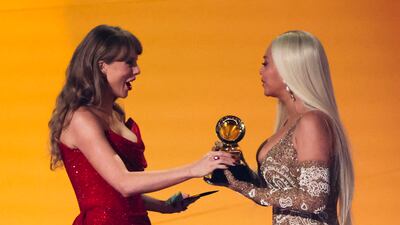
  • Beyonce receives the Best Country Album award for "Cowboy Carter" from Taylor Swift. Reuters
    Beyonce receives the Best Country Album award for "Cowboy Carter" from Taylor Swift. Reuters
  • Brittany Howard, Sheryl Crow, St. Vincent, Taylor Goldsmith of Dawes, Brad Paisley and Griffin Goldsmith of Dawes perform onstage during the 67th GRAMMY Awards. AFP
    Brittany Howard, Sheryl Crow, St. Vincent, Taylor Goldsmith of Dawes, Brad Paisley and Griffin Goldsmith of Dawes perform onstage during the 67th GRAMMY Awards. AFP
  • US rapper and singer Doechii (R) accepts the Grammy for Best Rap Album with her mother (L). EPA
    US rapper and singer Doechii (R) accepts the Grammy for Best Rap Album with her mother (L). EPA
  • Sabrina Carpenter, center, performs a medley. AP
    Sabrina Carpenter, center, performs a medley. AP
  • US singer Chappell Roan (C) performs during the 67th annual Grammy Awards ceremony. EPA
    US singer Chappell Roan (C) performs during the 67th annual Grammy Awards ceremony. EPA
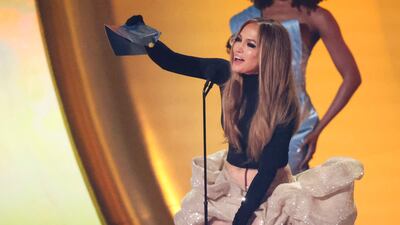
  • Jennifer Lopez speaks during the 67th Annual Grammy Awards in Los Angeles. Reuters
    Jennifer Lopez speaks during the 67th Annual Grammy Awards in Los Angeles. Reuters
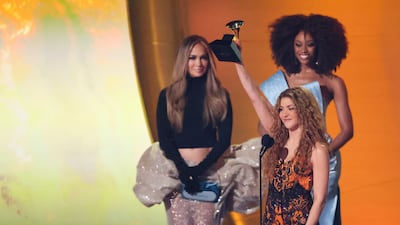
  • Shakira receives the Best Latin Pop Album award for "Las Mujeres Ya No Lloran" during the 67th Annual Grammy Awards in Los Angeles, California, U. S. , February 2, 2025. REUTERS / Mario Anzuoni
    Shakira receives the Best Latin Pop Album award for "Las Mujeres Ya No Lloran" during the 67th Annual Grammy Awards in Los Angeles, California, U. S. , February 2, 2025. REUTERS / Mario Anzuoni
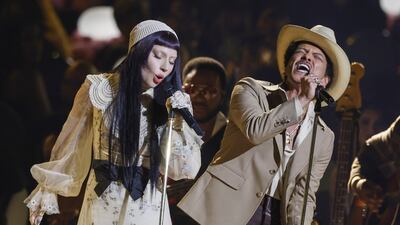
  • US singers Lady Gaga (L) and Bruno Mars (R) perform. EPA
    US singers Lady Gaga (L) and Bruno Mars (R) perform. EPA
  • Benson Boone performs during the 67th Annual Grammy Awards in Los Angeles. Reuters
    Benson Boone performs during the 67th Annual Grammy Awards in Los Angeles. Reuters

Beyonce – following a long line of zeitgeist-defining artists, from Michael Jackson to Taylor Swift – has also played her part in the cultural evolution of the awards through wins and nominations for albums that have become cultural milestones.

Her Grammys journey also reflected her own evolution as an artist, transitioning from polished yet musically conservative RnB to bold, statement-making albums. She first appeared at the ceremony in 2001, as part of the all-girl group Destiny’s Child, when they won awards for Best RnB Performance by a Duo or Group and Best RnB Song. In a way, these wins may have hastened her decision to launch a solo career two years later. The group seemed to have hit their artistic ceiling in terms of recognition.

Destiny's Child's Grammy Award wins proved to be their artistic ceiling. Getty Images

And when it came to her solo journey, the Grammys were there from the start. Her first solo album, Dangerously in Love – a genre-expanding release in 2003 that blended hip-hop, soul and pop influences with traditional RnB – made a near-clean sweep of the RnB-specific categories in the 2004 ceremony, including Best Contemporary RnB Album and Best Female RnB Vocal Performance.

That initial success would eventually turn to frustration over the next five years, as Beyonce seemed locked out of major award categories and instead settled for genre-specific accolades.

These included Best RnB Performance by a Duo or Group with Vocals for her Stevie Wonder collaboration So Amazing in 2006, followed a year later by a win for Best Contemporary RnB Album for B’Day.

Like her decision to pursue a solo career following Destiny’s Child’s Grammy wins in 2001, the Grammys could be credited for prompting Beyonce’s shift away from commercially-driven RnB. She may have been motivated to expand her sound and avoid being boxed in.

Beyonce wins Best Female Pop Vocal Performance for Halo at the 2010 Grammys. Reuters

After securing four more genre-specific awards – as well as Song of the Year for Halo in 2010 – she embraced a more adventurous, boundary-pushing sound.

It was an era in which Grammy voters faced criticism for failing to properly recognise Beyonce’s catalogue. Her 2011 album, 4, a subtle and lush record that saw her embracing African rhythms, was universally acclaimed yet didn’t even receive a nomination for Album of the Year.

Meanwhile, her self-titled 2013 album, which pioneered the now-standard strategy of releasing a visual album without prior promotion, once again earned her RnB-specific awards, as well as a win for Best Surround Sound Album.

Then came Lemonade (2016). It was a masterpiece that sparked conversations about racism, intergenerational trauma and the complexities of relationship breakdowns in an era of “conscious uncoupling”. Widely regarded as one of the biggest Grammy snubs of all time, its loss to Adele’s 25 in the Album of the Year category even had the winner herself apologising on stage.

In many ways, her eventual walk to the podium for Cowboy Carter marks a significant moment for both the artist and the Grammys. For Beyonce it serves as a mid-career lifetime achievement award – recognising both a boundary-pushing album and her astonishing consistency. For the Grammys, it represents a much-needed course correction in acknowledging popular music within an increasingly genre-fluid landscape.

While Beyonce may have been visibly shocked to win Best Country Album Award earlier in the night – making her the first black woman to win a country award at the Grammys since the Pointer Sisters in 1975 – it is a welcome sign that the gatekeepers of the genres are also becoming more welcoming to those who cut their teeth in other traditions.


Mercer, the investment consulting arm of US services company Marsh & McLennan, expects its wealth division to at least double its assets under management (AUM) in the Middle East as wealth in the region continues to grow despite economic headwinds, a company official said.

Mercer Wealth, which globally has $160 billion in AUM, plans to boost its AUM in the region to $2-$3bn in the next 2-3 years from the present $1bn, said Yasir AbuShaban, a Dubai-based principal with Mercer Wealth.

Within the next two to three years, we are looking at reaching $2 to $3 billion as a conservative estimate and we do see an opportunity to do so,” said Mr AbuShaban.

Mercer does not directly make investments, but allocates clients’ money they have discretion to, to professional asset managers. They also provide advice to clients.

“We have buying power. We can negotiate on their (client’s) behalf with asset managers to provide them lower fees than they otherwise would have to get on their own,” he added.

Mercer Wealth’s clients include sovereign wealth funds, family offices, and insurance companies among others.

From its office in Dubai, Mercer also looks after Africa, India and Turkey, where they also see opportunity for growth.

Wealth creation in Middle East and Africa (MEA) grew 8.5 per cent to $8.1 trillion last year from $7.5tn in 2015, higher than last year’s global average of 6 per cent and the second-highest growth in a region after Asia-Pacific which grew 9.9 per cent, according to consultancy Boston Consulting Group (BCG). In the region, where wealth grew just 1.9 per cent in 2015 compared with 2014, a pickup in oil prices has helped in wealth generation.

BCG is forecasting MEA wealth will rise to $12tn by 2021, growing at an annual average of 8 per cent.

Drivers of wealth generation in the region will be split evenly between new wealth creation and growth of performance of existing assets, according to BCG.

Another general trend in the region is clients’ looking for a comprehensive approach to investing, according to Mr AbuShaban.

“Institutional investors or some of the families are seeing a slowdown in the available capital they have to invest and in that sense they are looking at optimizing the way they manage their portfolios and making sure they are not investing haphazardly and different parts of their investment are working together,” said Mr AbuShaban.

Some clients also have a higher appetite for risk, given the low interest-rate environment that does not provide enough yield for some institutional investors. These clients are keen to invest in illiquid assets, such as private equity and infrastructure.

“What we have seen is a desire for higher returns in what has been a low-return environment specifically in various fixed income or bonds,” he said.

“In this environment, we have seen a de facto increase in the risk that clients are taking in things like illiquid investments, private equity investments, infrastructure and private debt, those kind of investments were higher illiquidity results in incrementally higher returns.”

The Abu Dhabi Investment Authority, one of the largest sovereign wealth funds, said in its 2016 report that has gradually increased its exposure in direct private equity and private credit transactions, mainly in Asian markets and especially in China and India. The authority’s private equity department focused on structured equities owing to “their defensive characteristics.”

COMPANY%20PROFILE
%3Cp%3E%3Cstrong%3EName%3A%20%3C%2Fstrong%3EShaffra%3Cbr%3E%3Cstrong%3EStarted%3A%20%3C%2Fstrong%3E2023%3Cbr%3E%3Cstrong%3EBased%3A%20%3C%2Fstrong%3EDIFC%20Innovation%20Hub%3Cbr%3E%3Cstrong%3ESector%3A%20%3C%2Fstrong%3Emetaverse-as-a-Service%20(MaaS)%3Cbr%3E%3Cstrong%3EInvestment%3A%20%3C%2Fstrong%3Ecurrently%20closing%20%241.5%20million%20seed%20round%3Cbr%3E%3Cstrong%3EInvestment%20stage%3A%20%3C%2Fstrong%3Epre-seed%3Cbr%3E%3Cstrong%3EInvestors%3A%20%3C%2Fstrong%3EFlat6Labs%20Abu%20Dhabi%20and%20different%20PCs%20and%20angel%20investors%20from%20Saudi%20Arabia%3Cbr%3E%3Cstrong%3ENumber%20of%20staff%3A%20%3C%2Fstrong%3Enine%3C%2Fp%3E%0A
Updated: February 03, 2025, 11:42 AM