When it comes to creating awe-inspiring, heart-in-mouth on-screen images, few can compete with the magic of Disney. From the intricately detailed alien worlds of Star Wars to the epic space battles of the Marvel Cinematic Universe, almost every cinema goer or TV watcher will have been bowled over by Disney's visuals at one point or another in their viewing journey. A new show that will debut on OSN Disney+ this week, however, proves that we don't have to travel to fantastical galaxies far far away, or even use a single special effect, to be truly humbled by real-life, on-screen events happening right here on Planet Earth.
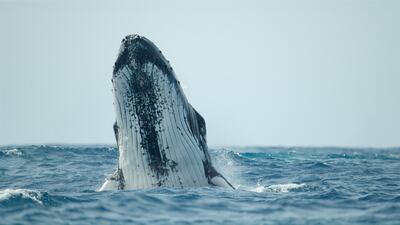
Secrets of the Whales is a four-hour, four-part special event documentary from National Geographic photographer and explorer Brian Skerry and writer/director/producer Brian Armstrong that gives us a simultaneously intimate, yet epic insight into the supersized world of the giants of the sea.
Shot over a three-year period in 24 countries, executive produced by Titanic's James Cameron, and with Alien's Sigourney Weaver on narration duties, it has both the sheer scale and the star power to compete with Disney's biggest blockbusters when it launches on Earth Day, on Thursday, April 22.
The bar has already been set incredibly high by the much-loved David Attenborough, whose The Blue Planet series has won over awards juries and audiences alike over the years all around the world – he even temporarily broke the internet in China when Blue Planet II launched on the local Tencent streaming platform in 2017.
For Skerry, who has been documenting the natural world for National Geographic for about 23 years, this new series offered an opportunity to do something a little different to traditional nature documentaries, however, and delve deep into the distinct social cultures of whales. It offers an almost fly-on-the-wall documentary of the family lives of different whale species.

"In the last decade, I've been searching for a narrative that would allow me to do a big multi-species story, and I couldn't get that right," the whale-loving snapper tells The National. "I started reading a lot of scientific papers and talking to scientists, and I saw this theme emerging about culture, and the fact that some of the latest science was revealing that, like us, whales have their own cultures. That within genetically identical species they're doing things differently depending where in the world they live. They have food preferences, they have parenting techniques, they isolate by dialect or language. They even have singing competitions. It sounds to some degree to be anthropomorphising, but the reality is they really do it."
If anyone is an ideal production partner for the anthropomorphisation of the world’s animals, it’s surely Disney, with its long history of all-singing, all-dancing animal heroes.
Before long, what Skerry had initially planned as “a magazine story, book, and a bit of TV” about his discoveries had grown into something much bigger. Red Rock Films, a powerhouse of US natural history programming, was brought on board, alongside Weaver and Cameron. Red Rock’s president, Brian Armstrong, who also writes, directs and co-executive produces the show, quickly recognised its potential.
“I think it was initially envisaged as a one-off doc, like a photographer profile, but, with no offence to Brian [Skerry], this wasn’t about Brian, it was about a breakthrough in science,” Armstrong explains. “Even Darwin had said about animals having emotions, but it’s been somewhat taboo to talk about. Brian had been working with scientists that really were the gateway to discussing animals in this way, and once we realised that potential we knew that we were going to need four hours instead of one, and to really make it fully about the whales.”
Armstrong and Skerry both admit that by focusing on the whales almost as characters in a family drama, they were able to make a documentary more in the American narrative tradition than Attenborough's fact-based approach. While some of the scenes of joy and tragedy are clearly selected to tug at our heartstrings, the show is undisputedly documentary, and never in danger of spilling over into Finding Nemo whimsy. We can, though, perhaps think March of the Penguins rather than The Blue Planet, and the two Brians hope that by using this approach they can inspire an emotional connection in their audience, and perhaps even help to elicit change in the world.

“I often feel that wildlife filmmaking is very clinical, very scientific. It doesn’t want to go into these kind of personal issues,” says Skerry. “I think once you know that these whales have cultures, and families, and empathy, and love, and grief, you can’t unknow that. It changes the way you see things, and maybe as a result you care more about the ocean and the planet. That’s hopefully the takeaway.”
The series director agrees: “If you are able to tell a story that makes that emotional connection, then you’re going to drive a bit more towards a result, which could hopefully be action from audiences,” he says.
At least one viewer of the series has clearly already felt that emotional connection, though given the time constraints of completing such an epic series under Covid-19 restrictions, in time for Earth Day, the producers may wish their narrator could have kept her composure until the footage actually screened publicly.
"I can give you an exclusive about the final narration session with Sigourney on our last episode," Armstrong teases. "She started crying. She'd seen the show and she was reading the narration, and she got through to a very emotional part where, without spoiling anything, we reconnect with a whale that we met earlier on, and she just burst into tears.
"It was tears of joy, but she really felt for these creatures. I think that’s the sort of storytelling we’re talking about, and I think there’s a real thirst for it right now.”
Secrets of the Whales is available to stream on OSN Disney+ from Thursday, April 22

