

The Academy of Motion Picture Arts and Sciences will require guests at the 94th Oscars ceremony in March to show proof of Covid-19 vaccination and at least two negative results from PCR tests, a person with knowledge of the matter said on Thursday.
Performers and presenters at the film industry's highest honours must also undergo PCR testing, but will not need to show proof of vaccination, the source said.
Previously, The Hollywood Reporter said the Oscars would not mandate proof of vaccine, with or without a booster shot, for all those attending the ceremony, despite requiring its own employees to be vaccinated.
Face covering requirements will vary at the event on March 27 at the Dolby Theatre in Hollywood, according to the source.
Nominees and their guests in lower sections of the theatre will not be required to wear masks. They will be seated with more distance than usual between groups, the source said. The Dolby seats 3,317 people and 2,500 people will be invited.
Those seated in the mezzanine area may be required to wear masks, as they will sit shoulder-to-shoulder. Covid-19 cases are declining in Los Angeles County and organisers are consulting with government officials and infectious disease experts.
The vaccination policies were first reported by The New York Times.
Comic actor Amy Schumer, actress Regina Hall and fellow comedienne Wanda Sykes will host the awards, making it the first time three women are emceeing the Oscars.
"I'm not sure who thought this was a good idea but I am hosting the Oscars, along with my good friend Wanda Sykes and Regina Hall," Schumer, an Emmy award-winning comic, writer and producer said during an appearance on Good Morning America. "I better go watch some movies."
This year’s show is all about uniting movie lovers, producer Will Packer said. “It’s apropos that we’ve lined up three of the most dynamic, hilarious women with very different comedic styles.”
Schumer is best known for her award-winning sketch show Inside Amy Schumer, while Hall is known for films such as Girls Trip, Scary Movie and The Best Man. Sykes, who created, wrote and stars in the Netflix sitcom The Upshaws, has appeared in films such as Bad Moms and Down to Earth, as well as TV shows including Curb Your Enthusiasm and black-ish. She's also won an Emmy for writing for The Chris Rock Show.
It’s the first time hosting for all three women and the first time in 35 years there has been this many hosts for one broadcast.
-
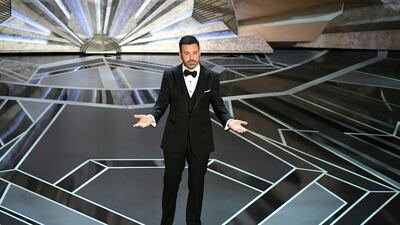
In 2018, US comedian Jimmy Kimmel was the host of the Academy Awards, after also serving in the role in 2017. AFP -
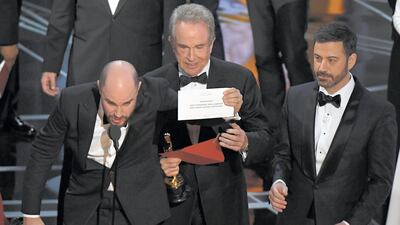
Jimmy Kimmel, right, at the 2017 Oscars, watches on while 'La La Land' producer Jordan Horowitz shows the card stating that 'Moonlight' won the Best Picture Award. AFP -
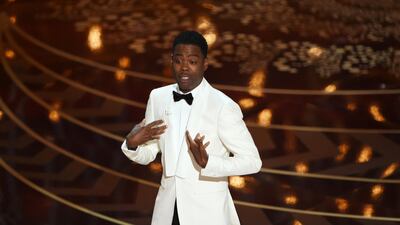
Chris Rock hosted the Academy Awards in 2016, with an opening monologue criticising the lack of black acting nominees. AFP -
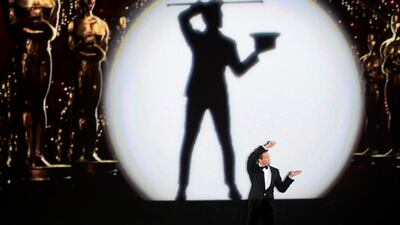
In 2015, Oscars host Neil Patrick Harris did a musical performance along with Anna Kendrick. AFP -

In 2014, the award ceremony's host Ellen DeGeneres clicked the star-studded selfie that went viral. -

Seth MacFarlane opened the 2013 Oscars with a 19-minute monologue that was criticised by many as racist and sexist. AFP -
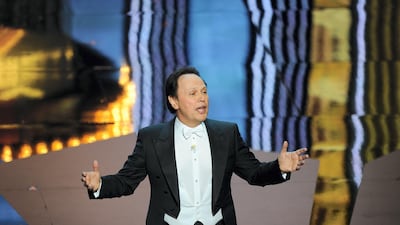
The 2012 Oscars host Billy Crystal has emceed the event a total of nine times. AFP -

James Franco and Anne Hathaway's hosting of the 2011 event was criticised as among the worst Oscar telecasts. AFP -
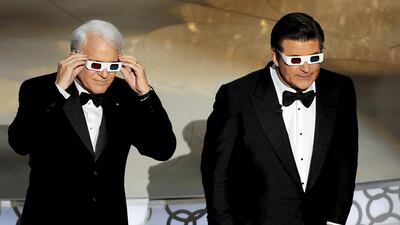
In 2010, veteran actors Steve Martin and Alec Baldwin played hosts at the Oscars ceremony. AFP -

The 2009 event was highly praised for host Hugh Jackman's opening musical performance. AP Photo



