

For the first time in 15 years, Hollywood’s film and TV writers have walked out on strike. The strike was announced on Tuesday morning by the Writers Guild of America — the union that represents the industry through branches on the east and west coasts of the US — and came into effect immediately.
What does this mean?
The Guild has asked its members to stop writing with immediate effect. The guild includes not only behind-the-scenes writers, but also familiar faces who pen some of their own material, such as Seth Meyers, who used his Late Night show on Monday to call for “fair compensation” for writers. Tonight Show’s Jimmy Fallon also expressed support for his “whole staff” from the red carpet of Monday’s Met Gala.
-
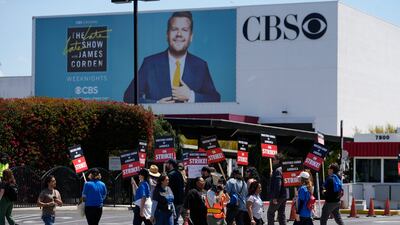
Members of the Writers Guild of America outside the CBS Television City in the Fairfax District of Los Angeles. For the first time in 15 years, Hollywood’s film and TV writers have gone on strike. AP Photo -

Writers of some of the most popular shows on television are striking for higher pay amid rapid changes in the way people watch their programmes and films. Bloomberg -
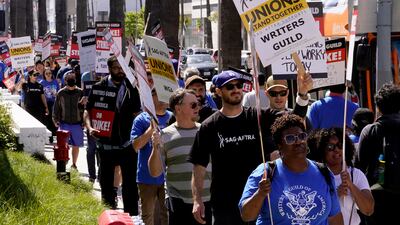
Members of the Screen Actors Guild - American Federation of Television and Radio Artists join a picket line in support of the Writers Guild of America outside the Netflix office on Sunset Boulevard. AP Photo -

Zoe Marshall, a board member of the Writers Guild of America, left, outside CBS Television City. AP Photo -
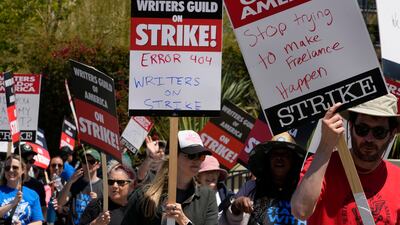
The union is seeking higher minimum pay, more writers per show and shorter exclusive contracts, among other demands, all conditions it says have been diminished in the content boom driven by streaming. AP Photo -

Placards at the close of a picket by members of The Writers Guild of America outside Walt Disney Studios. AP Photo -

Striking Writers Guild of America workers picket outside the Disney Studios. AFP -

Striking Writers Guild of America workers picket outside the Sunset Bronson Studios building. AFP -

Set dresser Norma Smithee shows her support for striking writers at a rally outside Warner Bros. AP Photo -
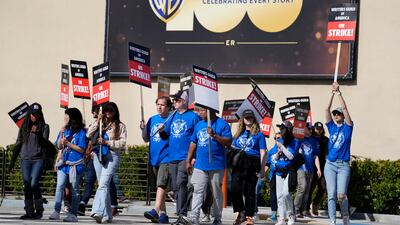
Members of the Writers Guild of America picket outside Warner Bros. Late-night shows are expected to stop production immediately, while television series and movies scheduled for release later this year and beyond could face major delays. AP Photo


The strike call follows weeks of failed negotiations with the major studios — Netflix, Amazon, Apple, Disney, Warner Bros Discovery, NBC Universal, Paramount Plus and Sony — under the umbrella of their own trade association, the Alliance of Motion Picture and Television Producers. The Guild described AMPTP’s response as “wholly insufficient given the existential crisis writers are facing".
Why are they striking?
In simple terms, they want more money, but it’s also more complex than that. As with so many changes in the recent film and TV market, streamers are in large part to blame. Under the old linear TV system, writers would generally be paid a fee for writing a show, then be paid “residuals” each time the show was repeated.
This system became irrelevant with the rise of streaming. New contracts were negotiated between the Guild and the streamers, but it’s fair to say they’re significantly less generous than the old TV deals.
According to the Guild’s contract with the AMPTP, a single rerun of an hour-long, primetime show on ABC would currently net its writer $24,558 in domestic residuals. Put the same show on Netflix and the writer would earn a maximum of $20,018, assuming some impressive viewing figures.
The figure also drops by the size of the streamer, so the same show on HBO Max would earn a maximum $13,346. Queens and Woke scribe Kyra Jones took to Twitter in the earliest days of the dispute last year to illustrate this even more starkly — “My first residual check for the broadcast show I wrote on was $12,000. I just got my first residual check for my streaming show… $4.”

Another practice the streamers have adopted is simply removing entire shows from their platforms. No one promised that your favourite show would hang around in cyberspace forever, but it wouldn’t be overly cynical to suggest that the practice of writing pulled shows off against tax may have a small role to play.
The highest profile case of this is Warner Bros Discovery’s decision last August to write off a host of all-but-complete projects spearheaded by Batgirl — a film it had already spent about $90 million on, and which had finished shooting when the rug was pulled.
The decision made a lot more sense when the studio filed to the US Securities and Exchange Commission in September — Warner Bros had saved about $2.5 billion in what its accountants referred to as “content impairment and development write-offs” and “pre-tax restructuring charges". This is at the extreme end of the scale, but accountants can employ the same process to the smallest series that are pulled from libraries too.
When a show disappears completely, so do writers’ residuals. They may be a pittance for studios compared to the vast tax sums, but they’re more than a pittance for writers. Other concerns the Guild has raised include the trend towards smaller writers’ rooms and the increase in shorter episode orders — another consequence of streaming, with no traditional half-hour or hour-long broadcast slots to fill.
Have there been writers’ strikes before?
There have — five in total.
The first was in 1960 and lasted more than four months. The longest was in 1988, and lasted five months exactly. The most recent, lasting 100 days, was in 2007-2008, just as streaming began to emerge.
A key concession won during this walkout was that the nascent streamers would have to have to hire Guild writers on shows more than a certain budget, as well as a new deal for a percentage payment of the exotic new concept of “digital distribution".
How will it affect viewers?
Initially, hardly at all. As with previous writers’ strikes, the studios have been stockpiling scripts to prepare, and many dramas will have plenty of episodes already in the bank. The first shows affected are those which rely on topical content — Saturday Night Live and the late-night chat shows will be immediate victims.
If, as expected, the strike drags on, the 2007-8 strike suggests we’ll see plenty of (unscripted) reality shows, repeats and new seasons abruptly ending.
A few shows may turn to non-unionised writers, although this will be acrimonious and probably not widespread — Power Rangers was an unlikely strikebreaker last time. Another new weapon streamers have in their arsenal this time around is their international content, which is unaffected by the strikes.
Audience monitor Nielsen’s figures showed that streaming became the single most popular form of viewing in the US for the first time last July, with 34.8 per cent of total viewing time. That still means that more than 65 per cent of viewing takes place on broadcast or cable TV.
The idea that 65 per cent of American audiences would be pleased to see their favourite channels follow Netflix down the route of K-Drama and European arthouse is probably fanciful at best, so it could be a bumpy ride.

