

Sustainability and experimentation are the core themes at the 18th Venice Biennale of Architecture.
The Laboratory of the Future, which opened last month and is curated by Lesley Lokko, has invited architects to imagine what the future might hold.
For the Uzbekistan National Pavilion in Arsenale, this translates into a cross-section of the country’s ancient architectural heritage, hoping to be the building blocks for a new movement that challenges the concept of modernity.
Titled Unbuild Together: Archaism vs Modernity, the pavilion is commissioned by Uzbekistan's art and culture government department and curated by the French-Moroccan architectural firm Studio KO, founded by Karl Fournier and Olivier Marty.
The research-based project spotlights Uzbekistan’s lesser-known heritage, inspired by the ruins of qalas – more than 300 ancient desert fortresses found in the Karakalpakstan region – from between the 1st century BC to 8th century AD.
About 50 remain today; they are in good condition and crafted from clay mud bricks – one of the most universal archaic building materials. The sustainable construction technique has already stood the test of time and climate change, making them an ideal material to consider for alternatives to modern concrete.
-
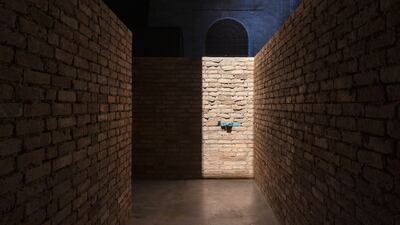
Uzbekistan's National Pavilion at Venice Biennale of Architecture is inspired by the maze-like ruins in the country's historic qala fortresses. Photo: Gerda Studio / ACDF -
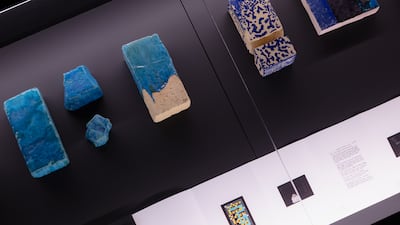
A vitrine table showcases various artefacts selected from the workshops, such as sketches, photos and small material experiments. Photo: Gerda Studio / ACDF -
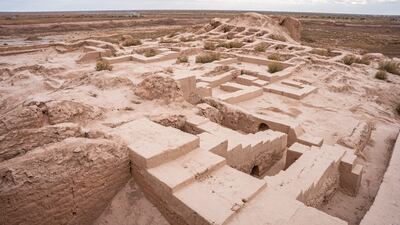
The pavilion is the final product of two workshops led by creators Studio KO in January, which involved trips to see the qalas firsthand – such as Toprak Qala, pictured. Photo: Studio KO -
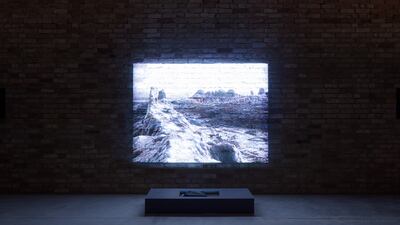
At the heart of the maze is a projected video by Moroccan filmmaker El Mehdi Azzam, showing moments of collective research from the workshops that gave life to the project. Photo: Gerda Studio / ACDF -
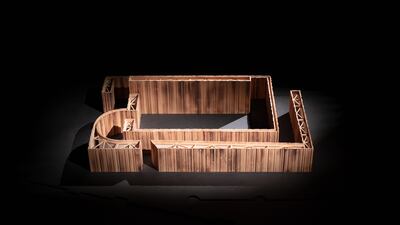
Upon exiting the maze, a wooden scaled model of the maze by Italian sculptor Miza Mucciarelli offers an overhead view of the maze. Photo: Gerda Studio / ACDF


“They built them by using the earth from the soil, thousands of years ago. This kind of construction made with mud, thanks to its inertia, is very adapted to the region extreme climate condition from severe heat to severe cold,” Marty tells The National.
“What is very strong in our approach is to try to deconstruct and question the relationship, or the admitted limits, between what is past and what is modernity. From the very beginning of this project, we had the intuition that a proposal should be embodied by architecture, so what you'll be seeing here is built.”
The resulting pavilion is the final product of two workshops led by Studio KO in January, which brought on 25 architecture students and professors from Tashkent’s Ajou University, to explore the materiality of bricks, earth and clay.
The workshops also took the students to see the qalas first-hand – such as Toprak Qala and Koi Krylgan Qala, some of the best-preserved sites – and to Bukhara, which is famous for its intricate brickwork and blue-glazed tiling that is typical of the Islamic Timurid era.
“We felt it was very important to engage more with the future generation of architects in Uzbekistan because we have a few universities of architecture, but at the same time, how do they see the future of their own country?” Gayane Umerova, executive director of the country's Art and Culture Development Foundation, says.
“We felt the need to research that and to bring on Studio KO, not only as curators, but also as mentors so they could empower the students for the next generation and to really try to see the impact of the vernacular architecture of yesterday and how it could be used for tomorrow.”

The pavilion, therefore, borrows the look of the mazelike ruins seen at the qalas, creating a dark labyrinth of bricks that biennale visitors slowly navigate, needing to touch the walls to guide them through. Flashes of turquoise-glazed terracotta – some as whole bricks forming a whole wall, others crushed chunks embedded randomly into parts of the maze – can be discovered as people traverse the site.
“The primary architectural structure is built by Venetian masons with reclaimed bricks, all of them coming from various demolition sites in Veneto,” Marty explains. “We'll walk through these Venetian bricks, which not only give a new perspective to the reading of the room itself but enter in conversation with Uzbek inputs, which are the little fragments of enamelled terracotta, which we experimented on with the students in Bukhara in January.
“Their colour comes from copper oxide, in a very traditional way. Only the glazing twists it by mixing opaque and transparent mix in an unorthodox way,” he adds. “This technique refers to Timor golden age of Uzbek architecture; in contrast to the qalas, dating to a pre-Islamic civilisation of the Zoroastrian faith.”
Two hundred glazed bricks were shipped from Uzbekistan to be included in the maze, created under the tutelage of master ceramicist Abdulvahid Bukhoriy, one of the few craftsmen still practising the traditional glazing techniques.

At the heart of the maze is a projected video by Moroccan filmmaker El Mehdi Azzam, showing moments of collective research from the workshops that gave life to the project, including photos of the qalas by Turkish photographer Emine Godze Sevim. Upon exiting the maze, a wooden scaled model of the maze by Italian sculptor Miza Mucciarelli offers an overhead view, and a vitrine table showcasing various artefacts selected from the workshops, such as sketches, photos and small material experiments, which Studio KO calls “relics”.
While the pavilion rooted in history offers up an experimental architectural concept, Umerova believes that the application of similar ideas isn’t difficult to achieve. During Uzbekistan’s Soviet occupation, building designs dramatically shifted from what was previously traditional to the country. The use of air conditioning became essential for modern buildings, rather than the natural temperature regulations the clay bricks, carefully planned building layouts and high ceilings offered.
“Since the beginning of the century they used to use a lot of AC, which in my childhood was so uncommon because all of our houses were naturally good at regulating temperature,” Umerova says. “It was very hot outside but was very cold inside, because of the bricks, and then when it was winter, you just needed a few heaters and it would be nice and warm inside.
“Now when we see the new buildings, it takes a lot of time, money and energy in order to make it comfortable and it's all not sustainable,” she adds. “As we look towards the future, our ancient heritage can help us to rethink the trajectory of humanity and the role that architecture plays in shaping our collective destiny.”
Venice Biennale of Architecture runs until November 26 at Arsenale and Giardini della Biennale, Venice, Italy.

